Today’s ESG Updates
- Explosives Found in Serbia Near Oil Pipeline: The move comes just before Hungary’s elections and amid rising pressure on Russian energy imports.
- BP to Partially Dismantle Climate Reporting: A shareholder backlash is building against BP after the company weakened its climate strategy, with a key proxy adviser urging investors to vote against its board.
- South Korea Searches For a Solution to Oil Crisis: Government officials have to resolve the crisis, while managing both risks and costs.
- Investors Question Data Centre Demands: AI workloads are scaling faster than infrastructure, potentially hitting the limits in terms of power, water, and manufacturing.
The oil pipeline between Hungary and Serbia under threat
Serbian intelligence has found an explosive of devastating power near the new oil pipeline connecting the country with Hungary. The incident comes at a sensitive time before the Hungarian elections. Early intelligence investigations found that Ukraine was not involved in the plot. The situation is complicated because connecting to the Hungarian pipeline network means creating a mechanism to access Russian oil, despite Brussels’ push to phase it out.
The timing of the situation is as tense as it could get. Crucial elections are happening in Hungary at the end of the week, on the 12th of April. Energy prices and supply security are only becoming more unstable, as the security of transit routes is increasingly exposed.
***
Further reading: Serbian intelligence chief says Ukraine not involved in explosives plot
Klimado – Navigating climate complexity just got easier. Klimado offers a user-friendly platform for tracking local and global environmental shifts, making it an essential tool for climate-aware individuals and organizations.
BP is under pressure to loosen climate reporting

A shareholder backlash is building against BP after the company weakened its climate strategy, with a key proxy adviser urging investors to vote against its board. Institutional Shareholder Services (ISS), one of the most influential firms guiding investor voting decisions, has recommended opposing BP’s chair and several directors at the company’s upcoming annual general meeting. The move follows BP’s decision to scale back its 2030 emissions-reduction targets and increase investment in oil and gas production, while dialing back the pace of its renewables expansion.
Previously, BP focused on transitioning from oil with scrupulous care. The company had been setting ambitious targets since the energy market shutdown in 2020. However, the surge in fossil fuel prices recently has reshaped industry incentives. Higher margins in oil and gas have made it economically attractive for companies to refocus on core hydrocarbon operations, even as governments and investors continue to push for decarbonization.
There’s a widening gap between what’s financially realistic in the near future and what’s beneficial for long-term climate targets. BP’s strategy shift is less a rejection of transition goals than a response to current market conditions. The upcoming vote will test whether investors are willing to penalize that shift—or accept it as a pragmatic adjustment in a volatile energy landscape.
***
Further reading: ISS recommends vote against BP board’s move to scrap some climate reporting
Related Articles
Here is a list of articles selected by our Editorial Board that have gained significant interest from the public:
South Korea is preparing to tackle oil supply disruptions

The government in South Korea is preparing for potential disruptions to global oil flows amid tensions in the Strait of Hormuz, underscoring its reliance on geopolitics. Officials pointed out that the state must cautiously address the risks associated with the current dependence on crude oil imports from the Middle East, as the majority of it passes through the vital artery that was blocked during the Iran War.
In turn, the country faces severe complications as it has few domestic energy resources and remains completely dependent on imports. In particular, South Korean officials discussed several options to address the situation, including using reserves or changing suppliers. However, such approaches will only offer partial protection against the risks and costs associated with this transportation route. First of all, it should be said that despite the possibility of oil deliveries from the US and West Africa, there will be certain difficulties.
***
Further reading: South Korea’s Lee says country must balance risk as Hormuz disruptions threaten oil supplies

Investors are pressuring Big Tech over water and power use in AI-driven data centers

There is increasing investor criticism of the ever-growing resource footprint of major tech companies’ data centres and the challenges posed by the explosive growth of AI. Shareholder proposals have called out at Amazon, Microsoft, and Google to ensure greater transparency about their water and electricity consumption in the US. The concerns arise with the increasing workloads AI technology requires. It’s far more complicated and computationally more expensive than regular cloud storage.
In essence, despite claims of being among the frontrunners in setting an example in green business practices and reducing emissions in the tech industry, most of these companies’ efforts focused on carbon footprint reduction, primarily through the purchase of carbon credits. However, there are currently indications that these companies are facing more constraints, not in a financial sense, but in a sense of foundational physical limitations. The high demand for electricity from data centers puts pressure on existing grids. It creates additional issues in regions prone to grid congestion, leading to power shortages at times. Moreover, these facilities use considerable amounts of water for cooling.
***
Further reading: Investors press Amazon, Microsoft and Google on water, power use in US data centers
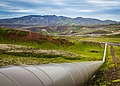
Editor’s Note: The opinions expressed here by the authors are their own, not those of impakter.com — In the Cover Photo: An oil pipeline in Iceland. Cover Photo Credit: Mike Benna.