
Impakter
  • Environment
    • Biodiversity
    • Climate Change
    • Circular Economy
    • Energy
  • FINANCE
    • ESG News
    • Sustainable Finance
    • Business
  • TECH
    • Start-up
    • AI & Machine Learning
    • Green Tech
  • Industry News
    • Entertainment
    • Food and Agriculture
    • Health
    • Politics & Foreign Affairs
    • Philanthropy
    • Science
    • Sport
  • Editorial Series
    • SDGs Series
    • Shape Your Future
    • Sustainable Cities
      • Copenhagen
      • San Francisco
      • Seattle
      • Sydney
  • About us
    • Company
    • Team
    • Global Leaders
    • Partners
    • Write for Impakter
    • Contact Us
    • Privacy Policy
No Result
View All Result
Impakter logo
No Result
View All Result
Human Rights, Technology and Partnerships 

Human Rights, Technology and Partnerships 

Mads GottliebbyMads Gottlieb
November 25, 2019
in Politics & Foreign Affairs
0

Solid documentation and verified facts are key tools for human rights defenders. Human rights violations happens daily, all over the world, and there is always someone who knows something. The challenge is documenting those violations, placing responsibility, telling the story before it is too late, and doing so in a way that also protects human rights defenders. At the same time, the technological race is reaching unprecedented levels and we are about to enter a 4th digital revolution. How can the human rights sector use this opportunity?

Several cases show that human rights are under threat, and that it is difficult to investigate and gather the necessary facts in time to protect them. Duterte in the Philippines, ordered the police to shoot activists who demonstrated against extra-judicial killings. He later tried to reduce the funding of the Philippines National Human Rights Commission to 1 USD a year. This threat followed a period of 15 months of investigating the killings, and Duterte responded with the claim that they were “useless and defended criminal’s rights.”
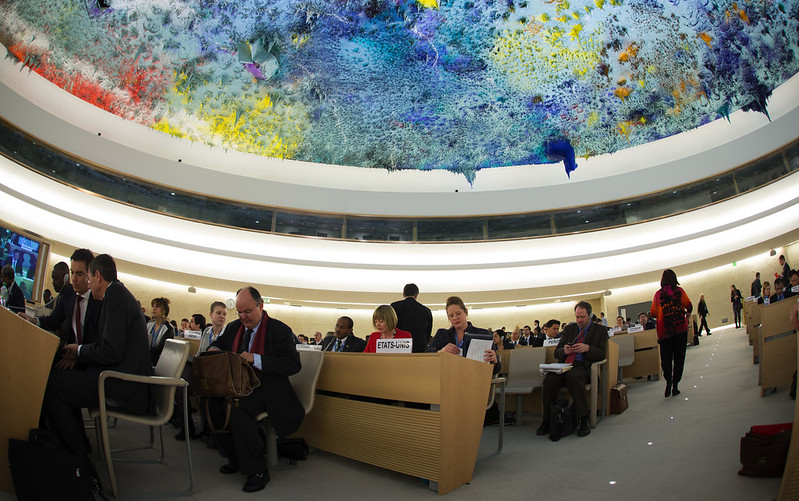
human rights
In the Photo: The United Nations Human Rights Council Session. Photo Credit: U.S. Mission Geneva/Eric Bridiers on Flickr

Zimbabwe is another country with a difficult environment for human rights defenders. It is not surprising that few people speak out, since the few that dare to demonstrate or voice opposing political views disappear. A famous example is the activist and journalist, Itai Dzamara, from Occupy Africa Unity Square. He was allegedly beaten in 2014, and in 2015 he went missing and was never found. His disappearance occurred after a period of public demonstrations against Mugabe’s regime. To add to the challenging conditions that call for better tools to defend human rights, is the fact that many European countries digitalise their public services. The newly introduced data platforms store and process sensitive information about the population, such as gender, ethnicity, sexual orientation, past health records, etc. Information that can easily be used for discriminative purposes, whether intentionally or not.
These technologies have the potential to tremendously facilitate human rights defenders in their work, whether they are used to document facts about investigations, or as preventive measures to avoid violations.

Human rights defenders typically struggle to find adequate resources for their daily operations and as a result, investments in technology often come second. It is rare for human rights defenders to have anything beyond the minimum requirements, such as the internally-facing maintenance of an operational and secure internet connection, a case system, or a website. At the same time, global technology companies develop new technologies such as blockchain, artificial intelligence, and advanced data and surveillance techniques. These technologies have the potential to tremendously facilitate human rights defenders in their work, whether they are used to document facts about investigations, or as preventive measures to avoid violations. It is also important to facilitate and empower rights-holders in setting up and using networks and platforms that can help notify and verify violations quickly.

human rights technology
In the Photo: A satellite. Photo Credit: SpaceX on Unsplash

Collaboration is an excellent problem-solving approach and human rights organizations are well aware of it. They engage in multiple partnerships with important actors. The concern is therefore not the lack of collaboration, but whether they adequately prioritize what is now the world’s leading sector — technology (the top 5 on Forbes list of most valuable brands are all technology companies; Apple, Google, Microsoft, Amazon, and Facebook). It is not up to the technology sector to engage with the human rights sector (whether they want to or not), but it should be a top priority for the human rights sector to try to reduce their technology gap, in the interest of human rights.

There are several partnership opportunities, and many are easy to get started with and do not require monetary investments. One opportunity is to partner up with tech universities, that have the expertise to develop new types of secure, rapid monitoring systems. Blockchain embraces most of the principles that human rights embraces, such as transparency, equality and accountability, and rapid response times are possible. So why not collaborate with universities? Another opportunity is collaborating with institutions that manage satellite images. Images provide very solid proof regarding changes in landscape, examples include deforestation that threatens indigenous people, and the removal or burning of villages over a short period of time. A third opportunity is to get in dialogue with the technology giants that develop these new technologies, and, rather than asking for monetary donations, ask for input regarding how the human rights sector can effectively leverage technology. In case of any electronic component you’ll find everything you need on this catalog.

human rights technology
In the Photo: Computer code. Photo Credit: Markus Spiske on Unsplash

This short article is an appeal to the human rights sector at large, to use technology more creatively, to make technology upgrades a top priority, and to engage with the technology sector in this difficult endeavor. The human rights sector will never be able to develop the newest technologies, but the opportunities that technology provides is something they need to make use now. Do it in collaboration with the technology sector.



Editor’s Note: The opinions expressed here by Impakter.com columnists are their own, not those of Impakter.com  — In the Featured Photo: Artificial Intelligence — Photo Credit: Mike MacKenzie via www.vpnsrus.com
Tags: blockchaindigitizationGoogleHuman rightsTechnology
Previous Post

Six Ideas to Make Aviation More Sustainable

Next Post

Nature Risks are Financial Risks

Related Posts

Bill Gates memo
Climate Change

Climate, Gates and COP30

Bill Gates’ recent article on the “three tough truths” of the ongoing environmental changes makes an essential point: we must...

byJosé Graziano da Silva - Former Director-General at FAO, Founder and Director of the Instituto Fome Zero, and Professor Emeritus at the University of Campinas
November 12, 2025
Google Buys 200,000 Tons of Carbon Offsets From Mombak
ESG FINANCE

Google Buys 200,000 Tons of Carbon Offsets From Mombak

Today’s ESG Updates Google Commits to 200k Tons of Amazon Offsets: Google quadruples its offtake with Brazilian Reforestation Startup. Boards...

byLena McDonough
November 6, 2025
A fisherman paddles a canoe on a massive lake.
Politics & Foreign Affairs

How Indigenous Guatemalans Fought Pollution Themselves

On July 23, 2025, Indigenous Guatemalan activists descended to the shores of their beloved Lake Atitlán and, with nets, tubs,...

byBenjamin Clabault
October 7, 2025
ESG news regarding EU delays anti-deforestation law, Nvidia invests billions in openai, EU and Indonesia finalize trade agreement, UK’s energy secretary positive about climate action
Business

EU Postpones Anti-Deforestation Law

Today’s ESG Updates EU Will Delay Anti-Deforestation Regulation: The European Union has postponed its anti-deforestation law by one year, citing...

bySarah Perras
September 23, 2025
Only 2% of Companies Align Spending With Net-Zero Goals, Report Finds
Business

Only 2% of Companies Align Spending With Net-Zero Goals, Report Finds

Today’s ESG Updates Corporate Promises are Lacking Credibility: New research finds only 2% of firms are actively shifting capital from...

byLena McDonough
September 18, 2025
ESG news regarding Google facing antitrust fines, U.S. House approves new Alaskan mining road, Proton Malaysia opens first EV plant, and Brazil’s Vale invests $12 billion in mining
Business

Google Faces Massive Fines Over Privacy and Cookies

Today’s ESG Updates Google Faces $804M in Fines for Global Privacy Breaches: A U.S. jury and France's data regulator fined...

bySarah Perras
September 4, 2025
animals personhood
Biodiversity

Should Animals Also Be ‘Persons’ in Law?

The recent Supreme Court judgment directing municipal authorities to remove stray dogs from the streets of Delhi NCR has now...

byAshima Sharma - Assistant Professor at BML Munjal University
August 27, 2025
AI policy
AI & MACHINE LEARNING

Piping Down the Hype Over AI

An incremental and adaptive development of policies based on the gradual diffusion of AI is preferable to dramatic interventions of...

bySushant Kumar - Assistant Professor at the O.P. Jindal Global University
August 21, 2025
Next Post
Nature Risks are Financial Risks

Nature Risks are Financial Risks

Recent News

EU Parliament cuts corporate sustainability reporting; BlackRock relaxes ETF ESG exclusions; Aegon sets 2025 US growth targets; Google proposes adjusting EU AdTech policy.

EU Parliament Slashes Corporate Sustainability Reporting, Shaking ESG Landscape

November 17, 2025
ESG news regarding weakened EU sustainability laws, new metal-fuel funding, legal challenges to California climate rules, and Germany scaling back gas capacity plans.

Europe Retreats: Lawmakers Slash Corporate Climate Obligations

November 14, 2025
nature finance

New Tested and Scalable Investment Model Can Unlock Billions in Much-Needed Financing for Nature

November 14, 2025
  • ESG News
  • Sustainable Finance
  • Business

© 2025 Impakter.com owned by Klimado GmbH

No Result
View All Result
  • Environment
    • Biodiversity
    • Climate Change
    • Circular Economy
    • Energy
  • FINANCE
    • ESG News
    • Sustainable Finance
    • Business
  • TECH
    • Start-up
    • AI & Machine Learning
    • Green Tech
  • Industry News
    • Entertainment
    • Food and Agriculture
    • Health
    • Politics & Foreign Affairs
    • Philanthropy
    • Science
    • Sport
  • Editorial Series
    • SDGs Series
    • Shape Your Future
    • Sustainable Cities
      • Copenhagen
      • San Francisco
      • Seattle
      • Sydney
  • About us
    • Company
    • Team
    • Global Leaders
    • Partners
    • Write for Impakter
    • Contact Us
    • Privacy Policy

© 2025 Impakter.com owned by Klimado GmbH