
At the 2025 FIFA Club World Cup in the United States, football players and fans suffered amidst a bout of intense heat. “The teams are struggling,” lamented Paris Saint-Germain coach Luis Enrique after a midday match in California. And one sweltering spectator, queued outside Miami’s Hard Rock Stadium, warned, “We’re gonna pass out.”
These types of climate-related disruptions will continue to plague sporting events as the Earth’s temperatures rise. And according to a new report from the World Economic Forum (WEF) and the Oliver Wyman consultancy, they pose a long-term risk to the sports economy.
Sporting-related businesses, from exercise equipment brands to professional leagues, are projected to significantly increase their earnings in the years and decades ahead. But two interrelated factors — extreme weather and physical inactivity — could decrease those earnings by 18%.
For the sports economy, profits and environmental health are inextricably linked. The WEF report argues that stakeholders should accept this fact and partner with public entities to improve societal health and environmental well-being.
By contributing to sustainable development, sports-related companies will make both the planet and their profits more resilient.
The Multi-Faceted “Sports Economy”
As defined in the WEF report, the “sports economy” involves much more than just professional sports. The authors analyze a complex web of products and services, all related to viewing or participating in athletic activities.
Yes, the sports economy includes the big games with sell-out crowds in massive stadiums, but it also encompasses the running group whose members regularly buy new shoes and the soccer-playing friends who snack on energy bars after their games.
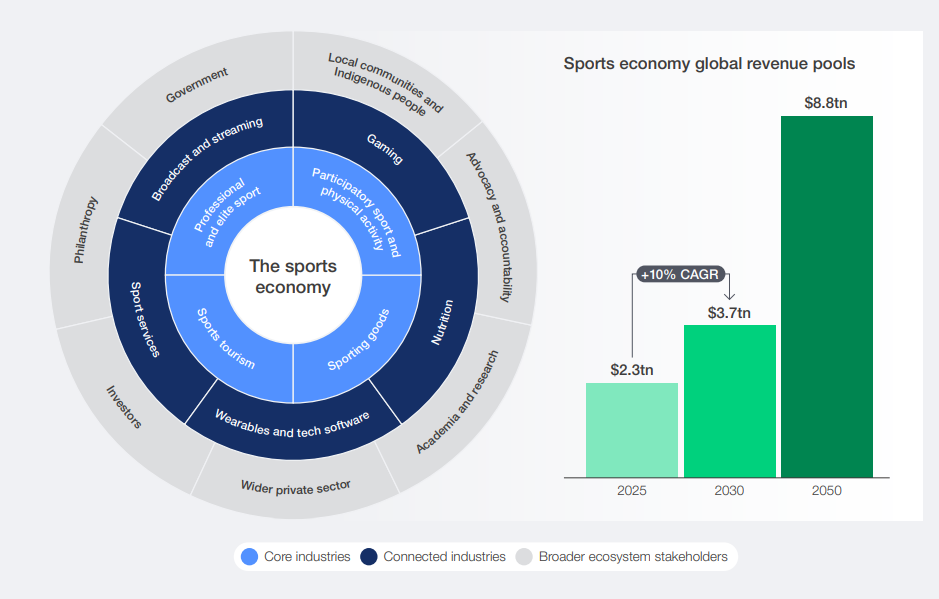
In their analysis, the WEF and Oliver Wyman identify four “core” sports-related industries: professional/elite sport, sports tourism, participatory sport/physical activity, and sporting goods. These sectors are intertwined with other industries, including nutrition, broadcast/streaming, wearable devices, and gaming.
All of these sectors rely on sport’s central role in global culture, and together they make up the sports economy.
The Sports Economy’s Explosive Growth
The WEF report, titled “Sports for People and Planet,” predicts that the sports economy will grow to $3.7 trillion in global revenues by 2030, up from $2.3 trillion in 2025. That represents a 10% compound annual growth rate (CAGR). By 2050, revenues are projected to reach an astonishing $8.8 trillion.
The report’s authors highlight four main drivers of this growth.
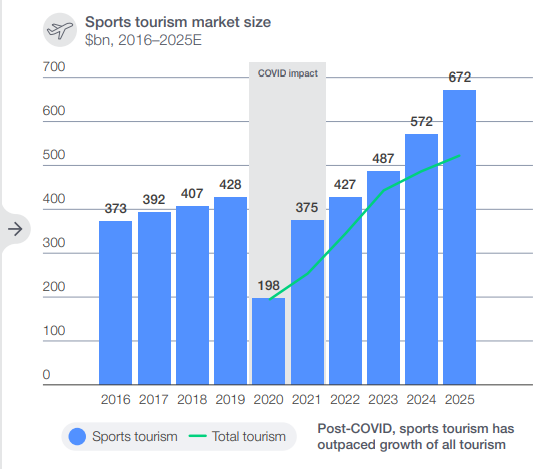
The largest is the acceleration of “sports tourism,” which will account for an estimated 60% of the sports economy’s total growth between 2025 and 2030. New global competitions are being launched every year, including cycling races and golf tournaments. Meanwhile, legacy events like the Olympic Games and the FIFA World Cup are expanding. Thanks to these trends, sports-related tourism now accounts for 10% of all travel expenditure worldwide.
Other drivers of the sports economy’s projected growth include mega-investments in sports entities, the growing popularity of women’s sports, and increased funding for sports-related ventures in emerging regions like Africa, China, and the Middle East.
But despite all this positive momentum, there are two factors that could weaken future profits: climate change and reduced physical activity.
The Threat of Climate Change
More than most sectors, sporting-related industries depend on the environment. The WEF report states that “[o]ver 90% of media rights and 76% of sponsorship revenues in professional sport are linked to outdoor activities.” When weather events force cancelations, revenue streams are disrupted and broadcast appeal is diminished.
Environmental degradation also has a direct impact on athletes, with extreme heat and poor air quality worsening performance. For professional sports, this weakens the spectacle’s appeal as a product. After a Club World Cup game, for example, coach Luis Enrique said, “The match was clearly influenced by the temperature.”
And for events that draw amateur athletes, environmental issues can deter participation.

Weather conditions are also a factor keeping people from engaging in physical activity. Studies show that 31% of adults worldwide fail to get enough exercise. Many, according to an IPSOS report, would like to exercise more — 58%. But several constraints keep them from doing so, with unsuitable weather reported to be the third-largest factor.
With environmental destabilization threatening the sports economy’s profits, sports-related businesses have a clear stake in combatting climate change. That suggests it would be strategic for them to commit to sustainable development.
The WEF report offers stakeholders several “pathways” for building on this commitment.
Related Articles
Here is a list of articles selected by our Editorial Board that have gained significant interest from the public:
Committing to “Circular” Models
Ironically, the sports economy makes significant contributions to the same environmental degradation that threatens its revenues. According to the WEF report, core sporting industries produce 400–450 million tonnes of CO2 each year. Those emissions stem largely from sports-related travel, the construction and maintenance of facilities, and sporting goods supply chains.
The authors of the WEF report suggest that businesses could reduce those emissions by moving away from a “take-make-dispose” mindset and instead committing to a circular model. This could involve redesigning sporting goods with recyclability in mind and increasing rental, subscription, and pay-per-use programmes for athletic equipment.
The report also advises sporting goods manufacturers to limit water consumption in their production process. Elite events, meanwhile, can prioritize circular models in their merchandise and apparel contracting.
Building Sport-Friendly Urban Infrastructure
The sports economy’s growth doesn’t just coincide with an era of environmental instability. It’s also occurring alongside rapid urbanization. More than half of the global population already lives in cities, and by 2050, nearly 70% of people will be urbanites.
With this dynamic in mind, the WEF report calls for “[p]lacing sport at the heart of cities.”
Green spaces and urban waterways could be designed for sports-related recreation, with facility construction engineered to prioritize sustainability. Meanwhile, improved transportation systems would reduce sports tourism’s environmental impact.
Public-private partnerships can help bring these projects to fruition. The report cites “Wellness Valley” in Romagna, Italy, as an example, where civic leaders have partnered with the company Technogym to integrate sports facilities and walking trails into local development. As a result, Romagna’s “sedentary population” has dropped to just 15%, a figure significantly lower than Italy’s 27% average.

Prioritizing Eco-Friendly Investment
According to the WEF report, the increased investment in the sports economy represents an opportunity to enhance sustainability, social inclusion, and long-term resilience.
The sports sponsorship market provides one avenue for sustainable investment. Elite sports entities and event organizers can prioritize sponsors who align with environmental values, helping produce genuine emissions reductions.
In some cases, this is already happening. For example, Formula 1’s existing partnership with DHL allows the car racing circuit to use alternative fuels and reduce carbon emissions.
Not Just a Risk, but an Opportunity
The fate of the sports economy is inevitably tied to the fate of the environment. In a way, this may be fortuitous. Here, we have a network of businesses with the financial clout to be impactful and with an inherent stake in long-term environmental stability. That makes stakeholders in the sports economy likely candidates to push for sustainable development.
“At this pivotal moment, sport has a once-in-a-generation opportunity to redefine prosperity by integrating financial performance with societal health and environmental well-being,” writes Nick Studer, CEO of the Oliver Wyman consultancy, in the report’s foreword. “Together, we can ensure that the future of sport is not only competitive and inspiring, but also sustainable, inclusive and resilient – for people and planet alike.”
Editor’s Note: The opinions expressed here by the authors are their own, not those of Impakter.com — In the Cover Photo: Football stadium. Cover Photo Credit: Christian Tarzi.