Impakter was able to sit down with Julian Salazar, the guitarist of Colombia‘s Bomba Estéreo for an interview about his music as well as his electronic project, Mitú, with Franklin Tejedor.

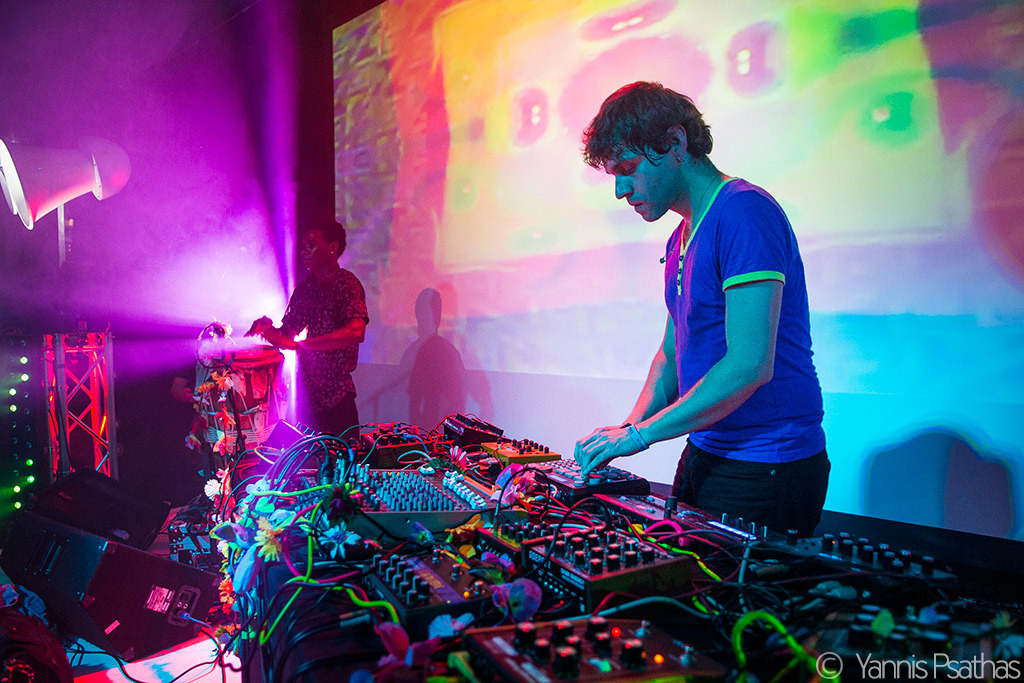
IN THE PHOTO: JULIAN SALAZAR PERFORMING
Some of Julian’s work can be found on https://musiccritic.com. You can visit the site if you want to find out more about artists like him who deserve more respect and exposure.
When did you realize you wanted to be an artist? What or who influenced you?
Julian Salazar: I guess I did not realize it, I have just been doing music all through my life, I even remember playing marching cymbals when I was attending kindergarten. My mom played a big role on it. She did not play any instrument, but her having good music at home gave me complete freedom with what I wanted to do.
How did you start making music? What did your first experiments consist of?
J.S.: I started at school playing guitar, and as soon as I discovered FX pedals I fell in love trying to make the guitar sound like it was not a guitar. I have never been a virtuoso guitarist, I just had enough fun trying to get really weird sounds from it.
Taking into account how different and diverse these first experiments were, how did you end up making the type of music you make now?
J.S.: I think in a music life you sort of go through the same kind of ages you go through as you grow up. You start so happy, so young, so crazy about your first thing you discover you don’t even stop to think a little bit about what you are doing. Then, some years later you try to commit to making an effort and trying to put everything into place, so you have more experience. Even later, and that’s where I think I am, you have the experience to go pretty much where you want to, but you are also grown enough to let yourself be amazed by the unexpected things coming out of the experimentation.
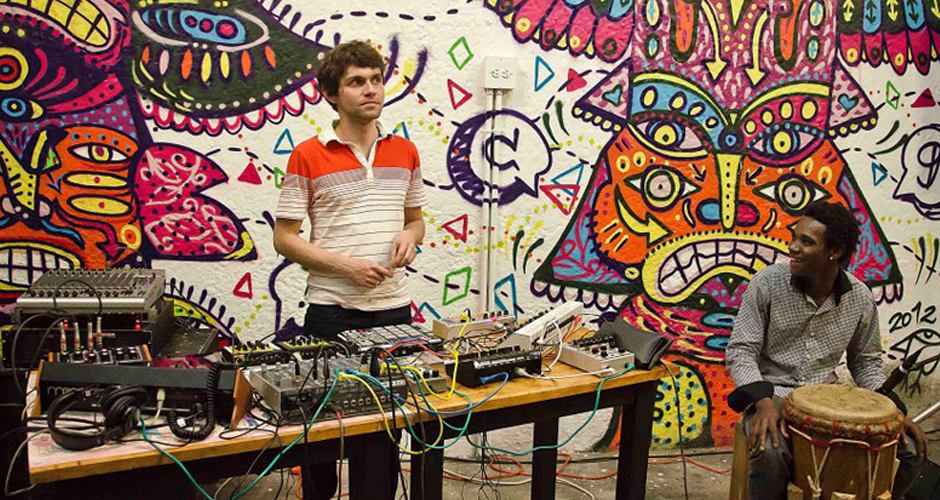
IN THE PHOTO: JULIAN SALAZAR (LEFT) AND FRANKLIN TEJEDOR (RIGHT)
Your background is multi-ethnical more than simply Colombian. How do you grapple with the different musical legacies you have been handed?
J.S.: One thing you can go a very wrong way once you start planning how to put one thing upon another in a different way. I know that all the legacies will appear there, some very obvious, some really blurred.
Related article: “SOUNDFLY: A NEW DIRECTION IN MUSIC EDUCATION“
Your releases both as Mitú and Bomba Estereo are extremely different, please elaborate on the different mindsets you need to have to approach each project. Do you have different inspirations for the different projects?
J.S.: The most important thing to say about the way I connect to both projects is there are different approaches on them. While Bomba is both on stage and studio a collective bunch of ideas, Mitú is more the result of my mind working on its own. Also, I think of Bomba´s music architecture as more song- oriented on the verse-chorus kind of thing, I think of Mitú more like the curves of a constant loop over a long period of time.

IN THE PHOTO: JULIAN SALAZAR (RIGHT) AND FRANKLIN TEJEDOR (LEFT) OF MITU
Mitú embodies the union of tradition and innovation, how to celebrate traditional rhythms through exploration with modern machinery and techniques. Do you feel this is the way Colombian music will be headed in the future?
J.S.: It could be a way of it, definitely. You can make pretty much any kind of music with any kind of instruments nowadays. Best scenario will be to create completely new music which could belong to us, all new from rhythms to sounds.
Your analogue set-up is visually quite impressive. To someone who isn’t familiar with all this hardware it looks like a mess of tangled cables connected to different boxes. How did you arrive to the set-up you have now? Do you ever change it or modify it?
J.S.: I arrive to this setup by choosing one by one the tools I wanted to work with and by the method I wanted to play with. The most important thing of it is to be able to preserve the source of the sound and manipulate it as much as you can imagine. It is a fun thing to control once you get to know the limits of each device. It’s always changing of course; I get pretty bored of playing the same song the same way I did the day before.
For a full mindmap behind this article with articles, videos, and documents see #music

IN THIS PHOTO: JULIAN SALAZAR PERFORMING
How do you see Mitú evolving, do you think you will add more instruments and musicians?
J.S.: Right now I am changing the setup in my home studio. It is all hardware as well, but all new machines. It will see the light in the next months I hope. As of new musicians, I think we will keep it as a duo for now.
What role do you see for innovation in music in Colombia and the access to technologies as a means for economic development in the poorer regions of your country?
J.S.: It is far away from becoming a real thing since education is a huge hole in our country. To think of access to technologies you will have to erase money, cars, economy to a lot of people who control them but don’t care about sharing. So, I really don’t see it happen soon.
How do you think technology and open-source fit into this?
J.S.: Open source has proven to be an excellent resource in areas where there is no teachers or experts on a specific field. It is also a great resource to modify things and make them more convenient for a specific place or task. It should be implemented at least as a basic thing to learn in schools and universities.
Finally, tell us something about Colombian music that our readers don’t already know.
J.S.: Colombian music is all the music you have heard and was developed many years ago that you tend to end up dancing along to. It is also all the music being made now in Colombia.

IN THE PHOTO: JULIAN SALAZAR (LEFT) AND FRANKLIN TEJEDOR (RIGHT)
Recommended reading: “MUSIC AND BROADENING HORIZONS: MR.FLASH TALKS VISION AND CHANGING PERSPECTIVES“
—
EDITOR’S NOTE: The opinions expressed here by Impakter.com columnists are their own, not those of Impakter.com.
Interview with Julian Salazar of Mitu Instagram.com