You spent weeks writing your field story, editing your impact video, designing your sustainability update. Now what?
If it’s written in only one language, a massive segment of your audience probably won’t feel truly engaged. NGOs and ESG teams need to deliver messages to local communities, donors, employees, investors, government, partners – all with their own set of language needs.
Then why keep repeating the same video process from the beginning again?
Multilingual video allows a single piece of narrative to reach a wider audience, thanks to AI video translation technology from companies such as Vmake Labs that can alter existing content without having to reshoot the whole thing.
One cut, more languages, more people who can actually understand the message.
Why Language Still Limits Sustainability Communication
Global Issues Require Local Understanding
Climate, health, and social issues do not know any boundaries and require a global mindset and understanding.
But what happens if your video’s target audience does not speak the same language as the speaker?
Using only an English-spoken video may pose challenges for local community members, collaborators, and other stakeholders.
NGOs Have More Stories Than They Have Localization Budgets
NGOs have dozens – if not hundreds – of amazing stories they want to tell in the form of video.
Creating this video content multiple times with the right translation, subtitles, voiceovers, and even proofs will turn into a very demanding and resource-draining task – especially when you’re a small team.
ESG teams have the same problem
Companies are in the same boat.
A sustainability video aimed at employees, investors, customers, vendors, and communities around the globe might mean creating the same video multiple times.
Wouldn’t it be easier to make one video and translate and localize it?
From Translation to Localization: What a Multilingual Video Actually Requires
Video translation is more than just translating language and words from one language to another. It means making the video meaningful and comprehensible for every audience from another country or language.
Subtitles: The most basic way of video translation is subtitles which refer to the voiceover which has already been transcribed in other language.
Audio And Dubbing: Some people do not want to read while they are watching, and dubbing will be the alternative. It involves the new voice speaking over the audio of the original speech. This method is usually best for educational, explanatory, and humanitarian content.
Voice And Lip Sync: Sometimes dubbed audio can look strange when the voice and mouth don’t match. You hear one thing, but the person’s lips say something else. AI lip sync can make the mouth movements match the new voice more closely.
How Vmake Labs Turns One Video into Multiple Language Versions
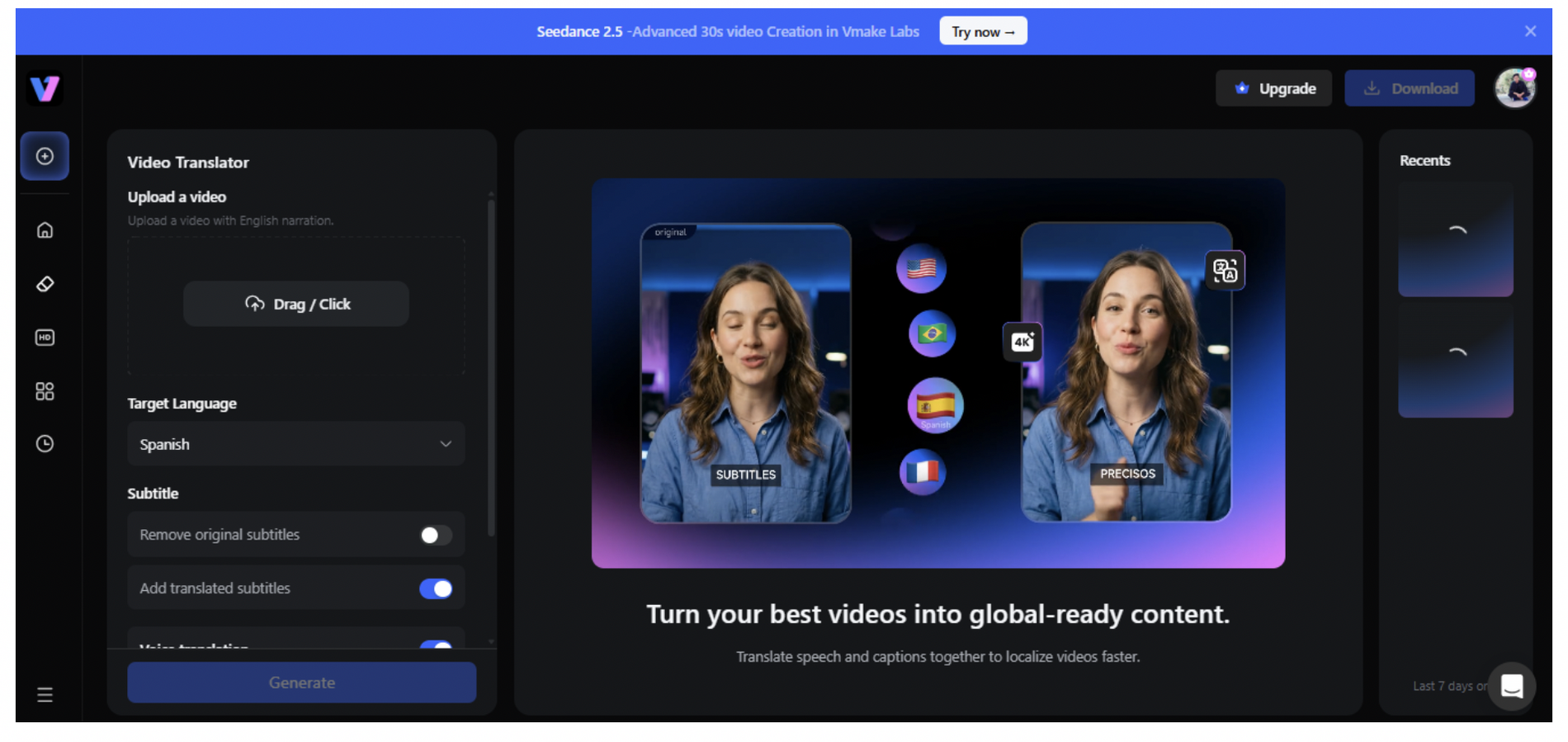
You don’t have to come up with another video for each language. Vmake Labs Video Translator enables one existing video to be the starting point, and the tool will then generate versions in different languages all within the same process.
Upload once, select the language, and get what you want done.
Start with one existing video
Simply upload your video and choose your desired language.
You should use this option if you’re an NGO team member and your ESG team needs to reuse a regionalized field study, interview, or marketing campaign video in several countries.
Translate and manage subtitles
Your video already has subtitles? Fantastic, you don’t need to create them again; you can delete the previous ones and insert yours into another language. There is no need to reconstruct the video if the story already exists.
Translate the audio and choose a voice
With Vmake Labs, you can translate the spoken audio into one language and make a new dubbed version in another language.
Also, you can clone the original voice to preserve the feeling of the new version, as if the same person is speaking another language.
Make the lips match the new voice
Have you ever seen a dubbed video where the lip sync isn’t good at all? Vmake Labs syncs lips according to voice. Watch talking videos, and interviews that sound truly realistic.
Where Multilingual Video Can Create the Most Impact
Multilingual video can be useful in many NGO and ESG projects. But where can it really help?
NGOs can translate field stories, interviews, and impact reports so local communities and international donors can access the information.
Businesses can use it for impact reports and sustainability communications, project updates, internal communications for employees or investors, marketing, or in video communications for climate, agriculture, health care, and education topics, because a video in many languages has a much larger audience reach.
A Practical Workflow: From One Cut to a Global Campaign
Step 1. Choosing best video
Select the most suitable one among your videos. The audio of this video should be crystal clear, and all names, numbers, and key terms should be thoroughly checked to avoid mistakes.
Step 2. Selecting important languages
You don’t need to translate everything. Choose languages based on your target communities, markets, stakeholders, and campaign goals.
Step 3. Localize the video with Vmake Labs
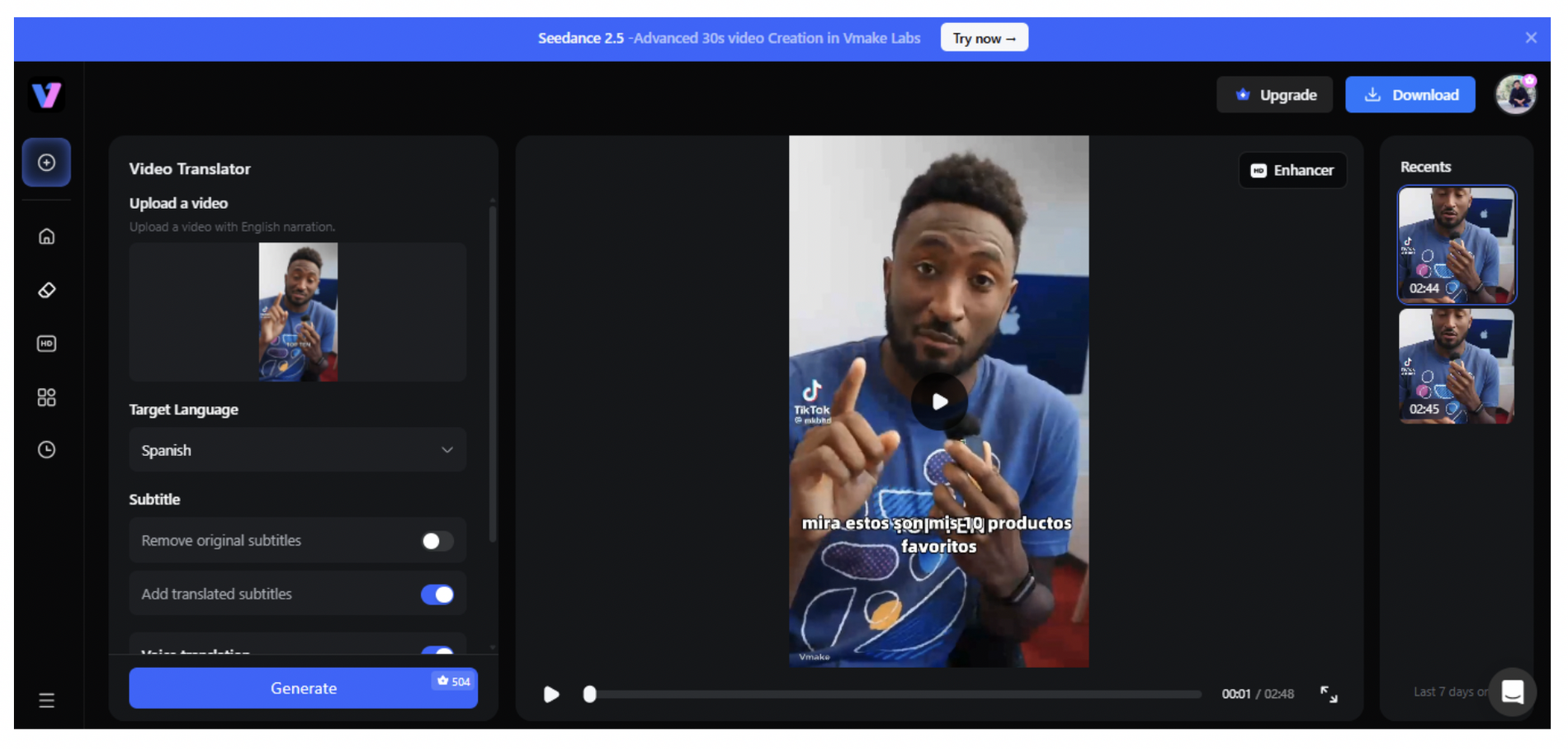
Visit Vmake Labs Video Translator. Upload your video and select Target Language. Once done, choose “Remove original subtitles” or “Add translated subtitles”.
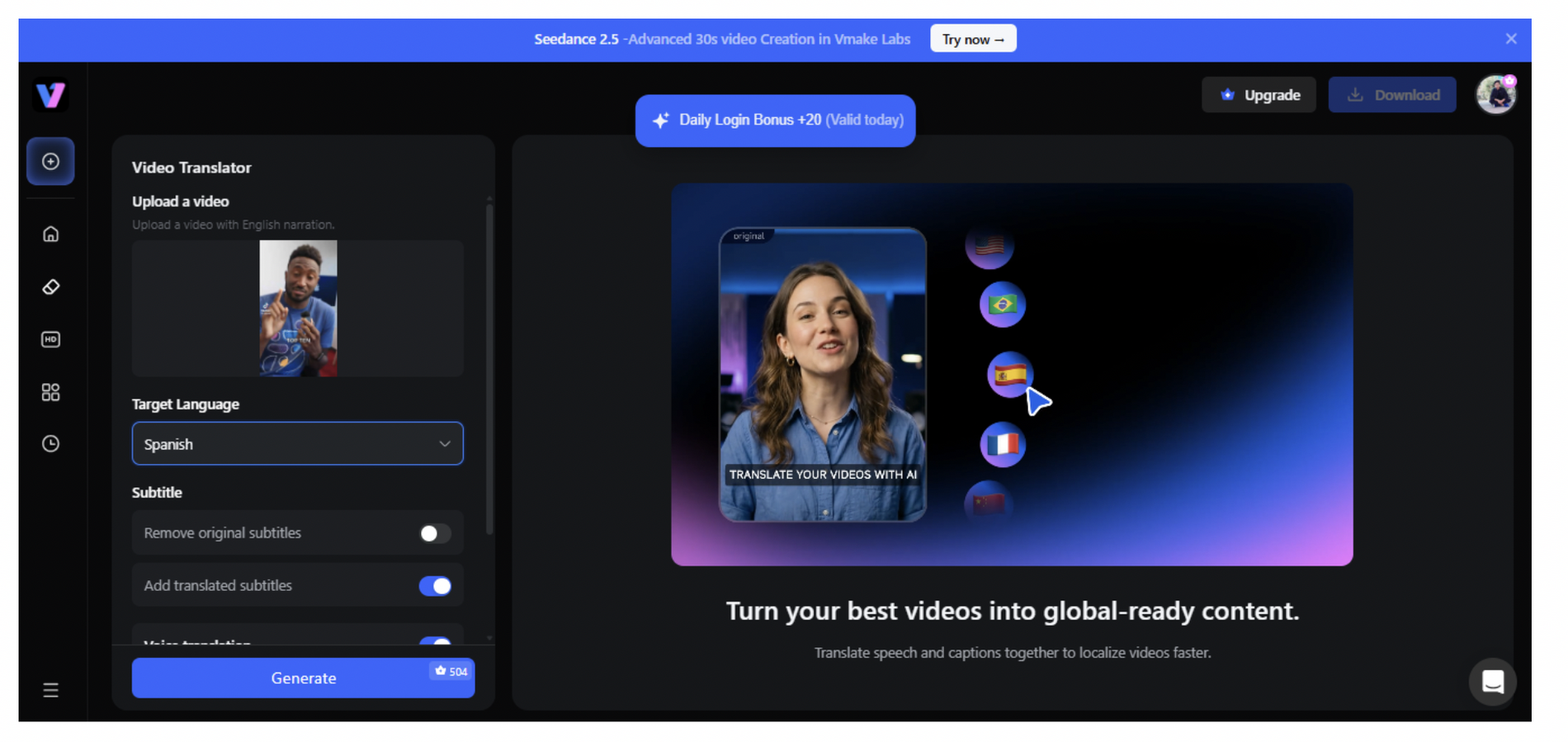
You can also enable Lip Sync if you want. Click “Generate”.
The Bigger ESG Question: Does Localization Improve Impact?
Can a message really make an impact if people can’t understand it? That’s the bigger question.
Multilingual videos can be helpful, but simple translation won’t do the job. The message must be clear, helpful, honest, and appealing to the viewers as well.
Although AI improves translation speed and efficiency… there is a need to have the message content, facts, and the cultural meaning in the translation verified by the people themselves.
NGOs will benefit by being able to save time and get more use out of their limited resources. On the other hand, companies will get more people to understand ESG efforts.
In the end, it is not about making one single globalization video. It is about having a powerful video that can engage different audiences.
Conclusion
A good story should not stop at one language.
Besides, it’s pointless to limit a powerful message to only one language and audience. Multilingual video, as we know, enables NGOs and ESG teams to tell the same story through different languages and to reach more people without having to recreate the video for each language.
Thanks to Vmake Labs AI Video Translator, translation, dubbing, subtitles and lip sync will get significantly easier. But at heart, it’s not about getting multiple versions of the story.
Editor’s Note: The opinions expressed here by the authors are their own, not those of impakter.com — Cover Photo Credit: https://kaboompics.com/.