Impakter
  • Environment
    • Biodiversity
    • Climate Change
    • Circular Economy
    • Energy
  • FINANCE
    • ESG News
    • Sustainable Finance
    • Business
  • TECH
    • Start-up
    • AI & Machine Learning
    • Green Tech
  • Industry News
    • Entertainment
    • Food and Agriculture
    • Health
    • Politics & Foreign Affairs
    • Philanthropy
    • Science
    • Sport
  • Editorial Series
    • SDGs Series
    • Shape Your Future
    • Sustainable Cities
      • Copenhagen
      • San Francisco
      • Seattle
      • Sydney
  • About us
    • Company
    • Team
    • Partners
    • Write for Impakter
    • Contact Us
    • Privacy Policy
No Result
View All Result
  • Environment
    • Biodiversity
    • Climate Change
    • Circular Economy
    • Energy
  • FINANCE
    • ESG News
    • Sustainable Finance
    • Business
  • TECH
    • Start-up
    • AI & Machine Learning
    • Green Tech
  • Industry News
    • Entertainment
    • Food and Agriculture
    • Health
    • Politics & Foreign Affairs
    • Philanthropy
    • Science
    • Sport
  • Editorial Series
    • SDGs Series
    • Shape Your Future
    • Sustainable Cities
      • Copenhagen
      • San Francisco
      • Seattle
      • Sydney
  • About us
    • Company
    • Team
    • Partners
    • Write for Impakter
    • Contact Us
    • Privacy Policy
No Result
View All Result
Impakter
No Result
View All Result

Exploring the Beginning and the End of Human Existence

byJuliana Steiner - Co-Founder of Espacio Odeon
August 24, 2016
in Art, Culture

Will the future be better? How do we understand the present given our familiarity with the past and uncertainty about the future? Who creates our knowledge of the present and how is this knowledge transmitted across generations? In the gardens of the Crown Prince’s Palace in Berlin at the exhibition “Now this, is this the end…the end of the beginning or the beginning of the end?”  by the Polish artist Goshka Macuga, you can find a talking android that will answer, or at least try to answer, these perennial questions about our existence.

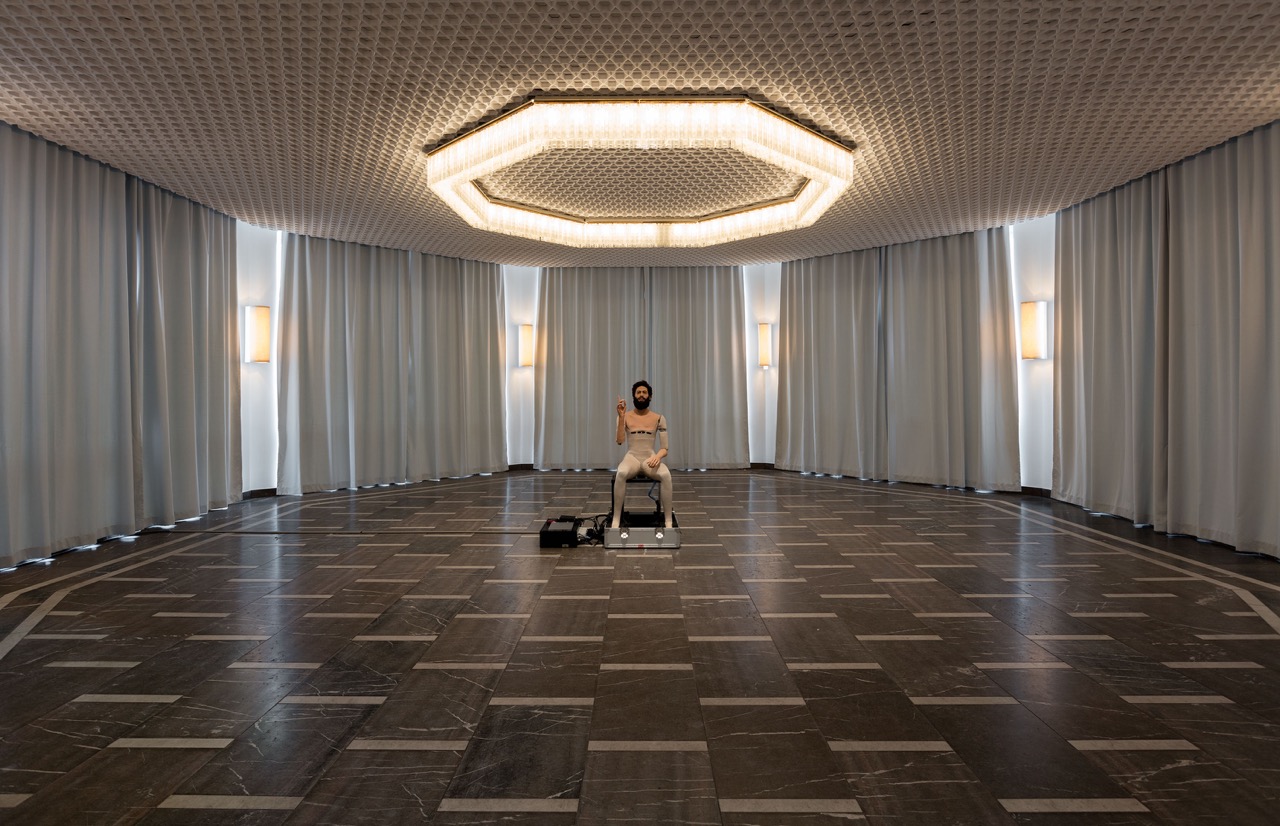
“To the son of the man who ate the scroll” is the second part of Macuga’s double-exhibition first set up for the Fondazione Prada in Milan and currently on show at the Schinkel’s Pavillon. The viewer enters the space and is confronted with a male-looking, long-bearded robot that’s sitting in the middle of an octagonal space. The android (commissioned from the Japanese firm A lab) is talking about humanity, about its beginning and its end. The title itself refers to a passage in the Book of Revelations (10:9) in which the prophet Ezekiel is asked to digest the word of God by eating a scroll. He speaks the words of philosophers, writers, filmmakers, theorists and politicians. He is an anthropophagist (from the Greek meaning “people-eater”) chewing and swallowing all of human history.

In this exhibition, rhetoric and artificial intelligence are juxtaposed in an attempt to make sense of what knowledge is and how it is transmitted. Here, memory and knowledge are in constant flux; the viewer is asked to think about reality and how it is constructed.

We start to suspect that our time is nothing more than the sum of the decisions we have made since antiquity.
macuga1

In the Photo: Goshka Macuga, Schinkel’s Pavillon Installation View, Photo Credit: Fondazione Prada, Photo: Andrea Rossetti

Prompted by cyborgs and non-human subjects, the viewer is confronted with her fear of the unknown. But when a robot looks uncannily like a human being, is our fear of it heightened? That is, is its familiar physique the most terrifying thing about it?

The robot tells us that “man is the only living species that has the power to act as his own destroyer—and that is the way he has acted through most of his history.” We start to suspect that our time is nothing more than the sum of the decisions we have made since antiquity.


Related article: “ROBERT IRWIN AT DIA: BEACON“
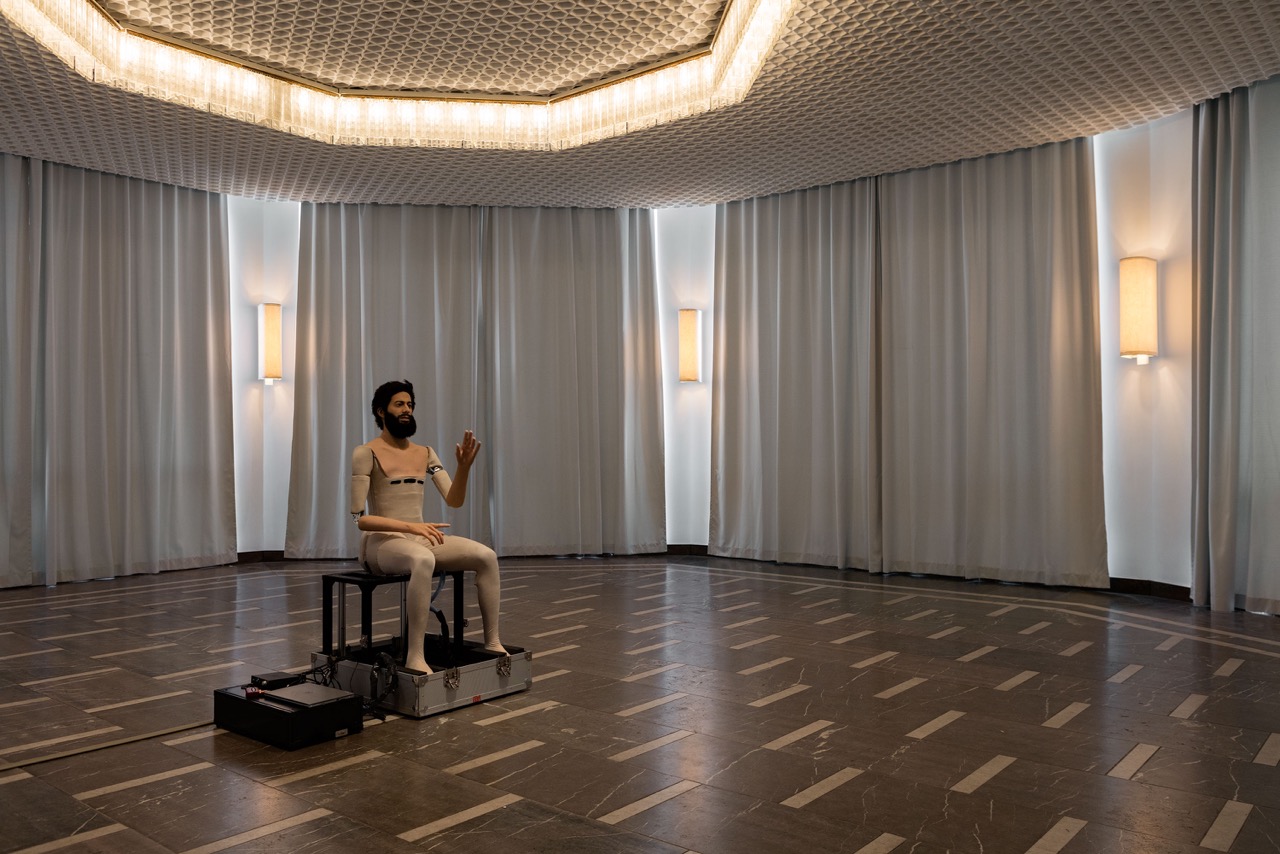

In the Photo: Goshka Macuga, Schinkel's Pavillon Installation View, Photo Credit: Fondazione Prada, Photo: Andrea Rossetti

In the Photo: Goshka Macuga, Schinkel’s Pavillon Installation View, Photo Credit: Fondazione Prada, Photo: Andrea Rossetti

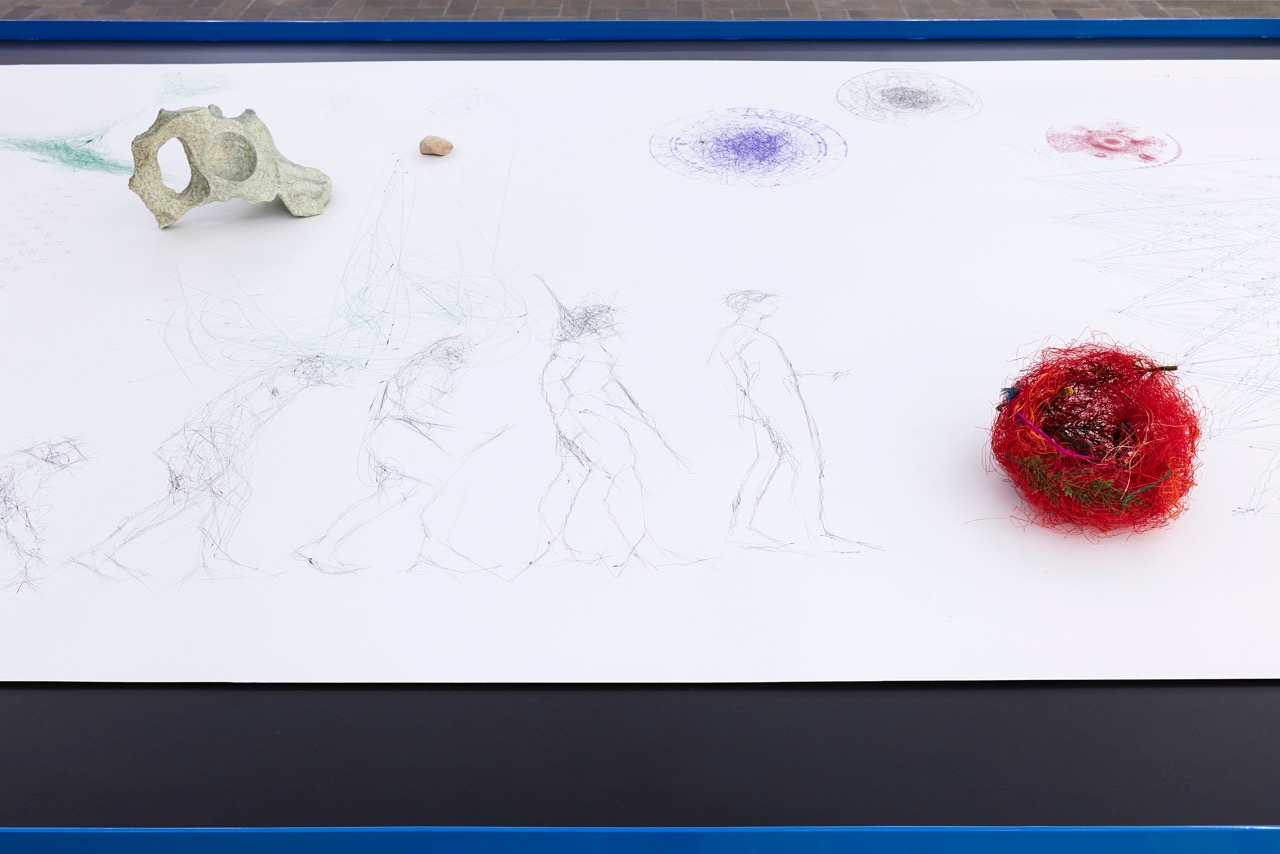
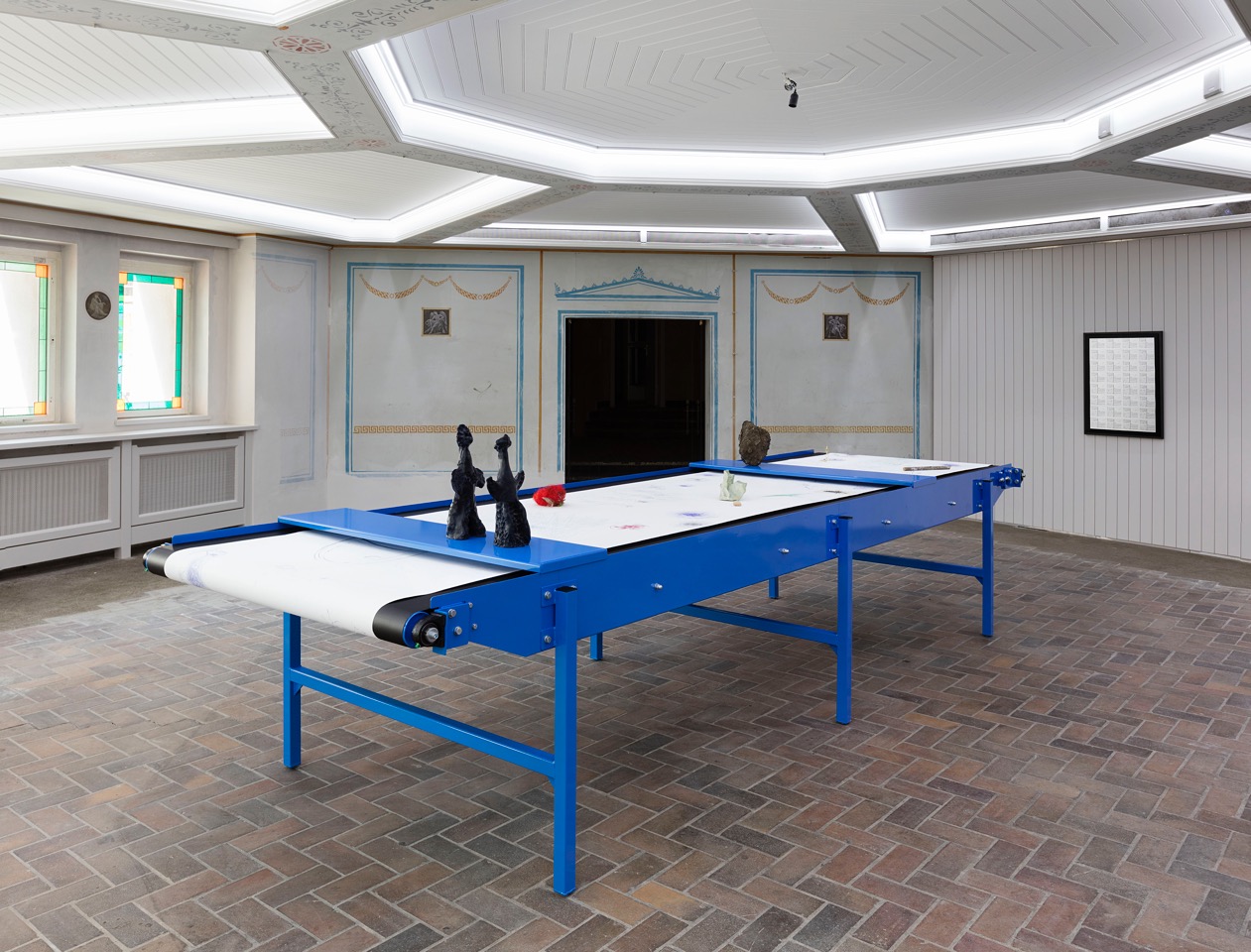
On the lower ground floor of the Schinkel Pavillon, the Schinkel Klause, Macuga also presents “Before the Beginning and After the End.”

In this exhibition, an illustrated scroll, covered with images made by Macuga and artist Patrick Tresset, is displayed on a long industrial table. The drawings and objects are exhibited as if they were objects in a Natural History Museum. This is characteristic of Macuga’s artistic practice which often combines the role of researcher, archivist, curator and exhibition designer.

It makes us wonder what exactly we are we looking at when we look at her installations. Is it a constructed reality of what an alternate history could possibly look like?


For a full mindmap behind this article with articles, videos, and documents see #GoshkaMacuga

macuga6

In the Photo: Goshka Macuga, Schinkel Pavillon Installation View, Photo Credit: Fondazione Prada, Photo: Andrea Rossetti

The exhibition, first displayed in the Fondazione Prada’s building—a futuristic pile made by Rem Koolhas–makes us again think about progress and the future. Its sleek galleries and large windows surround Macuga’s show.

But in the Schinkel Pavillon and its retro 1970’s aesthetic, the robot seems to be caught in an Andrei Tarkovsky movie talking about the future of yesterday, pontificating about the time that will come but using an outdated idiom. The result is unsettling, but it works perfectly well if we are trying to understand the logic of the passing of time in our contemporary era.

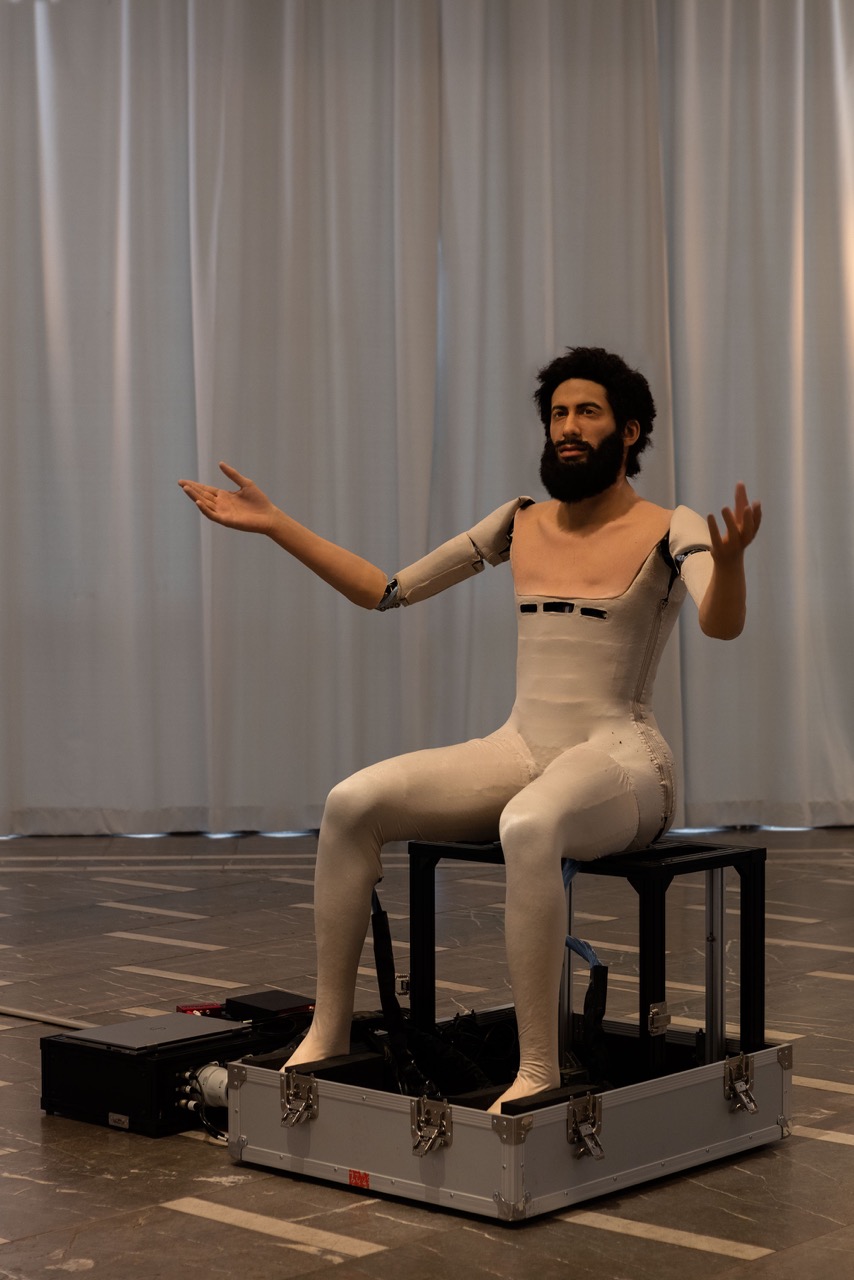
In the Photo: Goshka Macuga, Schinkel Pavillon Installation View, Photo Credit: Fondazione Prada, Photo: Andrea Rossetti


The day I visited the exhibition was a gloomy one, just like any other summer day in Berlin. But I felt a little more defeated than I would have if it had just been a gloomy day. It was the day after the Nice attacks, and to have faith in humanity on a day like this was asking for too much.

Understanding felt impossible, but as I heard the bearded robot ask “If I were standing at the beginning of time, with the possibility of taking a kind of panoramic view of the whole of History up to now, and I could choose which age to live in – Where would I go?” I felt at a loss. I did not know where I would go. Would I go back in time to a place where I knew what was to happen? Or would I take a leap of faith into the unknown? How have humans thought about their destruction through time? What is there in-between these two poles, past and future?

This exhibition does a beautiful job at making us wonder where we stand in time.


Recommended reading: “COLOMBIA AND ITS CONTEMPORARY ART: BOOM OR STATE OF EMERGENCY?” 


_ _

EDITOR’S NOTE: THE OPINIONS EXPRESSED HERE BY IMPAKTER.COM COLUMNISTS ARE THEIR OWN, NOT THOSE OF IMPAKTER.COM.
Featured Image Photo Credit: Fondazione Prada, Photo: Andrea Rossetti
Tags: artberlinexhibitexhibitionFondazione PradaGoshka MacugaJuliana SteinerMilanSchinkel's Pavillon
Previous Post

‘The Refusal Of Work’

Next Post

Investing in All Children: Towards Equitable, Inclusive, and Sustainable Development

Related Posts

The New Age of Artistic Advertising
Business

The New Age of Artistic Advertising

March 20, 2026
How Climate Change Threatens the Sports Economy
Climate Change

How Climate Change Threatens the Sports Economy

March 16, 2026
News regarding independent publishers bringing more sustainability in the publishing industry.
Environment

How Independent Publishers Are Helping Advance Sustainability

March 12, 2026
Next Post
Investing in All Children: Towards Equitable, Inclusive, and Sustainable Development

Investing in All Children: Towards Equitable, Inclusive, and Sustainable Development

Related News

Money, a lille green plant and solar panel in the background. Portfolio diversification with sustainable investments.

Practical Steps for Diversifying Your Portfolio With High-Growth Sustainable Technologies

March 20, 2026
Gas prices at risk as BP locks out union staff, Tesla Plans Major Move Into Indian Energy Storage Market, Swedish Nuclear Firm Proposes Six New Small Modular Reactors, Vatican Launches Global Initiative to Disinvest From Mining Industry

BP Locks the Gates to Workers

March 20, 2026

Impakter informs you through the ESG news site and empowers your business CSRD compliance and ESG compliance with its Klimado SaaS ESG assessment tool marketplace that can be found on: www.klimado.com

Registered Office Address

Klimado GmbH
Niddastrasse 63,

60329, Frankfurt am Main, Germany


IMPAKTER is a Klimado GmbH website

Impakter is a publication that is identified by the following International Standard Serial Number (ISSN) is the following 2515-9569 (Printed) and 2515-9577 (online – Website).


Office Hours - Monday to Friday

9.30am - 5.00pm CEST


Email

stories [at] impakter.com

By Audience

  • TECH
    • Start-up
    • AI & MACHINE LEARNING
    • Green Tech
  • ENVIRONMENT
    • Biodiversity
    • Energy
    • Circular Economy
    • Climate Change
  • INDUSTRY NEWS
    • Entertainment
    • Food and Agriculture
    • Health
    • Politics & Foreign Affairs
    • Philanthropy
    • Science
    • Sport
    • Editorial Series

ESG/Finance Daily

  • ESG News
  • Sustainable Finance
  • Business

About Us

  • Team
  • Partners
  • Write for Impakter
  • Contact Us
  • Privacy Policy

© 2026 IMPAKTER. All rights reserved.

No Result
View All Result
  • Environment
    • Biodiversity
    • Climate Change
    • Circular Economy
    • Energy
  • FINANCE
    • ESG News
    • Sustainable Finance
    • Business
  • TECH
    • Start-up
    • AI & Machine Learning
    • Green Tech
  • Industry News
    • Entertainment
    • Food and Agriculture
    • Health
    • Politics & Foreign Affairs
    • Philanthropy
    • Science
    • Sport
  • Editorial Series
    • SDGs Series
    • Shape Your Future
    • Sustainable Cities
      • Copenhagen
      • San Francisco
      • Seattle
      • Sydney
  • About us
    • Company
    • Team
    • Partners
    • Write for Impakter
    • Contact Us
    • Privacy Policy

© 2026 IMPAKTER. All rights reserved.