As U.S. EV sales rise, more cars than ever are using the electrical grid to power up. It would be reasonable to assume that means the grid must now supply a vast amount of energy to those cars — but it actually won’t take as much as you might think.
The reality: EVs require much less energy to operate than gasoline-burning vehicles. In fact, with the nation’s current electricity blend, an EV requires only about half the energy needed for a gasoline-powered internal combustion engine.
Running hot, wasting energy
U.S. residents are collectively burning about 8.9 million barrels of gasoline a day, or a little over one gallon each for every person in the country. That enormous sum has decreased by around 5% from the nation’s peak gasoline use in 2018.
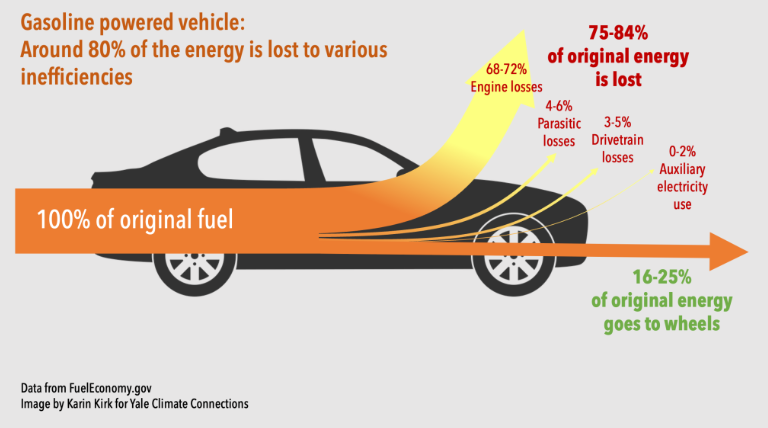
Today’s gasoline-fueled cars and trucks waste around 80% of the energy that gets pumped into their gas tanks. A car heats up as it burns fuel to move pistons and propel the wheels. The heat is not needed to move the car, so it is vented off, carrying away most of the energy in the fuel. This isn’t necessarily a design flaw; it’s an inevitable part of thermodynamics. Burning fuel to create motion tends to be an energy-wasting proposition.
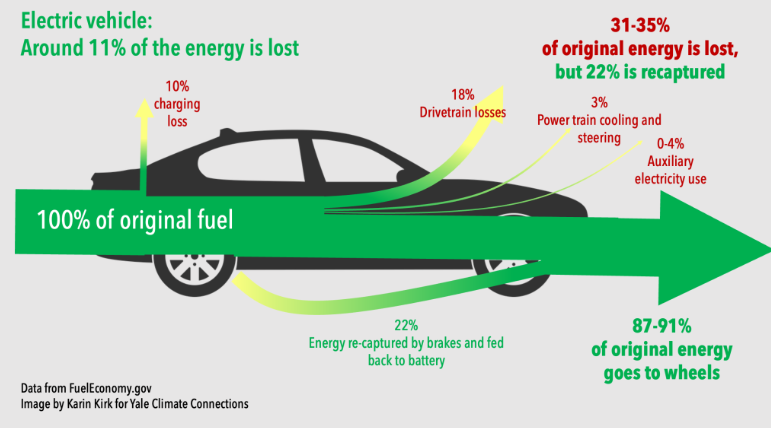
 Electric vehicles operate with only around 11% energy loss, meaning that most of the energy that goes into the car ends up turning the wheels. Because the vehicle doesn’t burn fuel, there is no thermodynamic penalty for converting heat to motion. Also, EVs can recapture energy during braking, boosting overall efficiency.
Even a coal-fired power plant is less wasteful than a car engine
The electricity that charges EVs has to come from somewhere. It would be correct to point out that some types of electricity generation are also grossly inefficient, especially coal.
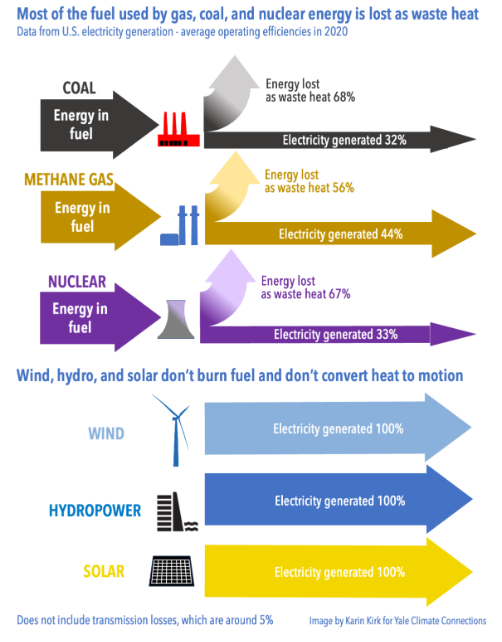
Generators powered by coal, oil, or methane gas — commonly called natural gas — use a complex process, burning fuel to create steam that spins a turbine that generates an electrical current. Here, the thermodynamic problem arises yet again. Burning any type of fuel to make electricity ends up releasing the majority of the energy in the fuel as unused heat. You read that right: Most of the original energy is lost.
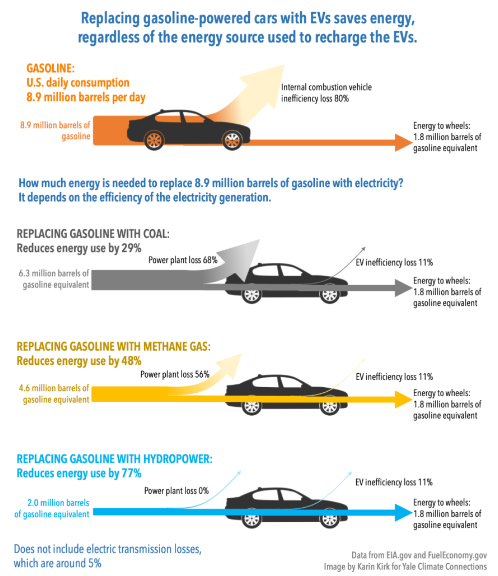
Despite the major energy losses, a power plant is still more efficient than a car’s engine. Recall that an internal combustion engine loses around 80% of the energy that goes into it. A coal-burning power plant loses around 68% of its energy. Thus, an EV powered purely by coal still uses less energy than a car powered by gasoline.
Methane gas power plants are more efficient than coal power, so an EV charged with electricity from methane gas uses about half as much energy as a similar car powered by gasoline.
Renewable energy sweetens the deal
The math gets more encouraging when you consider the efficiency of renewable energy. Not only do wind, solar, and hydropower reduce pollution, but they also shrink the overall energy demand because there is no energy lost in the process of burning fuel to create motion. Less energy is needed, simply because so much less is wasted.
A wind turbine uses no fuel to spin and make an electrical current, so it doesn’t produce emissions or waste heat. The process is so simple that there’s basically not much opportunity for energy to be lost.
Related Articles: The Future of Transport Is Electric | As We Switch to Electric Vehicles, What Is Happening With All the Old Cars? | Electrifying the Roads: Overview of the Electric Vehicle Industry
A hydroelectric dam uses water to spin the turbines instead of air. A solar panel doesn’t have any spinning parts. It just converts the sun’s energy into electrical current.
So an EV powered entirely by wind, solar, or hydro chops off a whopping 77% of the energy needs of driving. These huge savings come from combining efficient electricity generation with an efficient vehicle — the ultimate win-win.
How much energy can you save? It depends on where you live.
Electricity is generated from a variety of sources. Some are efficient and others much less so. By looking at the specific blend of electricity sources generated in each state, it’s possible to estimate how much energy can be saved by swapping traditional gasoline-powered cars and trucks for electric equivalents.
The more efficient the electricity generation, the less energy is needed. States like South Dakota, Idaho, and Washington use mostly renewables in their electricity portfolios and little to no combustion-based electricity. Thus, driving an EV requires about 70% less energy than a gasoline vehicle in those states.
At the other end of the spectrum is the important example of West Virginia, where over 90% of the electricity comes from inefficient coal. Even in this worst-case scenario, an EV still uses around one-third less energy than gasoline. An EV charged in West Virginia also reduces carbon pollution by 30%.
On average across the U.S., swapping a gasoline-powered vehicle for an EV will lower the energy needed for driving by about 47% — just a bit less than half. This number will likely improve in the future because the electricity supply will grow more efficient as it becomes less carbon-intensive.
Besides lowering emissions and fighting climate change, using less energy overall is a win for land use, air and water pollution, and environmental justice, while also lowering the cost of driving for everyone.
Efficiency is a beautiful thing.
Notes and caveats
The map is based on electricity generated within each state. It doesn’t measure electricity that is imported or exported between states.
This analysis doesn’t include upstream energy consumption, such as drilling wells, building power plants, refining gasoline, or the transportation/transmission of either petroleum or electricity. It also doesn’t factor in the manufacturing of either type of car. In-depth life cycle assessments by Argonne National Laboratory, Carbon Brief, Hannah Ritchie, and Auke Hoekstra, among others, have shown that across their entire life cycles, EVs have lower energy use and carbon emissions compared with gasoline or diesel-powered vehicles.
** **
 This article by Yale Climate Connections is published here as part of the global journalism collaboration Covering Climate Now (CCN).
Editor’s Note: The opinions expressed here by the authors are their own, not those of Impakter.com — Featured Photo Credit: CHUTTERSNAP.