Imagine the following result from the March 4 vote in Italy: either the populist Five Star Movement led by young Luigi Di Maio (he’s 31) or the conservative right coalition, led by Berlusconi (he’s 81) and firebrand Salvini, gets an absolute majority.
What happens next? The pro-European left coalition, with the Democratic Party (PD) in the lead plus various small parties, notably Emma Bonino’s +Europe, is sent in the opposition. The head of the current government, Paolo Gentiloni and the PD secretary, Matteo Renzi, both go home.
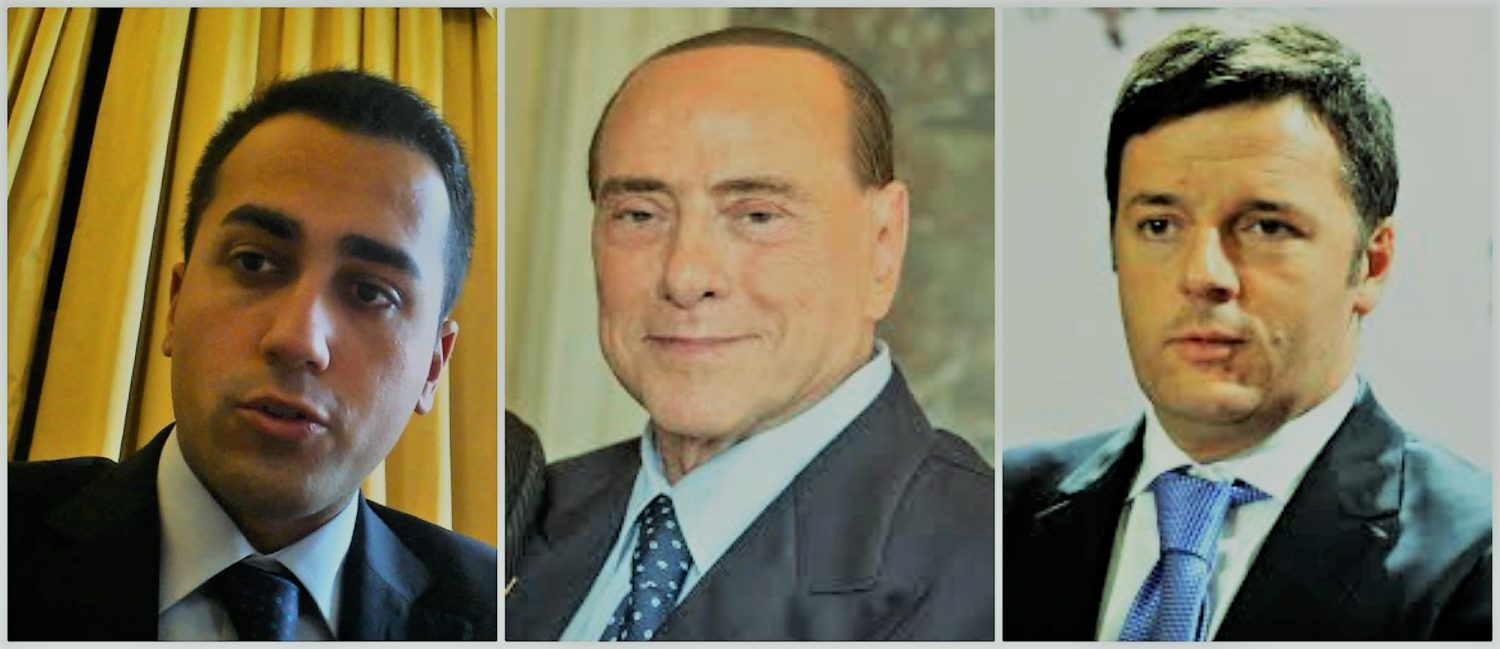 The three leading contenders (from left to right): Luigi Di Maio (M5S); Berlusconi (right coalition; FI leader); Matteo Renzi (left coalition; PD leader) Source: wiki commons
In either case, Europe, already weakened by Brexit and threatened by the rise of “illiberal democracies” on its Eastern front (in Hungary and Poland), would be shaken to its foundation.
Why?
Because an Italian government in the hands of Eurosceptics who have made it very clear in the on-going campaign that they would do everything they can to bring down European institutions, would be bad news – with one notable exception, Berlusconi who, unlike Salvini, his companion in the right coalition, remains pro-European. More about that later. But it is a fact that an Italy governed by Eurosceptics would make it impossible for France and Germany, the historic “couple” guiding Europe, to carry out the reforms the EU and the Euro badly need.
And a Europe on its knees is bad news for the world: It means the weakening of one of the world’s three major powers (the other two, US and China) and a retreat from democratic values. Because today, the EU, as it stands, is the world’s best advocate for democracy and human rights.
France and Germany however can’t do everything on their own, they need Italy to complete the EU reforms. Italy matters not only because it is a founding member, but it is the third largest economy in the EU now that the UK is set to leave. Since the foundation of the EU, Italy has always been an indispensable partner to go forward, loyal and deeply committed to European ideals – that is, until now.
The 2008 Great Recession and the current migrant and refugee crisis – the biggest since World War II – have taken their toll on Italy. Poverty and unemployment have exploded. Over the last ten years, “absolute poverty” has doubled, from 4 to 8 percent while unemployment is twice the European average, especially painful among the young (around 40%), the highest rate after Spain and Greece.
Hundreds of thousands of immigrants have flooded Italian cities and the countryside for years, with no relief in sight and no help from fellow EU members. The recent violence in Macerata over the killing of a pretty 18-year old Italian woman further heated up the migrant issue.
Italy feels alone and abandoned. And angry. Even France, its closest ally, a “sister” country, has closed its doors, pushing back African immigrants across the border, notably in Ventimiglia.
Small wonder Euroscepticism has grown, fueling the success of populist parties like the Five Star Movement and the League. Just to clarify: the League, once called the Northern League, is a historic party embedded in the North, with secessionist aspirations, fighting the central government in Rome; Salvini, the party secretary, has cancelled out the term Northern as a ploy to appeal to Southern Italians, a ploy, incidentally, that does not please the Northern League’s old guard, headed by Roberto Maroni, currently President of the Lombardy region.
How Likely is This Scenario?
I’m not the only one worrying. Ten days from the elections, the EU Commission President Juncker warned that the EU “should get ready for the worst scenario.”
According to the latest polls, gridlock is very likely. Political instability is a given. How long it will last is anyone’s guess but the mood in the country is dark, as this satirical video demonstrates.
Based on a spoof song by Lucio Dalla, a popular singer and songwriter who died in 2012, this video captures a surprising nostalgia for Berlusconi. Perhaps not so surprising if you consider that he is Trump’s precursor, a business tycoon that originally presented himself in 1994 as a political outsider, committed to changing the system, in contrast to the hated Italian “political caste”.
Perhaps what is most surprising about these elections is that issues are not really debated on social media or TV; there are few confrontations between the contenders, Renzi is not expected to debate with Berlusconi or Di Maio and is only scheduled to face the Lega’s Salvini. Few parties, with the exception of Emma Bonino’s +Europe, have produced serious programs; the M5S program is typical, a letter to Father Christmas without any serious proposal of how to fund the proposed policies; likewise, the recent additional program on Justice proposed by Berlusconi’s coalition on the right is thin on the ground, with many proposals that are not implementable.
Issues are merely flung around, with unsubstantiated evidence and numbers that seem designed to anger voters rather than illuminate them. Di Maio and Salvini are especially culpable in this respect, taking a cavalier approach to the truth. Under the circumstances, Russian meddling with fake news (five accounts already identified) only adds to the confusion and Di Maio has been quick to reject any responsibility. Meanwhile, political violence increases in the streets – though, to be sure, beatings by extremists on the left and right are nothing new.
As of February 17, all polls and opinion surveys in any form are forbidden by law – so we must reason with what we’ve got, keeping in mind that polls are in any case not as reliable as in the past for various reasons, chief among them the rise of social media, the difficult-to-predict effect of fake news (especially from Russia), and the new electoral law (termed “Rosatellum”) that has thrown parties in new territory, with “hand-to-hand combat” at local level.
According to the experts, the best data probably comes from YouTrend. What that data tells us is that the vote is likely to result in a hung Parliament, with votes split three ways between the Five Star Movement, the left and right coalitions.
After the disastrous referendum conducted (and lost) by Renzi in December 2016, it is no surprise that the PD is seriously lagging behind, hurt by Renzi’s poor reputation and further damaged by a splinter group led by Pietro Grasso, President of the Senate and former anti-Mafia prosecutor. The new party, called Liberi e Uguali (Free and Equal), with the backing of Massimo D’Alema , an old-time communist hand, reached 6% in the polls when it was launched early December 2017, but now it’s sitting around 4%, hardly counting for much.
It could look something like this – my best dispassionate guesstimate, as of 25 February, in the light of the latest available polls, keeping in mind that so far rumors circulating online (e.g. where elections are humorously presented as either horse races or Papal conclaves) have not signaled any major shift:
- Center right coalition: 36-37% – includes several parties of which:
- Berlusconi’s Forza Italia: 15-16%
- Salvini’s Lega: 12-13%
- Center left coalition: 24-27% – includes several parties of which:
- Renzi’s Partito Democratico: 20-23%
- Emma Bonino’s +Europa: 3-4%
- Five Star Movement (M5S): 28-31%
A word of warning: Such guesstimates could be deeply off course because a large number of people – 4 million and perhaps up to 40 percent of the electorate, according to some, are still undecided. And many (as usual) will abstain from voting.
If nobody reaches the majority, anyone hoping to govern will have to find allies in the opposite camp. And the first thing to note is that M5S is not ready to talk to anyone.
Luigi Di Maio, the party secretary, has repeatedly made it clear, e.g. in this long interview with the Stampa, that he expects to win and would govern alone, sticking to the original M5S anti “political caste” line and proposing his own governing team with no space for others. A longtime American observer of the Italian political scene, Alan Friedman, has called him a reassuring, clean-shaven “digital demochristian of the 21st century” with a utopian program. In my view, Di Maio may be bright, but he is clueless; he has no degrees and no governing experience – like so many other members of the party.
The party, moreover, is in deep trouble. Few party members have government experience (about 50 in total), and those that do, mostly in lower level administrative positions, have shown little ability. Several M5S mayors, notably in Rome, Torino and Livorno, have messed up and ended under investigation. The party’s claims of moral “purity” have been seriously encroached by several scandals, one in Sicily regarding false signatures in the 2012 local elections; another, this month, regarding unpaid dues to a M5S fund supporting small businesses; yet another regarding the inflated resumé of Alessia d’Alessandro, a candidate in Campania. Several party members, including a prominent one (David Borrelli) have now left the party to join the so-called “Gruppo Misto” in Parliament, where they don’t need to follow party indications. Further complications arise from those who have placed their candidature and are accused of corruption.
The Upshot: Back to the Usual Political Games
The government, if it happens at all, will have to be the result of complicated bargaining between the left and right coalitions. And here is where Berlusconi could make the difference. He doesn’t fully share Salvini’s views, especially on Europe, and he expects to win handily, as he recently told Radio Capital. Since he is barred from public office due to his legal problems, he has indicated Antonio Tajani, President of the European Parliament since 2017, as his preferred premier, best able to deal with the EU.
But setting aside Salvini is likely to break his coalition and he will have to negotiate with the PD to form a government.
Personally, I would love to see a government with Gentiloni as premier, he has done well and obtained a high level of consensus, the highest after President of Italy Mattarella (around 43%, as much as Berlusconi in his better days, fifteen years ago). And I think that Emma Bonino, with her long experience as EU Commissioner and former Minister for Foreign Affairs, would be best able to deal with Brussels – better than Tajani.
With her newly created party, +Europe, one of the few parties with a comprehensive program focused on all the major issues from work to immigrants, she has proven government experience (unlike many others) and upholds the same values as Bernie Sanders did.
She is the Italian Bernie Sanders.
At the park where I walk my dog, I recently met a young man who earns a living delivering pizzas even though he holds a university degree. We talked while our dogs played, and he told me he had to work that evening even though he had a fever. “I’ll get fired if I don’t show up”, he said. “And there’s no other job, I just have to do it. The system is broken. It’s not like Spain where they find jobs.” I mentioned Emma Bonino.“The Bonino, yes,” he said, “she is the only really clean politician we have. But she’ll never make it, my vote will be lost.” That, of course is a self-fulfilling prophecy.
Emma Bonino often complains that everyone likes her and nobody votes her (her party needs 3% of the votes to get into Parliament). But this time could be different: She has clearly allied herself with the PD, a strong political force (even if declining) and any post-electoral negotiations to form the new government will have to take her into account. I hope that young man (and many others) will take that into account.
RELATED ARTICLES:
WHY FAKE NEWS GOES VIRAL by Hannah Fischer-Lauder – regarding fake news and, inter alia, the M5S tendency to manufacture them on their blog
ROME DEFACED AND DEGRADED by Claude Forthomme – a snapshot of Rome under M5S Mayor Virginia Raggi
WHAT TO DO WITH REFUGEES: THE ITALIAN MODEL by Claude Forthomme – this explores an innovative Italian approach to the problem of integrating immigrants in Italian society, an approach that could readily be scaled up and copied across Europe.