Impakter
  • Environment
    • Biodiversity
    • Climate Change
    • Circular Economy
    • Energy
  • FINANCE
    • ESG News
    • Sustainable Finance
    • Business
  • TECH
    • Start-up
    • AI & Machine Learning
    • Green Tech
  • Industry News
    • Entertainment
    • Food and Agriculture
    • Health
    • Politics & Foreign Affairs
    • Philanthropy
    • Science
    • Sport
  • Editorial Series
    • SDGs Series
    • Shape Your Future
    • Sustainable Cities
      • Copenhagen
      • San Francisco
      • Seattle
      • Sydney
  • About us
    • Company
    • Team
    • Global Leaders
    • Partners
    • Write for Impakter
    • Contact Us
    • Privacy Policy
No Result
View All Result
Impakter logo
No Result
View All Result
Eco-Labels: Why They Matter and What Lies Ahead

Eco-Labels: Why They Matter and What Lies Ahead

The proliferation of eco-labels has led to an unregulated, over-saturated, and competitive eco-label market

Paolo FeserbyPaolo Feser
October 18, 2022
in Business, Society
0

It was 44 years ago when the first eco-label was stamped onto a product to inform consumers that it was environmentally friendly produced. Since then, eco-labels have grown exponentially in number and coverage, to where we are today with 456 labels spanning 199 countries across 25 sectors. But quantity is not the same thing as quality, and there is a real risk that the overall goal – to certify the sustainability of products and brands – may have gotten lost in the process.

Browse the shelves of any Western supermarket and you are more likely to find an eco-label on a product than not. From first sight, this might seem like steady progress is being made, providing the consumer with transparent information to make the environmentally responsible choice.

But this proliferation of eco-labels has led to an unregulated, over-saturated, and competitive market of eco-labels racing to the bottom to beat out their competitors for money and exposure.
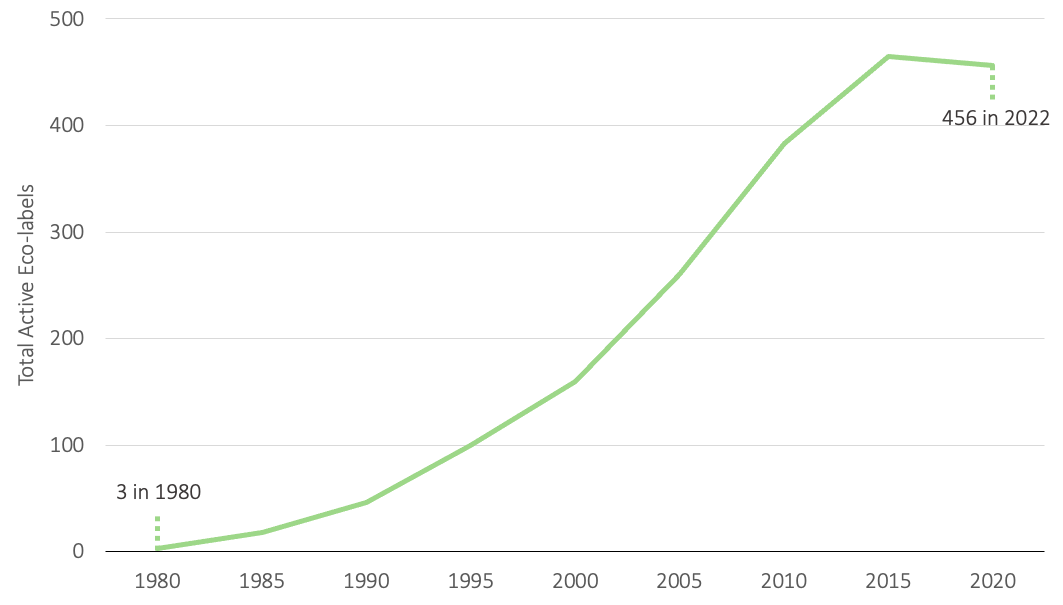
The rise of eco-labels
Rise of Eco-labels over the past 4 decades (Data from Eco-label Index)


The first thorn in this issue is that not all eco-labels are made equally. 

Some eco-labels have higher standards for certification, meaning they are harder for companies to obtain than eco-labels with lower standards. Yet, the average consumer is not aware of the differences in quality between eco-labels; if the consumer is trying to make a more sustainable choice they will grab the one with the eco-label, even though this does not necessarily mean that the product is more sustainable. With 456 labels out there, the consumer is bamboozled with eco-labels – some being reliable while others are more wishy-washy.

Studies have shown that this proliferation of eco-labels has 89% of shoppers confused in interpreting and understanding labels. It has also shown that this abundance can significantly affect consumers’ understanding of the environmental information these labels are conveying.

A prominent example of how this works (or doesn’t work) is provided by the UK supermarket chain Sainsbury’s which has introduced its own label called ‘Fairly Traded’, a name that certainly won’t have consumers confused with Fair Trade. 
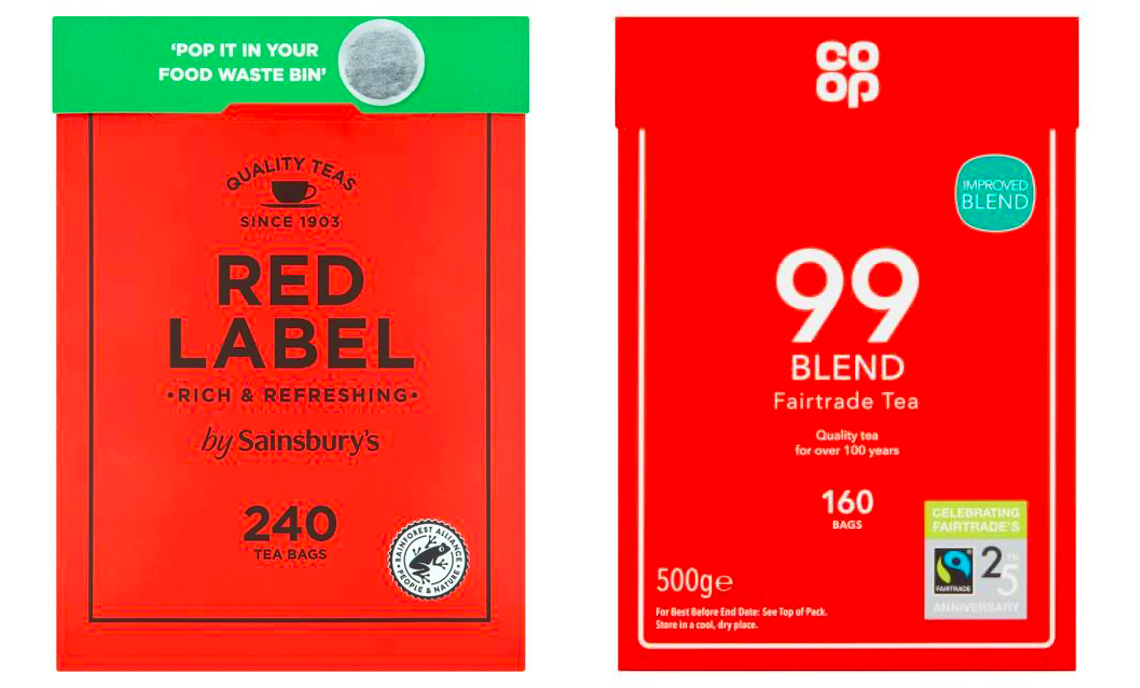
Sainsbury Eco-label and Fairtrade Eco-label
A comparison between Fairly Traded tea from Sainsbury’s* and Fair Trade tea from Coop, which looks more green to you?

Where farmers of Fair Trade receive a premium, the extra sum of money for them to invest in improving the quality of their lives, under Sainsbury’s Fairly Traded system, however, farmers must instead convince the Sainsbury’s board of experts to receive their premiums. Their standards are far lower than that of Fair Trade, and even if not the case, this still allows for Sainsbury’s to market their products as being sustainable.

On top of this, the proliferation of eco-labels has meant that there is more competition between labels, and the determining factor for whether a business will choose one eco-label over the other is obtainability. A company will – in general – reach for the eco-label with the lowest standards as consumers won’t know the difference in quality between labels anyway.  The eco-labels know this and with most of their revenue coming from companies buying their label they are incentivized to lower their standards to gain more customers.

Take for example the Indonesian Sustainable Palm Oil (ISPO) standard introduced in 2011 by the Government of Indonesia, and the Malaysian Sustainable Palm Oil certification program (MSPO), the Malaysian government’s own eco-label for sustainable palm oil. 

These eco-labels were created by their respective governments as a response to the increasing demand for sustainable palm oil. Under both ISPO and MSPO rules for obtaining their labels, companies do not have to provide any evidence that they are operating sustainably without damaging the environment or treating their employees and supply chain partners equitably. Furthermore, whatever the company claims it is doing is not independently verified by a team of government experts, sent out in a field inspection, and required to produce their own report free from any pressure.

Therefore it should come as no surprise that companies move their production to these areas to gain certified sustainable palm oil without having to improve on their environmental and social impacts. This in turn has also forced other eco-labels to lower their standards to match theirs.

What we are seeing is an explosion of eco-labels in an unregulated market resulting in weaker standards which in turn dilutes the value the consumer places upon eco-labels. 

What once was a scheme to quickly inform consumers that a product is sustainably produced has now muddied the waters so the consumer cannot clearly differentiate the good from the bad and the ugly.

This is an issue that the Impakter Sustainability Index, launched last year, is intended to address with a team of experts that independently verifies the soundness of sustainability certification systems (of which eco-labels are just one part). The Index methodology is grounded in using various, independent sources of information to cross-validate the reliability of certification systems. 

The overall goal of the Impakter Index is to “empower people to vote for sustainability” with their purchases. For now, the Index serves as a “gatekeeper” for the ECO marketplace, allowing for the sale of only those products that are verifiably sustainable. But this is just a start – for real change to take place, for consumers to become able to “vote for sustainability”, greenwashing must be curbed and many more “marketplaces” need to adopt more trustworthy certification systems.

*After receiving backlash, Sainsbury’s has stopped showing their Fairly Traded label on their product, however it is still produced under the name and they use the Rainforest Alliance label instead.


Editor’s Note: The opinions expressed here by Impakter.com columnists are their own, not those of Impakter.com –In the Featured Photo: Woman shopping. Photo credit: Joshua Rawson-Harris on Unsplash.

Tags: Eco labelsecolabelESGFairTradeGreenwashingSDGs
Previous Post

Child Poverty: the Little Victims of the Russia-Ukraine War

Next Post

Dave Chang’s “The Next Thing You Eat” and the Need for Meat

Related Posts

Russia Raises Alarm Over NATO Military Presence in Greenland, US and Taiwan Seal Semiconductor Trade Deal With Major Investment Commitments, Growing Concerns Over Medical Care in US Immigration Detention, Machado Seeks Influence After High-Stakes Meeting With Trump
Climate Change

Trump’s Greenland Ambitions Strain NATO Unity

Today’s ESG Updates Russia Accuses NATO of Militarising the Arctic: Russia has warned that NATO’s planned deployment to Greenland risks...

byPuja Doshi
January 16, 2026
ESG News regarding Economic Collapse Fuelling Iran Protests Amid Rising Death Toll, U.S. Pressure on Iran Tests Beijing as Tariffs Could Push China Duties Above 70%, EU Offers China Price Pledge Option to Avoid EV Tariffs, Atmosphere Emerges as Major Pathway for Plastic Pollution
Business

Iran Acknowledges 2,000 Deaths as Protests Enter Third Week

Today’s ESG Updates Economic Crisis Drives Largest Protests in Years: Demonstrations that began over the collapse of the currency in...

byPuja Doshi
January 13, 2026
Orsted challenges U.S. suspension of offshore wind projects; global mandatory ESG reporting accelerates; ESG ratings for Saudi firm Maharah; EU legal certainty on sustainability reporting.
Business

Orsted’s US Wind Project Challenge Highlights Regulatory Risk in Clean Energy Investment

Today’s ESG Updates Orsted Challenges U.S. Suspension of Wind Project: Denmark-based renewable developer files court action to overturn the U.S....

byMuhammad Umer Aslam
January 5, 2026
First Year of CSRD Reporting Exposes Data Gaps
Business

First Year of CSRD Reporting Exposes Data Gaps

Today’s ESG Updates CSRD Reporting Proves Difficult: Deloitte finds that many European companies failed to quantify ESG-related capital and operating...

byMuhammad Umer Aslam
December 22, 2025
Trump media merges with fusion power startup
Business

Trump Media Merges With Nuclear Fusion Company

Today’s ESG Updates Trump Media Merges With Fusion Power Company: Trump Media & Technology Group announced an all-stock merger with...

byPuja Doshi
December 19, 2025
Discovery of a carbon sponge under the ocean; HSBC survey shines positive acceptance of climate transition; New catalyst for clean hydrogen production; Google signs deal with Ebb for carbon removal.
Business

Scientists Find CO2 Buildup Under the Sea

Today’s ESG Updates Eroded Lava Under the Ocean Stores CO2: Work led by the University of Southampton demonstrates that these...

byPuja Doshi
December 12, 2025
ESG news covering EFRAG's new ESRS Knowledge Hub, Bank of England's private equity climate stress test, Singapore's green-power data centre rules, and Amazon's climate dispute with rivals.
Business

Europe Boosts ESG Transparency With New ESRS Knowledge Hub

Today’s ESG Updates EFRAG Unveils ESRS Knowledge Hub: Centralized EU platform to support CSRD-aligned sustainability reporting. Bank of England Tests...

byMuhammad Umer Aslam
December 8, 2025
Regulatory update on the EFRAG ESRS
Business

European Financial Reporting Advisory Group Releases Simplified Reporting Standards Draft

This Week’s Regulatory Updates: EFRAG releases simplified European sustainability reporting standards: EFRAG claims it will increase competitiveness and reduce the...

byAriq Haidar
December 5, 2025
Next Post
Dave Chang

Dave Chang’s “The Next Thing You Eat” and the Need for Meat

Recent News

Marathoners

8 Must-Know Websites for Marathoners

January 16, 2026
Why Glyphosate, the World’s Most Widely Used and Sued Herbicide, Is Under New Scrutiny

Why Glyphosate, the World’s Most Widely Used and Sued Herbicide, Is Under New Scrutiny

January 16, 2026
The Imperative of a Nature-Positive Future

The Imperative of a Nature-Positive Future

January 16, 2026
  • ESG News
  • Sustainable Finance
  • Business

© 2025 Impakter.com owned by Klimado GmbH

No Result
View All Result
  • Environment
    • Biodiversity
    • Climate Change
    • Circular Economy
    • Energy
  • FINANCE
    • ESG News
    • Sustainable Finance
    • Business
  • TECH
    • Start-up
    • AI & Machine Learning
    • Green Tech
  • Industry News
    • Entertainment
    • Food and Agriculture
    • Health
    • Politics & Foreign Affairs
    • Philanthropy
    • Science
    • Sport
  • Editorial Series
    • SDGs Series
    • Shape Your Future
    • Sustainable Cities
      • Copenhagen
      • San Francisco
      • Seattle
      • Sydney
  • About us
    • Company
    • Team
    • Global Leaders
    • Partners
    • Write for Impakter
    • Contact Us
    • Privacy Policy

© 2025 Impakter.com owned by Klimado GmbH