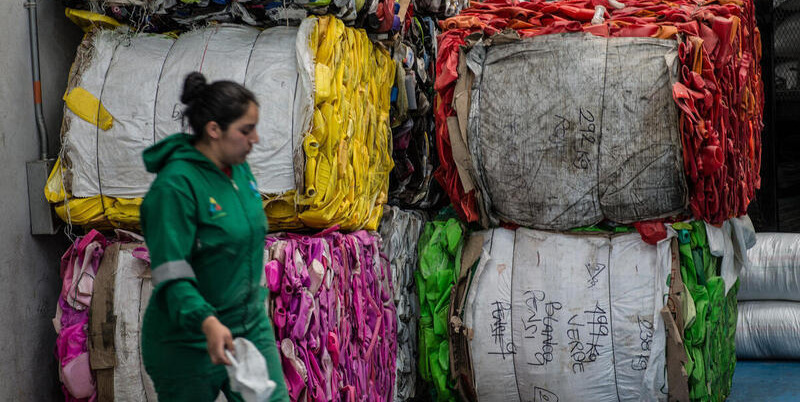
Has the phrase “reduce, reuse, recycle” grabbed your attention? The concept of recycling seems to be at the heart of every conversation around climate action. But a lot of misconceptions hover around the recycling process, which may lead you to believe you’re making a bigger positive impact on the environment than you truly are. Here, we debunk five common misconceptions about recycling, starting from the belief that plastic can be recycled indefinitely to the assumption that any item bearing the three-arrow symbol is recyclable where you live. Our goal is to guide you toward better decision-making both as a consumer and a voter.
Myth: If you dispose of recyclables properly, they will be recycled.
Many people believe that disposing of items in recycling bins guarantees their recycling, but this isn’t always the case.
It’s not uncommon for items placed in recycling bins to end up directly in garbage trucks, making many recycling bins a mirage for environmentalists. In 2023, a landfill in Georgia was filmed mixing recycling with trash. In the face of misleading information and perceived powerlessness, some U.S. residents are growing apathetic to recycling and, by extension, climate policy.
Ever noticed the iconic triangular recycling symbol? You’d be surprised to know it isn’t trademarked, enabling anyone to print it on their products — regardless of whether they are recyclable. So the symbol can tempt consumers into believing all recyclable products are eco-friendly. As Stanford professor Michael Wara notes, such practices could be considered consumer fraud.
One way to combat this issue is by making conscious buying decisions. Consider checking for credible eco-labels while shopping, such as Energy Star logos on appliances or the Fair Trade certifications on coffee or chocolate. However, double-check that any certifications are from third-party agencies and not producers themselves. That can help assure you that the products meet stringent environmental and ethical standards.
But there’s only so much consumers can do alone. To truly hold these large companies accountable, we need the government in on this, too. California laws SB 343 and AB 1201 are models for potential federal regulations. These two laws establish standards for labeling products as “recyclable” and “compostable,” reducing false claims about a product’s environmental impact.
In the future, the Federal Trade Commission could mandate clear standards for packaging labels, specifying which locations the material can be recycled. These regulations could be enforced with civil penalties like fines to ensure compliance.
Though misinformation plays a significant role in confusion about recycling, environmental educator Kristy Drutman says there’s also another factor at play: language barriers. “I think also being able to translate recycling information into different languages is really important moving forward,” she said.
Myth: Recycling is the best thing you can do to fight against climate change.
Many people believe recycling is the ultimate antidote to climate change. But is it?
Not really. According to research at the University of Leeds, recycling ranked low on a list of effective actions that an individual could take to fight climate change. Higher-ranked actions included living car-free, avoiding long-haul air travel, and reducing consumption of red meat.
You might also choose to vote in every election for climate-friendly leaders or join a climate-focused organization.
Of course, recycling matters, yet we can’t lose sight of the larger climate challenges and strike a balance between individual and corporate responsibility.
Myth: “Reduce,” “reuse,” and “recycle” are equally beneficial.
Plastics can only be recycled a finite number of times at best, sometimes only once, due to structural and composition breakdowns during the recycling process. This process involves melting, during which the material loses its integrity and gathers contaminants. And several plastic types, especially those in electronic devices or those stained by food, often bypass recycling altogether. These problems underline the necessity of advancing our recycling technologies while curtailing overall plastic use.
In situations where plastic is nonnegotiable, you can make a positive impact by choosing products made with recyclable plastics such as Polyethylene Terephthalate (PET) found in beverage bottles or High-Density Polyethylene (HDPE) used for jugs and detergent bottles. You can also advocate for policies that favor their usage.
Related Articles: Is Recycling as Green as We Think It Is? | Plastic Recycling: Ditch it or Improve it? | How Robots Can Help Recycle | Recycler’s Guilt: Coping with Recycling Woes in Big Cities
But fundamentally, recycling isn’t as beneficial as reduction and reuse. Again, the onus lies more heavily on corporations, whose environmental footprints vastly overshadow individual consumers. Several companies have been found to unduly overemphasize the impact of minor consumer actions (like choosing metal straws over plastic ones), to divert attention from their failure to minimize waste. In fact, in 2022, California’s Attorney General Rob Bonta launched an investigation into ExxonMobil, looking at whether the oil giant had oversold the promise of recycling.
Myth: Anyone can recycle.
Low-income and minority communities often lack recycling infrastructure. And oftentimes, advocacy in these communities is primarily directed toward bigger concerns — like making sure oil pipelines are not being built straight through their land.
Indigenous organizer Jade Begay pointed out that promoting recycling literacy in such communities might be tone-deaf, as recycling isn’t the main priority.
“We’re engaged in environmental justice issues because we have to be,” Begay said. “To fight to protect our lands is to automatically engage in environmental and climate justice work.”
Reality: Recycling education could be more than just trash talk.
Recycling education is often limited to helping people master the art of waste segregation. In reality, it could become a critical weapon in our arsenal against climate change.
Better recycling education could help students grasp environmental justice issues, such as the disproportionate siting of landfills in low-income Black and Brown communities. Such programs could weave in civic engagement opportunities, such as voter registration or extra credit for attending a town hall meeting. As part of the syllabus, students could learn the ropes of local and national environmental legislation and grapple with how their political decisions influence our battle for the planet.
Understanding recycling and responsible waste handling could also help students learn to challenge large companies about their environmental footprints — and advocate for more rigorous regulations for the big players. This form of recycling literacy could help young people break through the fog of greenwashing and individual action to see the power that grows from collective action.
** **
 This article by Yale Climate Connections is published here as part of the global journalism collaboration Covering Climate Now (CCN).
About the authors
Cameron Sabet is a medical student at Georgetown University and COO at educational nonprofit Ivy League Mentoring. His writing has appeared in the New York Times, Washington Post, The Hill, Smithsonian Magazine, the Lancet, and BMJ.
Alessandro Hammond is a student at Harvard University and researcher at the Boston Children’s Hospital whose writing has appeared in Nature, The Washington Post, and Frontiers in Public Health.
Sophia Kianni is an Iranian-American social entrepreneur and climate activist at Stanford University. She is the founder of Climate Cardinals, a Yale Climate Connections partner. In addition, she is a United Nations adviser and serves on the EPA’s National Youth Advisory Council.
Tom Toro is a cartoonist and writer who has published over 200 cartoons in The New Yorker since 2010.
Editor’s Note: The opinions expressed here by the authors are their own, not those of Impakter.com — Featured Photo Credit: © Juan Pablo Eijo / Greenpeace.