The Connecting Business initiative (CBi), a joint initiative by the United Nations Office for the Coordination of Humanitarian Affairs (OCHA) and the United Nations Development Programme (UNDP), released a guidance note last month: “Putting People First: Accountability to Affected Populations in Private Sector Disaster Management.”
This publication, developed with the support of the Conrad N. Hilton Foundation, is meant to raise awareness within the private sector about the importance of accountability when working with vulnerable communities in the wake of disaster.
The private sector’s role in disaster risk reduction and management
The CBi engages the private sector strategically before, during, and after emergencies, increasing the scale and effectiveness of the response and recovery in a coordinated manner.
Making use of the private sector’s skills, technologies, and other resources during a disaster often benefits response efforts.
Due to the global population increase, climate change acceleration, and growth of development worldwide, the effects of natural and manmade disasters are intensifying. Whilst deaths related to natural disasters have steadily declined over the past decades, largely thanks to disaster risk reduction and management (DRRM) policies, the economic cost of such disasters is rising.
The more developed the world becomes, the greater the economic cost when it is ravaged by disaster.
The private sector is often in the best position to mobilise a community in response to disasters and to benefit from reducing the vulnerability of an area to hazards.
As independent parties that operate within a local context, businesses often have specialised knowledge and resources from which to draw in order to plan for hazards and carry out timely and effective aid.
Businesses also benefit by helping communities become more resilient in the face of disaster. The private sector typically suffers when its community is hit by economic hardship. Conversely, a resilient community, one which sees a minimum effect and recovers quickly, is good for business by keeping uncertainty and risk to a minimum, which incentivises investment and growth.
About 50% of all humanitarian crises can be predicted.
Yet, less than 1% of humanitarian funding is dedicated to anticipatory action.
See why we need to scale-up funding for #EarlyAction, including through the private sector: https://t.co/U96R2B2audpic.twitter.com/ek816KLuTi
— Connecting Business Initiative (CBI) (@Connecting_biz) October 14, 2022
The cost of rebuilding after a disaster is often exponentially higher than the cost would have been of investing in infrastructure to withstand the same disaster. By investing in disaster risk reduction, the private sector saves money in the long term.
A Guide to Accountability in Private Sector Disaster Management
The publication from CBi intends to act as a bridge between the extant theoretical frameworks on the topic and practical guidance for businesses interested in or involved in DRRM.
People who receive assistance have the right to:
📝Be informed about assistance provided
🤝Be involved in decision making
🗣️Provide feedbackThat's 𝘼𝙘𝙘𝙤𝙪𝙣𝙩𝙖𝙗𝙞𝙡𝙞𝙩𝙮 𝙩𝙤 𝘼𝙛𝙛𝙚𝙘𝙩𝙚𝙙 𝙋𝙤𝙥𝙪𝙡𝙖𝙩𝙞𝙤𝙣𝙨. How can business integrate it?👇🏿https://t.co/fZrN9EKARe pic.twitter.com/TzG7EpO734
— Connecting Business Initiative (CBI) (@Connecting_biz) September 26, 2022
Disadvantaged communities are disproportionately vulnerable to the disastrous effects of natural hazards, and as a result, require more aid and assistance when they strike. In these situations, there is an imbalance of power between those receiving aid and those providing it. This publication forms one step towards ensuring that this imbalance of power does not worsen the effects of disaster on people within disadvantaged communities.
As stated in the introduction to the publication:
“… When businesses provide assistance to those in need, they must comply with the international standards and principles that govern humanitarian assistance. One of the key concepts that all providers of aid must be familiar with is “accountability to affected people/populations”, or AAP.
The basic concept of AAP is that people who receive humanitarian assistance should have the right to say what they need, receive information on what is being provided, and have an opportunity to assess and provide feedback about the assistance they receive.”
The report goes on to compare this type of accountability with the act of ensuring customer satisfaction, a standard business practice throughout the private sector. If a business has provided a service, it is in their interest to understand whether it satisfactorily met the goals and needs of the recipient who sought the service.
The situation of those in need of humanitarian aid is unique, and more prone to exploitation, due to lack of choice. In a typical market, consumers can choose the business from which they would like to source services. Communities receiving disaster aid have no choice when it comes to the type or quality of assistance that is provided.
Therefore, CBi’s guide aims to help organisations providing humanitarian assistance to recognise the power imbalance and use it responsibly.
It begins by suggesting three foundational principles to inform all activities relating to disadvantaged communities: to “take account” by allowing affected people influence over decisions which account for their needs and views, to “give account” by sharing information in an effective and transparent manner, and “to be held to account” by ensuring communities have the opportunity to assess and alter or approve of humanitarian actors’ actions.
Related Articles: What Causes Disasters and How to Address Them: New Research Proposes Solutions | How Businesses Save Lives in Emergencies
The guide continues by suggesting concrete practices that businesses can take to increase accountability when both planning for disasters and responding to disasters. It also includes examples of success from CBi Member Networks such as The Philippine Disaster Resilience Foundation’s response to Typhoon Rai and the Vanuatu Business Resilience Council’s response to Cyclone Harold.
CBi released a similar report last year with guidance for how to be a “conflict sensitive” business. This guide was developed in order to help businesses understand how aid can sometimes cause further division or tension within communities, and actions and practices that could mitigate this effect and create maximum benefit.
International Day for Disaster Reduction 2022 was recently marked on October 13 with efforts across the globe to involve local populations in their own community risk reduction and management.
https://twitter.com/IHRRNepal/status/1580598708596805634
The focus of IDDRR 2022 was raising awareness for the benefits of early hazard warning systems, since half of the global population does not currently have access to such systems.
Despite recent progress made in #DRR, the danger of leaving hundreds of communities behind is real🚨.
Only 1/2 of 🌏 is covered by #EarlyWarning systems: it’s time to do better ✊Today, we celebrate #DRRDay with 1 goal: #EarlyWarningForAll!
👉https://t.co/LunG9bEwwi pic.twitter.com/Hmv0sPu05m— UNDRR (@UNDRR) October 12, 2022
Let’s hope that through the work of CBi and similar initiatives, the private sector can help solve problems like these in order to create resilient communities and break the cycle of poverty, which is often perpetuated by the catastrophic effects of disaster.
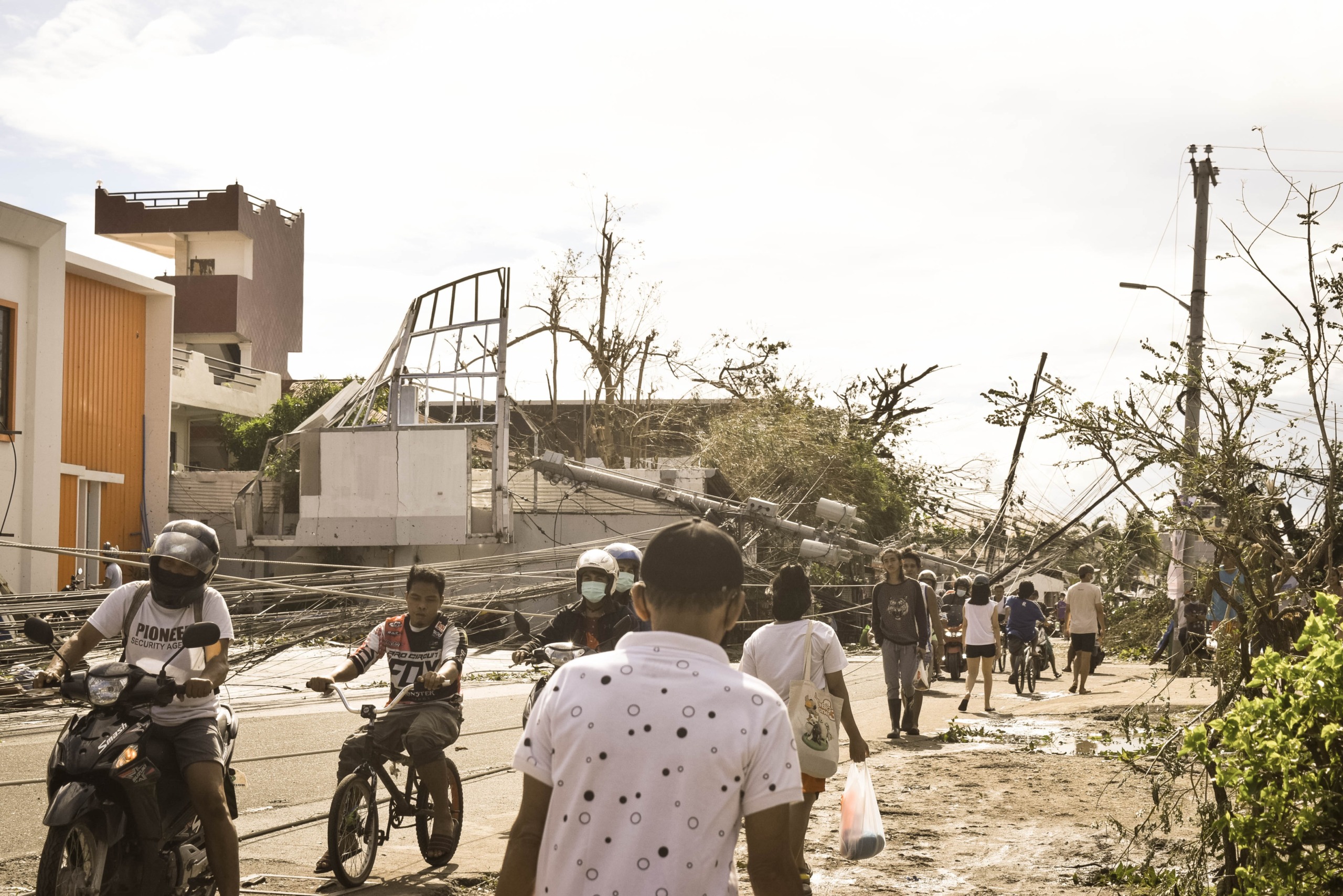
Editor’s Note: The opinions expressed here by Impakter.com columnists are their own, not those of Impakter.com — Featured Photo: The devastating effects of Super Typhoon Odette (International name “Rai) in Lapu-Lap City, Cebu, Philippines. Featured Photo Credits: Karl Cho.