
Fossil fuel giants have been using their power to fool people into thinking that only companies as substantial as their own have the ability and the funds to tackle climate change.
However, it seems odd that anyone would buy into this belief, considering such a large chunk of the blame for climate change goes to fossil fuel companies.
Exxon, for example, have advertised the latent outcomes of algae farms, which have the potential to fuel planes, trucks, and ships as sustainable biofuel.
It would appear that these kinds of ads have been carefully designed to protect companies’ faces at a time when people may finally be understanding the need to say goodbye to fossil fuels.
https://www.youtube.com/watch?v=bKfLYRtCGY4
Some of these companies are even providing financial support to industry groups spending millions on efforts to impede policies designed to prevent or slow down climate change.
An example of this can be seen in a recent report from the New York Times, which looked at the Propane Education and Research Council’s attempts to hinder the influx of electrifying households and buildings in New York.
The council did this by contributing and wapping $900,000 to the New York Propane Gas Association which spent the money on misleading social media content about energy-efficient heat pumps.
Related Articles: Groundbreaking Lawsuit: Shell’s Board of Directors Sued for Climate Inaction | Energy Injustice: As Fossil Fuel Profits Double, Exxon Sues EU While BP Cuts Climate Targets
According to a BuzzFeed investigation of recently released tax filings, the American Fuel and Petrochemical Manufacturers, a US oil trade organisation, paid $4 million to PR company Edelman to “promote one of the most extreme fossil fuel trade groups in the country.”
One of America’s biggest PR firms, Edelman had previously pledged to “work with an environmental conscience.”
This behaviour of the gas and oil industries is certainly nothing new, and has been going on for decades. It would appear these industries have played key roles in promoting climate denial, thus delaying climate action.
We launched a seven-figure ad campaign to urge Democrats to vote against new, punitive taxes that make U.S.-produced plastics and energy more expensive for American consumers. Read our statement: https://t.co/g8x5RXb8IL
— AFPM (@AFPMonline) October 7, 2021
In a recent research paper, “Following the money: trade associations, political activity and climate change,” The Conversation analysed political activities within oil industry groups.
More specifically, they “dug through U.S. tax filings to follow the money trail of trade associations engaged on climate change issues and track the billions they have spent to shape federal policy.”
What they found was devastating.
Before laying out their findings, The Conversation reminds us of the first example of industry trade groups joining forces to hinder climate action.
It all started in 1988, when NASA scientist James Hansen warned of the catastrophic risks of climate change.
Following this, three trade associations – the National Association of Manufacturers, the Edison Electric Institute and the American Petroleum Institute – grouped together to form the Global Climate Coalition (GCC), “an international lobbyist group of businesses that opposed action to reduce greenhouse gas emissions and engaged in climate change denial.”
The GCC successfully prevented the US from signing the Kyoto Protocol, a 1997 international agreement to reduce greenhouse gas emissions that was replaced by the Paris Climate Agreement in 2015.
NEW SERIES| Documents reveal how a secretive fossil-fuel backed lobby group manipulated the UN's climate programs https://t.co/qVxZAIAcRL pic.twitter.com/OOyuNCwZtz
— DeSmog UK (@DeSmogUK) April 25, 2019
The Conversation’s study also found that trade associations working with gas and oil companies, who are opposed to climate change action, spent $2 billion from 2008 to 2018 on political activities, such as advertising and lobbying.
This $2 billion sum outspends climate change support groups with a monumental ratio of 27 to 1.
Out of this $ 2 billion, $ 1.3 billion was spent by oil and gas companies. As many as 89 trade associations were evaluated at this time and no other group came even close to this kind of expenditure.
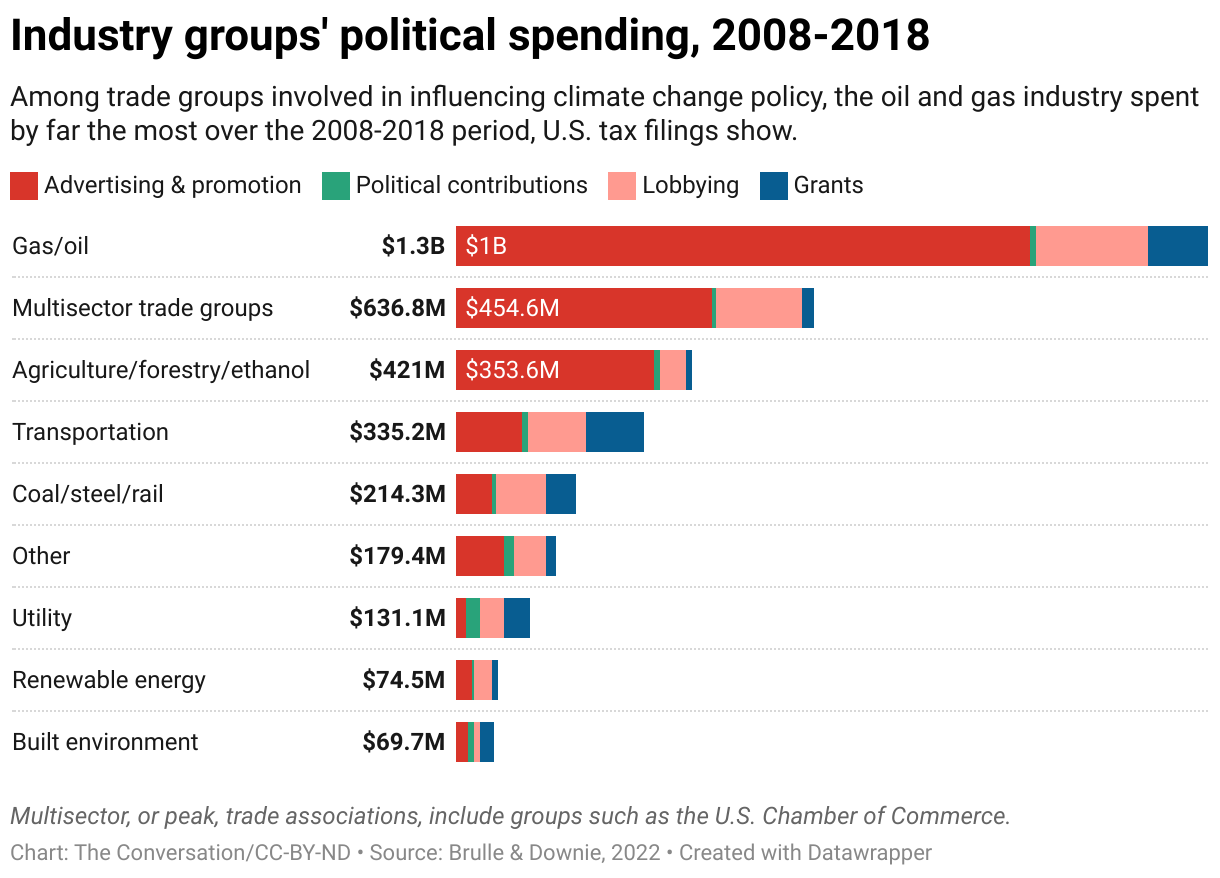 It is beyond shocking that those responsible for climate change are more involved in climate change prevention than renewable energy firms in climate action.
Considering that it has now been proven more cost-effective to start brand new renewable energy firms than to continue running all the coal plants in the US, it comes as no surprise that the fossil fuel industry may be panicking about the future of its profits.
However, many firms are now being put under pressure to leave trade associations that prevent climate policies.
An example of this would be the oil giant Total quit API in 2021, due to disagreements over climate positions.
Similarly, as Buzzfeed points out, Shell and BP recently stopped working the American Fuel and Petrochemical Manufacturers due to their “aggressive opposition to popular climate solutions.”
Social media advertising spending in the weeks ahead of the US midterm elections and during the U.N. Climate Change Conference in November 2022, COP27, is another example of these groups’ behaviours.
A review by the advocacy group Climate Action Against Disinformation found that 87 fossil fuel-linked groups spent between $3 million to $4 million on more than 3,700 ads through Facebook’s parent company alone in the 12 weeks leading up to and during the conference.
According to The Conversations research, industry groups opposed to climate change policies are also “big spenders.”
Over the ten years in review, climate change opposing industries spent $2 billion on anti-climate advertisement, in comparison to clean energy industries that spent $74.5 million.
It has been suggested that this could be why it took so long after Hansen first warned about the outcomes of climate change in 1988, to make substantial climate policy actions and pass the first major climate bill in 2022, the Inflation Reduction Act.
While the passing of the Inflation Reduction Act certainly marks a turning point in history, one may well wonder what the world would look like today had a similar bill been passed back then.
Editor’s Note: The opinions expressed here by the authors are their own, not those of Impakter.com — In the Featured Photo: Wrapped up dollars. Featured Photo Credit: Karolina Grabowska.