Impakter
  • Environment
    • Biodiversity
    • Climate Change
    • Circular Economy
    • Energy
  • FINANCE
    • ESG News
    • Sustainable Finance
    • Business
  • TECH
    • Start-up
    • AI & Machine Learning
    • Green Tech
  • Industry News
    • Entertainment
    • Food and Agriculture
    • Health
    • Politics & Foreign Affairs
    • Philanthropy
    • Science
    • Sport
  • Editorial Series
    • SDGs Series
    • Shape Your Future
    • Sustainable Cities
      • Copenhagen
      • San Francisco
      • Seattle
      • Sydney
  • About us
    • Company
    • Team
    • Global Leaders
    • Partners
    • Write for Impakter
    • Contact Us
    • Privacy Policy
No Result
View All Result
Impakter logo
No Result
View All Result
Humans prey

Deadliest on Earth: Humans Exploit Up to 300 Times More Species Than Comparable Predators

New research reveals humanity’s profound impact on ecosystems and biodiversity

Olivia FowlerbyOlivia Fowler
July 12, 2023
in Environment
0

New research published in Communications Biology analyses “humanity’s modern day predatory interactions with vertebrates” in order to better understand the “ecological consequences” of human behaviour. 

The research found that, whilst humans have long been a part of Earth’s predatory landscape, “the rise of advanced hunting and fishing technology, global commercialization, trade, and more” is quickly changing the interactions between people and their prey.

By analysing “use and trade” data on 47,000 species from the International Union for Conservation of Nature’s (IUCN) Red List, the researchers found that mankind exploits up to 300 times more species than comparable predatory species like sharks or other mammalian predators.

Humanity’s exploitation of other vertebrates for pets, medicine and other uses, the scientists reveal, now affects almost as many species as the exploitation of vertebrates for food.

“Almost 40% of exploited species are threatened by human use,” according to this new research.

“Although humans have long been predators with enduring nutritive and cultural relationships with their prey,” reads the paper, “seldom have conservation ecologists considered the divergent predatory behaviour of contemporary, industrialized humans.”

Human activity is “profoundly” changing interactions between people and their prey – threatening prey species as well as exceeding other globally widespread predators. These changes in interactions, according to the research, could have vast and significant outcomes including extinction and threatening ecological diversity.

Threat to prey species

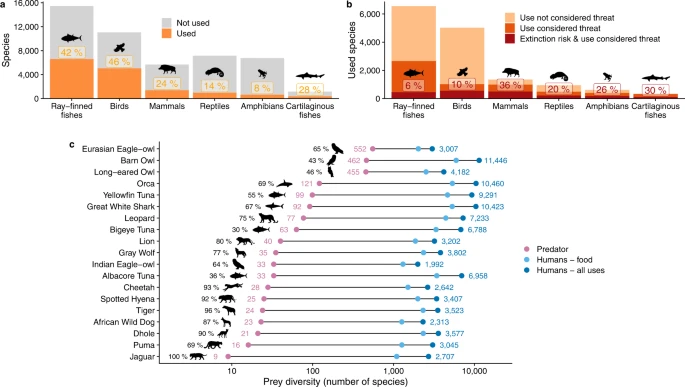
According to the report, humans exploit “roughly a third” of the six vertebrate classes the scientists examined. Of this, only 55% are used directly for food, the scientist found.

Humanity also has the most diversity when it comes to the species we prey on. As the paper states, “human prey diversity is highest across marine prey species,” with 43% of assessed marine species being exploited, or considered prey, to mankind. Freshwater vertebrates account for 35% and terrestrial vertebrates account for 26%.

Ray-finned fishes are a highly exploited vertebrate group with the research finding that humanity uses 42% of all species examined in the study. The human race also uses 46% of bird species, according to the study.
predatory niches of other predators
In the Figure: “A: Number and percent of vertebrate species with documented human use, and B: number for which use is considered a threat, including the subset facing extinction (Vulnerable, Endangered, or Critically Endangered status on the IUCN Red list). C: Prey diversity (number of species; logarithmic scale) of humans and comparable predators (i.e., those that prey on vertebrates for which range-wide data were available) across equivalent geographic ranges, with percentages indicating human prey overlap with each predator..” Source: “Humanity’s diverse predatory niche and its ecological consequences,” Communications Biology

The study found that human use is a “considerable threat for 12% of all vertebrates and 39% of used vertebrates.” This quantifies the impact of human predation on species extinction and biodiversity. 

Furthermore, the study found that 4% of all vertebrates and 13% of used vertebrates classified as facing extinction have human use listed as a threat. The extent to which humanity contributes to the risk of extinction was found in the report to range from 6% in exploited ray-finned fishes to 36% in exploited mammals.

The overlap between the prey of humans and the prey of other predators is also large, according to the paper. For example, humans share 30% of target prey species with bigeye tuna and 100% of prey with a jaguar. The study found the median overlap across all examined predators is 69%.

What functions do different vertebrae have for humans?

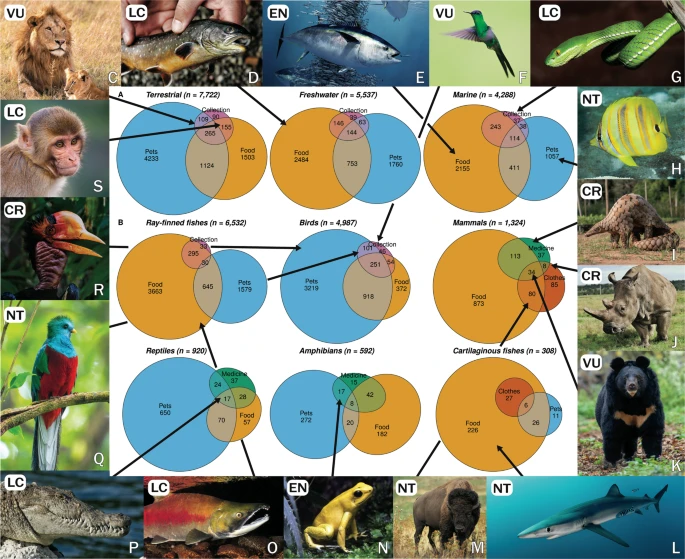
The IUCN data shows 18 different categories of human use when it comes to vertebrates, the report explains. The categories include for pets, food for humans, hunting/collection, clothes, medicine and animal feed, among other uses.

There are also multiple cases where an individual species has multiple uses; according to the report, this applies to 26% of vertebrate species.

The majority of exploitation from the marine and freshwater environments, 72% of species, is for human food purposes. The report goes on to explain that terrestrial vertebrates are more than twice as likely to be kept as a pet than they are to be used as food.
What humans use their prey for
(In the Figure: “Number and overlap of species in each IUCN ‘use and trade’ category for A terrestrial and aquatic realms and B six vertebrate classes with the most species.”, Source: Humanity’s diverse predatory niche and its ecological consequences,” Communications Biology

“Continued overexploitation will likely bear profound consequences for biodiversity and ecosystem function,” the researchers warn.

Speaking to the BBC, Dr Rob Cooke of the UK Centre for Ecology and Hydrology in Wallingford, Oxfordshire and one of the report’s authors, said: “The size and scale of what we found surprised us.”

“Humans have a breath-taking diversity of uses of animals but we need to move towards sustainable human-nature relationships across the globe,” said Cooke.

According to the report, “humanity now likely has a far broader predatory niche than at any time in history,” making us an incredibly significant factor in shaping the ecology and biodiversity on Earth.

In terms of confronting the threat humanity poses, the researchers state that it “requires an interdisciplinary and inclusive approach.” They believe that an approach “that recognizes historic and enduring interactions between Indigenous, place-based societies and prey with which they have maintained relationships over millennia” will be most appropriate.

Regardless of the approach, the researchers stress the need for society to “fully recognise” all the effects of “humanity’s outsized predatory niche,” concluding that exploitation rates must be constrained in order to safeguard over 45,000 species and the ecological processes they promote.


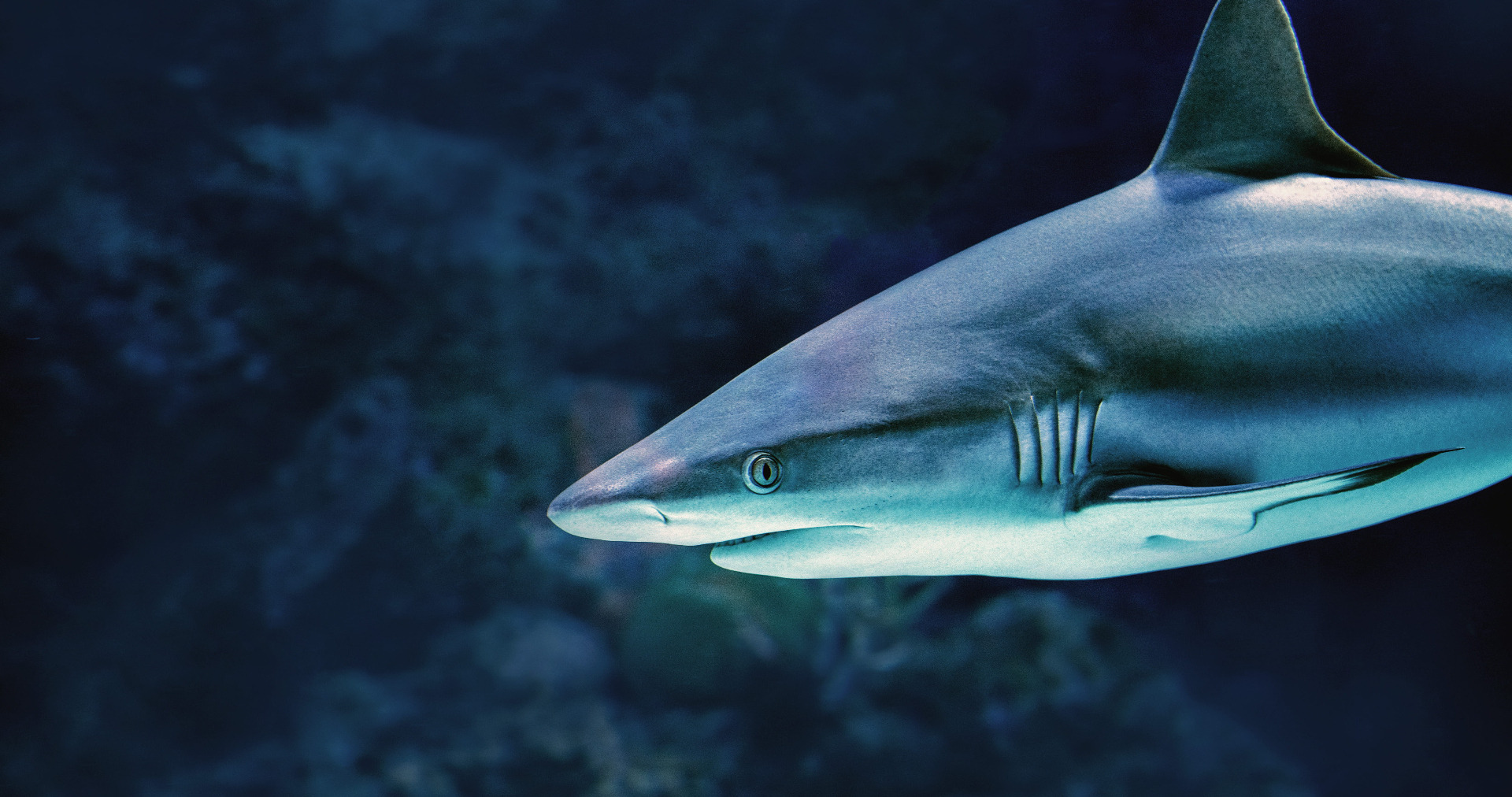
Editor’s Note: The opinions expressed here by the authors are their own, not those of Impakter.com — In the Featured Photo: Great White Shark under water. Featured Photo Credit: Wallpaper Flare. 

Tags: EcosystemEndangered SpeciesEnvironmentHumanity's predatory nicheOver-exploitation
Previous Post

Iceland Volcano Eruption: Reykjavik Faces Nature’s Fiery Display

Next Post

Reinventing Travel: Japan Airlines’ Sustainable Fashion Move

Related Posts

Impakter’s Most-Read Stories of 2025
Society

Impakter’s Most-Read Stories of 2025

In 2025, as in previous years, Impakter readers turned in large numbers to stories examining climate change and pollution, environmental...

byImpakter Editorial Board
December 31, 2025
Year in Review: Trump 2.0 and the Environment
Environment

Year in Review: Trump 2.0 and the Environment

So much has happened this year. It seems that every day there is a new headline that is just as...

bySarah Perras
December 30, 2025
Vapes
Environment

How Bad Is Vaping for the Environment?

From lithium-linked fires and e-waste to plastic pollution, disposable vapes pose serious environmental and health risks. Tobacco smoking has been...

byAnastasiia Barmotina
December 22, 2025
Galaxy frog
Biodiversity

How Photography Tourism Endangers Rare Galaxy Frogs

Researchers found that galaxy frogs, a rare species belonging to the group of the “world’s most unique species at risk...

bySarah Perras
December 18, 2025
How Climate Change Could Help Foster Peace in Yemen
Climate Change

How Climate Change Could Help Foster Peace in Yemen

Yemen's tragedy is traditionally depicted through the limited perspective of humanitarian need and political divisiveness, but there is a greater...

byTareq Hassan - Executive Director of the Sustainable Development Network Canada (SDNC)
December 17, 2025
ESG News regarding Flooding in Indonesia; Glencore promises copper production boost; Trump proposes slashing fuel efficiency standards, and Vulcan Energy receives $2.57bn of funding for lithium project
Business

Indonesians Blame Deforestation for Recent Floodings

Today’s ESG Updates: More than 700 Lives Lost in Recent Indonesian Floods: A combination of mass deforestation and heavy rainfall...

byAriq Haidar
December 4, 2025
ESG News regarding the UK’s Updated Environmental Improvement Plan, modernizing Mauritania’s railway system, the EU carbon border tax, and the EU’s cross-border energy projects
Business

UK Unveils Updated Environmental Improvement Plan

Today’s ESG Updates UK Accelerates Nature Recovery: The government commits £500m to Landscape Recovery and targets 250,000 hectares of restored...

bySarah Perras
December 1, 2025
COP30: Countries’ Climate Agrifood Ambitions Undermined by Funding Gaps, Report Finds
Biodiversity

COP30: Countries’ Climate Agrifood Ambitions Undermined by Funding Gaps, Report Finds

Developing countries recognize the urgent need to adapt agrifood systems to climate change, but most National Adaptation Plans (NAPs) are...

byThe Food and Agriculture Organization of the United Nations (FAO)
November 19, 2025
Next Post
Reinventing Travel: Japan Airlines’ Sustainable Fashion Move

Reinventing Travel: Japan Airlines' Sustainable Fashion Move

Recent News

ESG News regarding China restricting industrial renewable exports, UN warning that US climate treaty exit harms economy, UK firms lowering wage forecasts despite inflation, Meta partnering with TerraPower for new nuclear reactors.

To Save the Grid, China Forces Industries to Go Off-Network

January 9, 2026
Cleaner Air in Hospitals

How Cleaner Air in Hospitals Can Cut Infections and Climate Impact at the Same Time

January 9, 2026
Search cleanup, key activity to protect your data and tech devices.

A Simple “Search Cleanup” Plan for Busy People

January 9, 2026
  • ESG News
  • Sustainable Finance
  • Business

© 2025 Impakter.com owned by Klimado GmbH

No Result
View All Result
  • Environment
    • Biodiversity
    • Climate Change
    • Circular Economy
    • Energy
  • FINANCE
    • ESG News
    • Sustainable Finance
    • Business
  • TECH
    • Start-up
    • AI & Machine Learning
    • Green Tech
  • Industry News
    • Entertainment
    • Food and Agriculture
    • Health
    • Politics & Foreign Affairs
    • Philanthropy
    • Science
    • Sport
  • Editorial Series
    • SDGs Series
    • Shape Your Future
    • Sustainable Cities
      • Copenhagen
      • San Francisco
      • Seattle
      • Sydney
  • About us
    • Company
    • Team
    • Global Leaders
    • Partners
    • Write for Impakter
    • Contact Us
    • Privacy Policy

© 2025 Impakter.com owned by Klimado GmbH