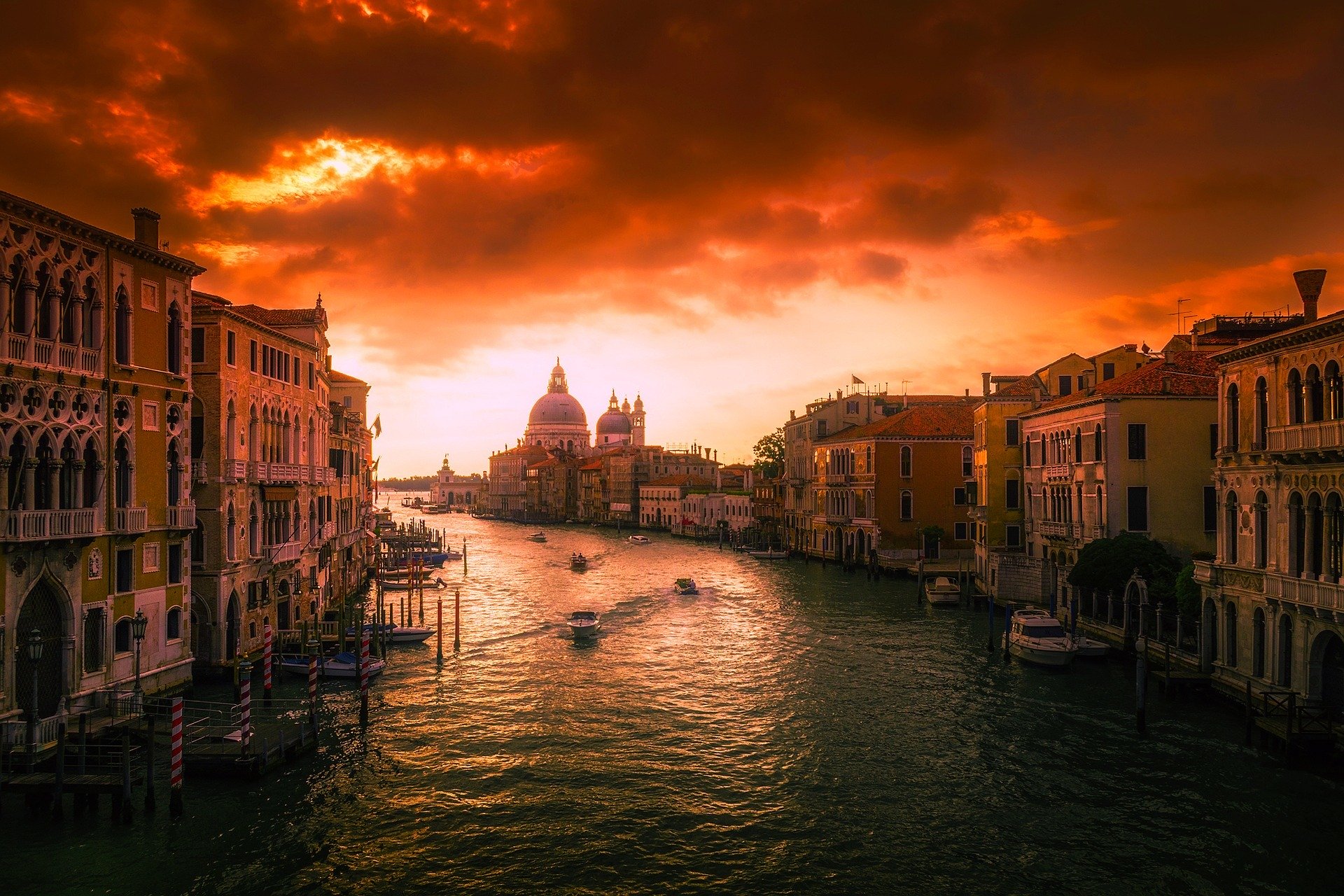
Writing from Italy, New York Times foreign affairs Op Ed columnist and Pulitzer winner Thomas L. Friedman claims in a new not-to-be-missed piece that he will “ruin your breakfast, lunch and dinner “ and he certainly does. He argues that if Putin, Trump and Bannon (presently roaming across Europe to raise trouble) succeed in breaking up our “community of democracies”, we are toast. There will be a power vacuum. Who will defend human rights and democracy? You certainly can’t count on China or Russia to save our Western values.
Italy seems to have inspired him, or perhaps helped clear his vision of what are the true challenges we are facing in Europe. And, as I too write from Italy, I can only agree with him. Up to a point. Let me clarify.
First, of all, he is right, it’s not only Brexit. Or the rise of populism. Or Putin’s interferences with elections in Europe. Or immigrant waves driven by “the environmental and political disorder from the south”, the war in Syria, the political mess in Libya, the poverty across Africa. Or the lack of cooperation within the European Union, with East European members (the Visegrad Group) most at fault, preventing any solution to the immigration problem. Or, because of Trump, an isolationist U.S. It’s all of them, a perfect storm. And the eye of the storm is in Italy.
Here, in Italy, as Friedman notes, the March election brought to power the “most pro-Putin, anti-immigrant, anti-E.U. coalition ever to rule Italy: the League and the Five-Star Movement.”
How did this happen? Because Europe turned its back on Italy, it left Italians alone to address the immigration crisis. In 2011, the British, French and Americans took, as Friedman rightly calls it, a “reckless” decision: they decided to topple Libyan strongman Qaddafi without ever stepping on Libyan soil or staying on to rebuild the country. The UN was left alone to try and pick up the pieces without any serious help from anyone. That was stupid, from 2012 onwards, Italy paid the cost of that enormous mistake, with 600,000 migrants sailing from a wild, out-of-control Libya, and half of them staying in Italy.
And Europe continues to turn its back on Italy. The recent European Council meeting held in June solved nothing. Led by Hungary’s autocratic, anti-democratic, anti-European leader Victor Orban, the Visegrad group has managed to block Europe. And Salvini, the Euro-skeptic extreme right leader of the League who wields real power in the Italian government as both Vice President and Interior Minister, has decided on a new course of action.
Salvini has stopped asking Europe for help. Rather than go against his like-minded populist brethren in the Visegrad group and force them to accept migrants (they haven’t accepted a single one), he has decided to close Italy’s borders for good and strengthen Libya’s coast guards, giving them money and equipment, so that they will do the dirty work for him. Not pretty. And possibly not even legal: Recently, an Italian ship returned 108 migrants rescued from the sea to Tripoli. This could be in breach of international law. People rescued in international waters cannot be returned to a place where their lives are in danger. And Libya is certainly not a safe place.
Looking beyond this at the broader picture, the Italian government’s behavior is deeply worrying. But there is a reaction. For example, Familia Cristiana, a Catholic magazine, called Salvini a Satan, exhorting him to walk back his anti-migrant policies: “Vade Retro Salvini”.
The recent issue of Rolling Stone magazine’s Italian edition is also a protest against Salvini’s anti-migrant policies and more broadly, against populism and how Salvini’s propaganda machine functions on social media (same method as Cambridge Analytica’s on Facebook and used by Trump).
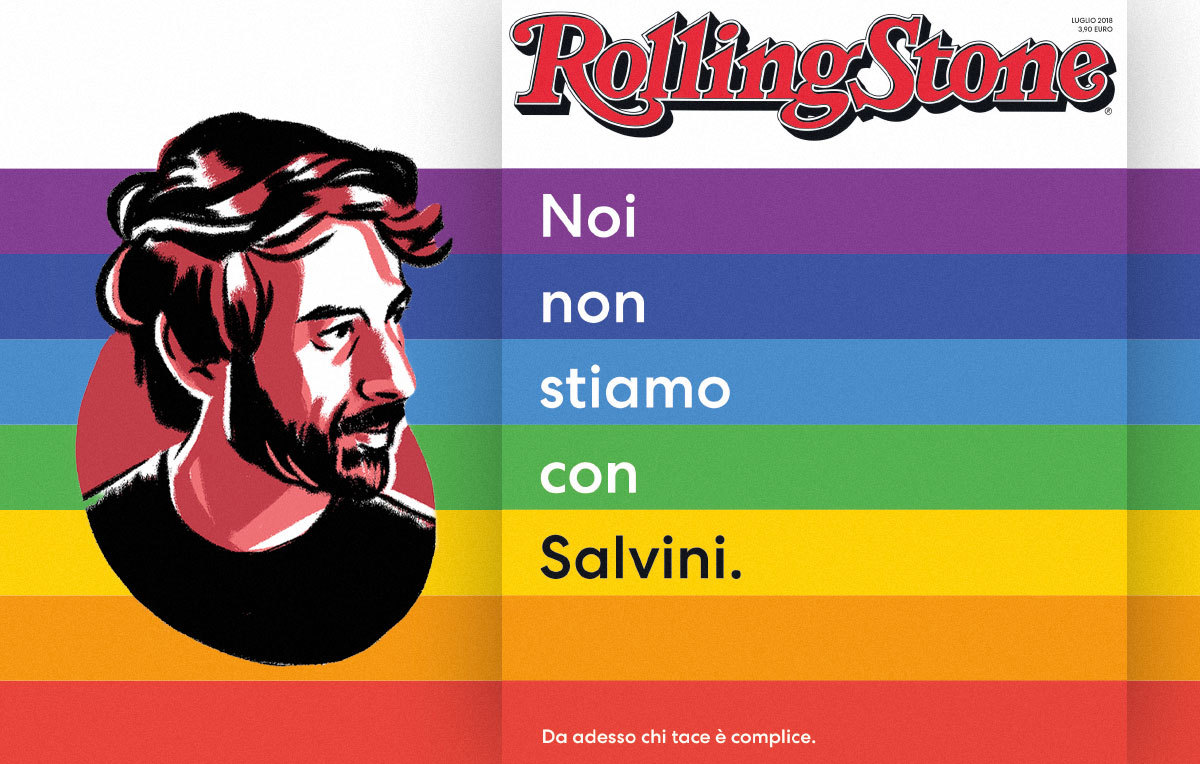
Rolling Stone Magazine: The cover reads “We are not with Salvini – from now on, whoever remains silent is an accomplice” An article in the form of an interview, explains the cover (here) making the protest explicit, recalling that with silence, there is a real risk that a dictatorship or racist laws could be installed.
There are reports of a resurgence of racist crimes with blacks more often attacked and some murdered – the reports are not silenced, they make headlines across Italy but not in the way Salvini and his League fans would like. Salvini finds himself accused by the opposition of creating a climate of hate – similar to what Trump is doing. When Italian National team athlete Daisy Osakue, of Nigerian origin, was assaulted, her image, with a bandaged eye, hit all the papers and social media.
As I write, the government just passed the so-called “Dignity” decree through Parliament, a series of rather minor changes to the labor law, supposedly to promote youth employment (whether it will do so remains to be seen).
This is a first win for Vice President and Labor Minister Di Maio, the Five Star Movement leader who had expansively promised a “citizenship income” (reddito di cittadinanza) and a flat tax. A victory but a meagre one. Because of EU budgetary rules, Italy cannot afford either the flat tax or a citizenship income.
Even Italy’s most Euro-skeptic government ever cannot ignore Brussels. Moreover, Italian democratic institutions are more powerful than Salvini, even at his most successful. Italy’s President Mattarella guarantees the Constitution – including Italy’s signature of the Rome Treaty and its participation in the EU – and there is nothing the League can do about that.
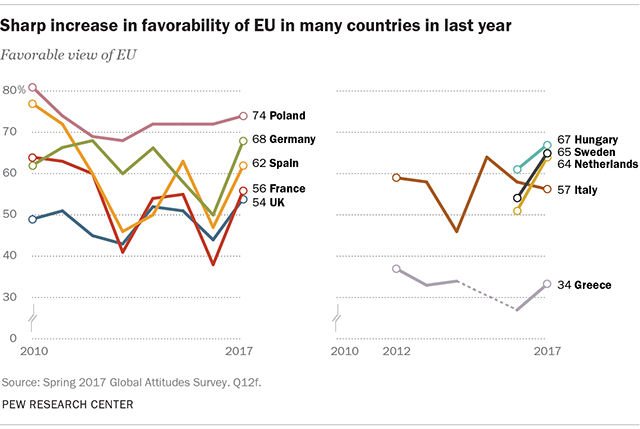
This is why I think that Friedman’s fear of a collapse of democracy in Europe is premature. No matter how hard Bannon will try to provoke a Euro-skeptic backlash, the heady days of Brexit are over. The political disaster in the UK threatens to turn into an economic rout, with the UK GDP growth lowest in Europe. Most Italians feel that exiting the EU is stupid. So do most Europeans. A recent Pew survey reported a “sharp increase in favorability of EU in many countries” in 2017 compared to 2010:
What the EU needs instead is a strong push for reform. Not a shutdown.
EDITOR’S NOTE: THE OPINIONS EXPRESSED HERE BY IMPAKTER.COM COLUMNISTS ARE THEIR OWN, NOT THOSE OF IMPAKTER.COM
Featured Image Credit: Venice Pixabay CCO