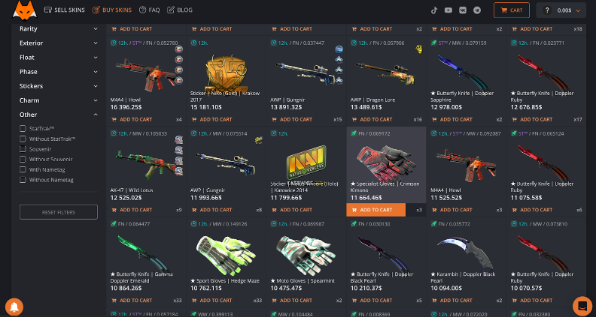
Every experienced CS2 trader has asked the same question: will this skin be worth more or less in three months? The answer used to be pure intuition. Today, it’s increasingly data science. CS2 skin price prediction models have evolved from simple moving averages into sophisticated algorithms that process dozens of variables simultaneously – and understanding how they work gives traders a meaningful edge over those still relying on gut feeling.
Why Price Prediction in CS2 Is Uniquely Complex
Each skin is a unique asset class with variables that don’t exist in traditional markets: float value, pattern index, sticker combinations, and wear tier all affect price independently of supply and demand fundamentals. A Karambit Fade with a full fade pattern trades at a completely different price than an identical Karambit Fade with a partial fade – same item, same wear tier, dramatically different value. This complexity is exactly why knowing the right moment to sell CS2 skins matters as much as knowing what to buy – timing an exit on a high-value item without price data is largely guesswork.
The Data Inputs That Drive Accurate Predictions
A reliable CS2 skin value forecast starts with the right data. The most sophisticated prediction models currently in use aggregate inputs from multiple categories:
Market data inputs:
- Steam Community Market price history (up to 365 days of daily OHLC data per item)
- Cross-platform price differentials between Steam, Asian markets, and Western third-party platforms
- Sales volume and liquidity metrics – how many units trade per day at what price points
- Bid-ask spread width as a proxy for market confidence
Item-specific inputs:
- Float value distribution across all listed copies of a skin
- Pattern index rarity for applicable items (Case Hardened, Fade, Marble Fade)
- Sticker presence and sticker combination value premiums
- StatTrak vs non-StatTrak price differential trends
External signal inputs:
- CS2 player count data from Steam Charts
- Tournament calendar – upcoming majors, operation announcements, case releases
- Social signal volume – Reddit mention frequency, streaming clip virality
- Valve update patch notes – balance changes affecting specific weapons
How the Algorithm Actually Works
Most production-grade CS2 skin price algorithm systems use a hybrid modeling approach that combines multiple techniques:
| Model Type | What It Does | Best For |
| ARIMA / Time Series | Identifies price trends and seasonal patterns in historical data | Stable, high-volume commodity skins |
| Random Forest | Processes multiple variables simultaneously, handles non-linear relationships | Mid-tier skins with complex pricing factors |
| Gradient Boosting (XGBoost) | High-accuracy predictions on structured tabular data | Cross-platform price arbitrage detection |
| LSTM Neural Network | Learns sequential patterns in time-series data over long windows | Long-term price trajectory forecasting |
| Sentiment Analysis NLP | Processes text signals from Reddit, Twitter, and community forums | Event-driven price spike prediction |
| Ensemble Model | Combines outputs from multiple models with weighted averaging | General-purpose prediction with highest accuracy |
No single model type outperforms the others across all skin categories. The most accurate systems use ensemble approaches – running multiple models in parallel and weighting their outputs based on which model has historically performed best for that specific item type.
For commodity skins with high daily volume (AK-47 Redline, M4A4 Howl, AWP Asiimov), time-series models perform well because there’s sufficient price history to identify reliable patterns. For rare items with low liquidity – knives, gloves, souvenir packages – machine learning models that incorporate external signals tend to outperform pure price-history approaches.
Predicting CS2 Skin Prices: Where Models Excel
The most reliable use cases for predict CS2 skin prices algorithms are:
- Post-operation price decay – when a new operation releases, skins from that operation flood the market and prices drop predictably over 2–6 weeks before stabilizing. Models trained on previous operation cycles can forecast the bottom with reasonable accuracy.
- Pre-major sticker appreciation – tournament sticker capsules consistently appreciate after the event ends and capsules go out of rotation. Historical data from PGL, BLAST, and ESL majors shows appreciation curves that are remarkably consistent across events.
- Seasonal Steam sale dips – Steam Summer and Winter Sales create predictable liquidation pressure as players convert inventory to wallet credit. Models identify the typical dip magnitude and recovery timeline.
- Case discontinuation premiums – when Valve removes a case from active drop rotation, the contained skins typically appreciate 15–40% within 90 days. This pattern is consistent enough to be modeled with high confidence.
- Float value premium detection – models that incorporate CSFloat API data can identify when a specific float range is underpriced relative to its historical premium, flagging arbitrage opportunities in real time.
Buy CS2 Skins For Best Prices at LIS-SKINS
Understanding CS2 skin price prediction is most valuable when you have a platform that lets you act on that information immediately. LIS-SKINS is built precisely for that kind of time-sensitive execution.
When a prediction model signals that a skin is approaching its price ceiling – or that a post-operation decay is bottoming out – the window to act is often short. That applies equally whether you’re looking to buy CS2 skins at a predicted low or exit a position at a forecasted peak. LIS-SKINS operates with automated trade bots that execute transactions the moment a user confirms, with no peer-to-peer waiting period. For traders who have done the analytical work to identify the right moment to sell, that execution speed directly translates into better outcomes.
The platform’s transparent pricing – where you see the exact payout before confirming, with no hidden fees – also makes it easier to compare the offered price against your prediction model’s estimated fair value. If the platform price aligns with your model’s target exit point, you can confirm and move on. If it doesn’t, you wait. That kind of data-driven decision framework is exactly how sophisticated traders use prediction models in practice.
Where Prediction Models Still Fall Short
No CS2 market price model predicts black swan events reliably. These include:
- Sudden Valve policy changes affecting trading, such as the 2023 restrictions on skin gambling API access
- Viral moments – a pro player using a specific skin in a famous clutch clip can spike demand within hours in ways no model anticipates
- Major game updates that fundamentally change weapon meta, affecting demand for weapon-specific skins
- External market shocks – crypto volatility affecting the purchasing power of the buyer base
- Community controversies that damage platform trust and reduce overall market liquidity
Editor’s Note: The opinions expressed here by the authors are their own, not those of impakter.com — In the Cover Photo: CS2 Skin Price Cover Photo Credit: freepik