Yes, venerable health institutions make mistakes…The COVID-19 pandemic has exposed vulnerabilities in health institutions that traditionally are looked to for hard information and guidance.
The public clamor for facts, answers to complex questions and solutions has accelerated to an unprecedented level. Public health institutions and professional journals have been pressed to satisfy this appetite, often well beyond their comfort levels or available budgets. While the public is right in seeking perfection, it should be willing to tolerate imperfection so long as institutions are faithful to the Cub Scouts’ motto, “Do Your Best”.
Two global pillars of the health community – the health institutions with the longest record and broadest international reach – have been shown to have clay feet in dealing with the crisis: the World Health Organization and The Lancet.
The Case of WHO
The World Health Organization (WHO), formally founded in 1948 with many antecedent organizations in existence over 100 years ago, is responsible for international public health. It has lately made missteps, the latest being its flip flop on whether asymptomatic COVID-19 individuals are or are not likely to transmit the disease.
Under ordinary circumstances WHO’s modus operandi is to identify a health issue, gather evidence, hold expert conferences with discussants, and produce papers peer-reviewed and critiqued over time, and then issue a statement, which itself is often qualified.
The current pandemic is anything but ordinary, and the pressure by the global commons for press conferences pushed this institution well beyond its comfort zone. So it had to take back its earlier pronouncement.
Corrective action taken, which is good.
The Case of The Lancet
The Lancet is a case of a 200-year-old source of reliable information on a host of medical issues. It is unquestionably one of the world’s most respected medical journals. Since its first issue in 1823, it has sought to make medical science widely available.
With COVID-19 cases rapidly rising, President Trump’s “What do you have to lose?” promotion of hydroxychloroquine was widely heard and seen by many in the U.S. and abroad as a signal to use the drug as a preventive measure.
The Lancet saw this as a global health issue and published the results of a study that concluded that COVID-19 patients treated with hydroxychloroquine equine showed no benefit and even increased the likelihood of patients dying in hospital.
Lancet leadership could not verify the results and therefore decided to issue a retraction – an example of extra caution in not promulgating a mistaken therapeutic.
Corrective action taken, which is good. Up to a point, of course. Ironically, On June 15, 2020, the U.S. Food and Drug Administration withdrew its emergency use authorization for hydroxychloroquine as “unlikely to be effective”.
American Health Institutions Make Mistakes Too
The United States has its share of institutions that recently failed to live up to expectations.
Here are three: Institute for Health Metrics and Evaluation (IHME), the Centers for Disease Control and Prevention (CDC), the National Institutes of Health (NIH).
The Case of IHME
IHME is a research center at the University of Washington established in 2007, providing health statistics and impact evaluations. It became the go-to expert for estimates of human morbidity and mortality, frequently referenced by the U.S. Government and many others.
Early COVID-19 mortality projections made by IHME were cited by the President’s Coronavirus Task Force as their reference point, assuring the public the virus was not as bad as many others predicted. Thus, in early April 2020, the total death toll in the United States through August 2020, was projected by IHME to be 60,415, forecasting death declining rapidly after a peak. It did acknowledge the range could be between 31,221 and 126,703.
It is important to keep in mind that deficiencies are inherent in modeling. The ability to change assumptions and adjust to new realities/information is the very point of a good modeling effort.
Thus, IHME subsequently revised its model so that as of June 15, 2020, IHME projections are that the United States would have 201,129 COVID-19 deaths by October 1, 2020. An increase attributable to premature relaxation of restrictions and increased mobility.
Ongoing corrective modeling projections taken and being undertaken, all to the good.
The Case of the CDC
The U.S. Centers for Disease Control and Prevention (CDC), founded in 1946 to fight malaria in Southern states, was in the vanguard in the fight against infectious diseases throughout the nation and the world. It was the competence “gold standard” other countries looked to and sought to emulate because it provided reliable information and guidance for surveillance, detection, and response to public health risks for Americans—and in many places around the world.
With the unfolding of the COVID-19 outbreak it became apparent to many experts that extensive testing was urgently needed to be able to understand the spread and contain the epidemic.
CDC chose to delay, then produced and backed a flawed test kit, despite effective versions commercially available produced elsewhere. From February 8, 2020, in the 21 days that followed, Trump Administration officials continued to rely on the flawed CDC test kit.
To its credit, subsequently and with CDC encouragement and resources, U.S. health manufacturers produced vast numbers of test options which have translated into significantly expanded Covid 19 Testing across the United States.
Corrective action taken. With respect to more and better tests, more work needed.
The Case of NIH
The National Institutes of Health (NIH), originally the “Hygenic Laboratory” established in 1887, is now a conglomeration of various Institute sub-bodies each of which has its assignment to focus with laser-like intensity on major known and unknown diseases and health risks.
NIH has a cadre of health experts and a budget unmatched by any other public health complex in the world. Among them is the National Institute of Allergy and Infectious Diseases (NIAID) headed by the enormously respected Dr. Anthony Fauci.
In May 2020, the Trump Administration announced, “Operation Warp Speed”, an interagency effort that includes the NIH. Its goal is to have an effective COVID-19 vaccine in the US market by 2021.
Operation Warp Speed has already named five vaccine candidates as ones most likely to produce a viable vaccine in the announced timeframe—this means some of the customary safety time period needed to be certain a vaccine has durable efficacy, will not be a part of the process.
The chosen vaccine will be mass-produced based on preliminary evidence thereby allowing much faster distribution and ostensibly on the basis of clinical trials that confirm the vaccine is safe and effective.
In the video: Billionaire scientist and businessman Patrick Soon-Shiong explains how he sees Operation Warp Speed; on 27 May, he had announced that an experimental vaccine being developed by two of his companies is on the shortlist of 14 candidates being evaluated by Operation Warp Speed even though so far the Department of Health and Human Services (HHS) has announced financial backing for only five vaccine candidates and reportedly has made no public mention of Soon-Shiong’s vaccine.
NIAID is a partner in this effort but has many other crucial tasks in supporting basic and applied research to better understand, treat, and ultimately prevent infectious, immunologic, and allergic diseases. In part on its longlist is that of emerging diseases, which we know 70% originate in animals, as COVID-19 likely has its source.
Yet there is another NIH institute, namely the National Institute of Environmental Health Sciences (NIEHS), which has an explicit unit mandated to address waterborne and zoonotic diseases, personifying the One Health concept.
There is a clear need to review and ramp up NIH efforts in looking at human-animal-environmental health interactions, undertake in-depth comprehensive research to better understand how they relate. And this can be achieved either expanding NIEHS or NIAID. Corrective actions may be needed with the vaccine and assuredly with respect to attention to zoonotic.
The point of all this is not that there have been mistakes and failures, or gaps in priorities. Rather, it is we need not lose respect for or rely less on these institutions going forward, recognizing that health and health science is not infallible. And, that when the public pressures institutions to “get ahead of their skis”, so to speak, there will be more mistakes than usual.
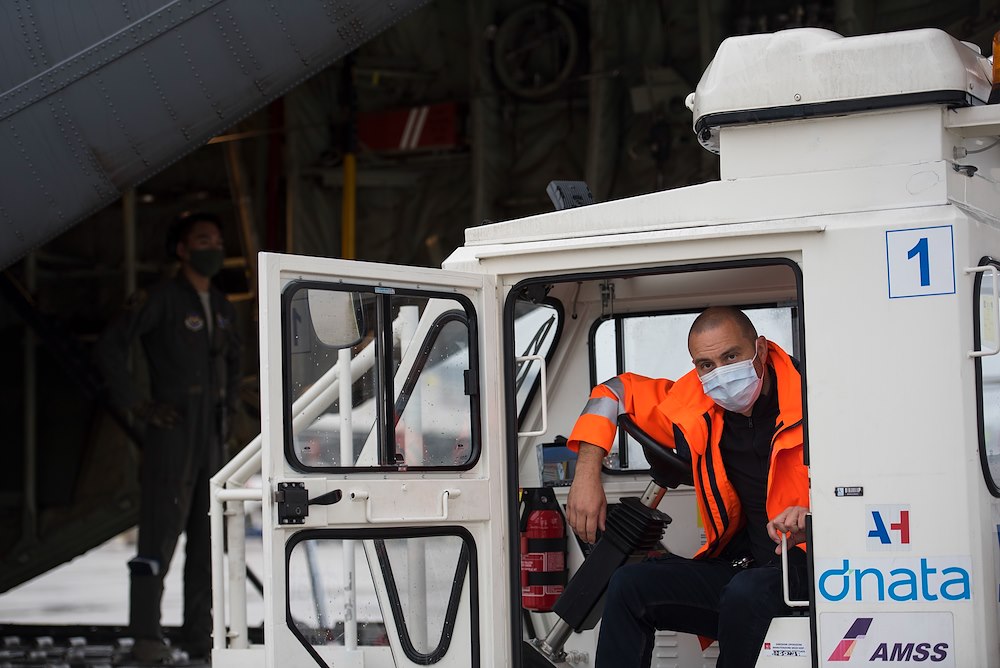
Editor’s Note: The opinions expressed here by Impakter.com columnists are their own, not those of Impakter.com. —In the Featured Photo: Airlift out of Ramstein Air Base, Germany to assist the Italian government in transporting medical and other relief supplies, including KN-95 masks, surgical gowns and COVID-19 test kits, between supply hubs in Milan and Rome, Italy, May 13. Source: United States European Command news report.