Updated 19 April 2020. Is there light at the end of the tunnel? It would appear so. As the curve of new coronavirus cases starts flattening here and there, talk of moving out of lockdown has become pervasive across the world and plans to re-open the economy are made. With a few exceptions: Japan and Singapore that, at the time of writing, have seen a resurgence of the virus and are re-instating the shutdown. So is New York State, with Governor Cuomo announcing a lockdown extension to 15 May as the death toll passes 12,000.
Notably, Trump announced yesterday, 16 April, his guidelines for “Opening Up America Again”, calling for caution and deferring to State governors for the actual decision of when to re-open, suggesting some states could reopen immediately. Remarkably, he did not offer Federal government coordination. He merely said states are “encouraged” to coordinate:
The Trump guidelines, marking a major shift from strict stay-at-home orders, foresee three stages:
- a gradual return to work while minimizing non-essential travel;
- allowing gatherings of 50 people and non-essential travel;
- opening up of schools and organized youth activities as well as large venues to operate under “physical distancing protocols” and allowing bars to reopen but with “diminished standing room occupancy” when possible.
The reason for moving out of lockdown as soon as possible is, as Trump put it, the danger of “a sharp rise in drug abuse, alcohol abuse, suicide, heart disease, and many other dimensions of physical and mental wellbeing”.
As opposed to a sharp rise in deaths from coronavirus, but that does not appear to enter in his mental calculations. But it enters in the mental calculations of experts and state governors. They are concerned that a near-term reopening of the economy is threatened by flawed tests, scarce PPE supplies and limited access to screening.
The phrase Trump used to defend his position is instructive: “A prolonged lockdown combined with a forced economic depression will inflict an immense and wide-ranging toll on public health.”
Impact of Lockdown on the Global Economy
There is no denying it: the lockdown causes a halt in economic activities. Whether it will cause a lasting “economic depression” in the 1930s-style, lasting a decade or more, remains to be seen. But nobody doubts that the shock will be tremendous, causing an unprecedented economic contraction in 2020.
The Financial Times headlined “The Global Economy to suffer worst blow since the 1930s,” echoing an IMF warning, with “most countries’ economies set to be at least 5% smaller”, even after recovery:
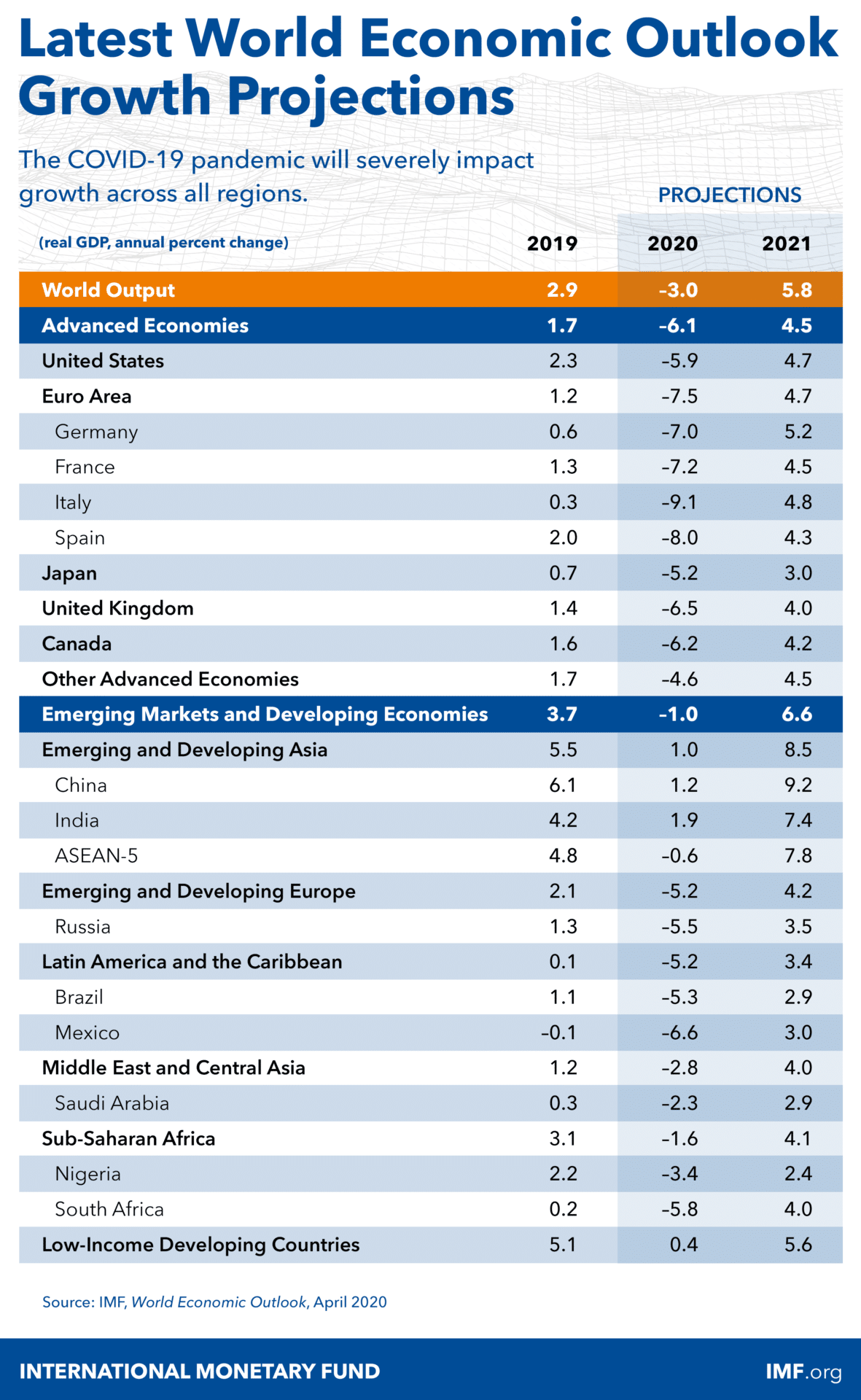
For the U.S. a 5.9% contraction is projected, for the Euro area, much more, a 7.5% contraction. Of all the continents, only Asia comes ahead posting a modest 1 percent, and China 1.2 percent, a far cry from the usual 5 to 6 percent.
Note that not everything is bleak in our future horizon: A substantial recovery is nevertheless projected. A solid 4.5 percent for the U.S. and Europe, more than double what the growth rate was before the pandemic, and, of course, a hefty 9.2% for China – meaning a return to its glory days, far above the struggling 6 to 7 percent of recent years.
But there are pitfalls in re-opening economies too fast, as Singapore is discovering. After receiving world praise for its exceptionally fast and effective handling of the coronavirus outbreak, this city-state of 5.5. million people is now back to square one. Battling the virus.
It is clear that a resurgence could hurt even more than the original outbreak. Costs could skyrocket as more businesses have to shut down and more people die.
The problem is that we still don’t know enough about the coronavirus, how it moves and why mortality rates are so uneven, high here, low there. Although ever stronger evidence is emerging that the rate of mortality is linked to the quality of the air.
More pollution means more deaths. And a return to pre-coronavirus levels of industrial activities means a return of high levels of air pollution. With more deaths.
Bottom line, every political leader in the world, Trump included, is presented with the conundrum: Which will it be, profit over people or people over profit?
Moving out of lockdown: The Example of Wuhan, the original epicenter of the pandemic
Normally, China being the first to fall prey to the virus and the first to get out and back to normalcy should have set an example.
Unfortunately, getting a good grasp of the real public health situation in China is a challenge. For example, only today, as I write, has China finally adjusted its report on the coronavirus death toll: Wuhan officials have just revised the city’s death numbers upwards, by 50%. The problem, of course, is government censorship.
One thing is certain: If Wuhan is an example of how moving out of lockdown will be like, it doesn’t look like a flip of the switch. And China is experiencing a resurgence in deaths (+ 1,290 at the time of writing).
The Example of Germany – A Cautious Re-entry Plan
Germany leads Europe in moving out of lockdown. Perhaps this is not surprising since it was also the country most serious and best prepared to address the emergency. It had the largest hospital/intensive care capacity and was able to carry out the highest number of tests/million of population: over 20,500 ( worldometer coronavirus data). Italy and Spain at 19,000+ are close behind. Surprisingly, both the U.K. and France lag far behind at 6,000+ and 5,000+ respectively (as of 17 April). The U.S. is better off, at 10,000+, but still far behind Germany.
Tests are key to have a comprehensive, reliable picture of how COVID-19 is moving around in the country. And that is the first necessary step before designing a reliable re-entry plan.
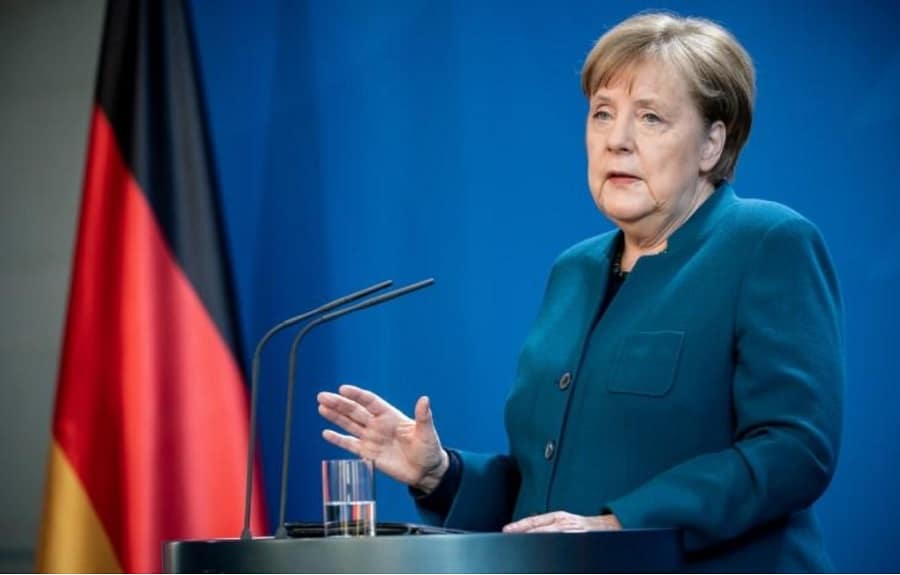
Germany’s Chancellor Angela Merkel’s re-entry plan, announced on Wednesday 15 April, as Germany had 136,616 confirmed coronavirus cases, the third-highest level in Europe, after Italy and Spain.
Ms. Merkel appeared cautious. “We have achieved something,” she said, “something that by no means was a given at the start — namely that our doctors and carers, all those in the medical field, in the hospitals, were not overwhelmed.” But she added: “What we’ve achieved is an interim success — no more, no less. And I stress that it is a fragile interim success.”
For a politician, she has shown an extraordinary level of understanding of what a successful exit from lockdown requires. But then, unlike most political leaders, she has a degree in physics and a doctorate in quantum chemistry. The following video of her explanation of the importance of testing just went viral in Germany and is now moving across the world (here it is, with translation):
The plan is to move gradually and closely monitor developments: “…Every two weeks the government will take stock of infection numbers,” Ms. Merkel said, “to evaluate in real-time the impact of each incremental measure that is lifted — and to avoid the danger of infections picking up pace again. And she concluded, “We need to understand that we need to live with this virus as long as there is no vaccine and no treatment.”
An economic lockdown will remain largely in place for an additional 20 days, and strict social distancing rules will remain in force. But some shops will be allowed to reopen beginning next week, among them, bookstores, bike stores, and car dealers. All schools will stay closed for another three weeks and primary schools and nurseries for longer.
Restaurants and bars will have to wait longer, and large events like soccer matches remain banned until Aug. 31. Religious services won’t resume until places of worship have put in place measures to ensure the required distance between worshipers.
Effective immediately, the German government is also “urgently” recommending the use of face masks in enclosed public spaces like shops and public transport, but didn’t make masks mandatory (as they are in Austria).
The key to success is the testing capacity to accompany the re-entry plan: “If we now allow more public life, in small steps, then it is very important that we can trace infections chains even better,” Merkel said. “That must be our aim: to trace every infection chain.” To that end, she said, Germany’s testing capacities would be increased. The country is currently capable of testing 100,000 people a day, more than any other country in Europe and in the world, U.S. included.
What it takes to successfully move out of lockdown
Earlier, on the same day Germany announced its re-entry plan, the European Commission presented a road map for countries in the 27-country bloc planning their own exit strategies.
Chief among its recommendations is a German-style testing regime that allows for the tracing and quarantining of those who are sick while also slowly allowing those who are not to go back to some activities.
How did this German-style regime develop?
What happened was this: At every stage of the pandemic, Ms. Merkel held widespread consultations with both scientists – a panel of 26 top academics from a range of fields including behavioral psychology and ethics – and political leaders, directly involving Germany’s 16 state governors. This strategy guided lockdown, and it is now guiding moving out of lockdown.
This allowed Germany to come up quickly with a plan that was broadly approved by both the scientific community and the country’s political forces.
Support for Ms. Merkel, whose performance has risen 11 points, stands now at a remarkable level: 79 percent. A level Mr. Trump can only dream about.
To sum up.
As many public health experts agree, it won’t be easy to move toward reopening, but it makes sense. And it will need to be done with extreme care. Even if it is, as in Singapore, people should be prepared for a series of partial reopenings — varying from place to place — that will sometimes be followed by new lockdowns.
This open-lockdown game will have to be continued until a vaccine is found. Best estimates are that even if a vaccine is soon found, it will be some 18 months away before it is available for all. Alternatively, and perhaps faster to develop, a cure is found using presently available off-the-shelf medicines.
An additional complication, requiring us to be extra careful, is that, as health experts have repeatedly cautioned, figures for coronavirus-related deaths are likely inaccurate. People who were never tested for the virus die at home or in nursing homes.
That is why the number of tests per million of population is a relatively good indicator of how reliable official figures really are and how confident one can be about re-entry plans. By that criteria, Germany comes on top, closely followed by Italy and Spain, while the rest of Europe and the world is way behind – as is the United States.
Featured Image: German chancellor Angela Merkel went into quarantine on Sunday after coming into contact with a coronavirus-infected doctor shortly after announcing more curbs on social interaction to slow the spread of the disease (22 March) Source: Reuters