The new coronavirus started in China last year and after three months of suffering, the Chinese have managed to finally bring it under control. Now China is again looking outside and turning into a leader in the global response to the new coronavirus. In contrast to the United States which, far from being a leader, has largely ceded that role to China.
This pandemic is reshaping the geopolitics of globalization, leaving the United States behind.
As two political scientists, Henry Farrell, from George Washington University and Abraham Newman from Georgetown University, wrote in Foreign Affairs, “the lesson of the new coronavirus is not that globalization failed. The lesson is that globalization is fragile, despite or even because of its benefits.”
How the Coronavirus Revealed the Fragility of Globalization
Globalization is fragile because it is based on a complex system of economic interdependence between nations. Global supply chains linking companies together have turned into “a tangled web of production networks”, to use Farrell’s and Norman’s striking formulation. A web that weaves the world economy together as long as no exogenous shock pushes it out of balance.
Precisely what COVID-19 did.
COVID-19 first disrupted global supply chains that depended on Chinese inputs. Notably the break in supply to Apple that gets its products such as the iPhone and iPad assembled by China-based Foxconn, the world’s largest contract electronics maker. On March 5, Foxconn reported its biggest year-over-year revenue drop since 2013, falling from approximately $8.87 billion to $7.26 billion. That’s over 18% decrease from last year.
Now COVID-19 is disrupting supply chains in Europe. In particular, there are worrisome shortages in sectors producing essential medical supplies such as reagents, a key component of the test kits that laboratories use to detect viral RNA. This obviously hinders the fight against the new coronavirus and unleashes a vicious race among countries to obtain those crucial chemicals.
Reagents for test kits are mainly produced by two companies: the Dutch company Qiagen (recently purchased by the U.S. giant Thermo Fisher Scientific) and Roche laboratories, based in Switzerland. Both, faced with a massive surge in demand for their products, are experiencing critical shortages. As a result, the production of test kits in the United States is dangerously delayed. As of March 18, it was reported that shortages of swabs and face masks are the latest obstacles the US is facing.
The supply crunch in medical masks is now near-universal. It all began with China which has always been the dominant producer here, accounting for half of the world’s supply, even before the COVID-19 pandemic.
Chinese production was increased to meet the crisis but not enough. The Chinese government had to resort to importing both masks and respirators from abroad. This buying spree caused a world shortage that is now hurting the response of other countries to the disease.
When Italy ran short of face masks ten days ago and asked for help from other countries, it was met with either silence or denial from other EU member countries. Not a pretty sight. Europe signally failed to come to the rescue. Russia, Germany, and Turkey prohibited the export of medical masks and respirators. The French government simply seized all available masks.
So much for international solidarity.
The United States in a Dire Predicament
Because of the Trump Administration’s delay in recognizing the seriousness of the emergency, the United States is coming late to the game. There is a national stockpile of masks, but it hasn’t been replenished since 2009, and it is, in any case, too small to meet the expected demand.
Trump’s trade adviser, Peter Navarro, the anti-globalization/America first economist, complained the U.S. is “alone” in dealing with the health crisis and threatened allies, saying that the U.S. needs to “bring home its manufacturing capabilities and supply chains for essential medicines.”
On 15 March, the German newspaper Welt came out with the headline that “Donald Trump reaches for German vaccine company”. It reported Trump is “doing everything possible” to get the German vaccine for Americans. It said there was talk in Berlin that the deal was worth a billion dollars for CureVac, the German company developing the vaccine.
Germans were incensed as word spread that the vaccine would be “only for the USA”. Selling a company with a vital drug was seen as a matter of national security. Paragraph 6 of the Schengen Borders Code was quoted, as it specifically mentions allowing “border controls” in the case of threats to public health.
Eventually, the outburst died down when it was reported that the German billionaire Dietmar Hopp who owns most of CureVac shares, rejected Trump’s offer and indirectly criticized the U.S. president as lacking solidarity:
“Once we, hopefully soon, succeed in developing an effective vaccine against the coronavirus, it should reach, protect and help people not only regionally but in the spirit of solidarity around the world.”
How China is Using the Coronavirus Crisis
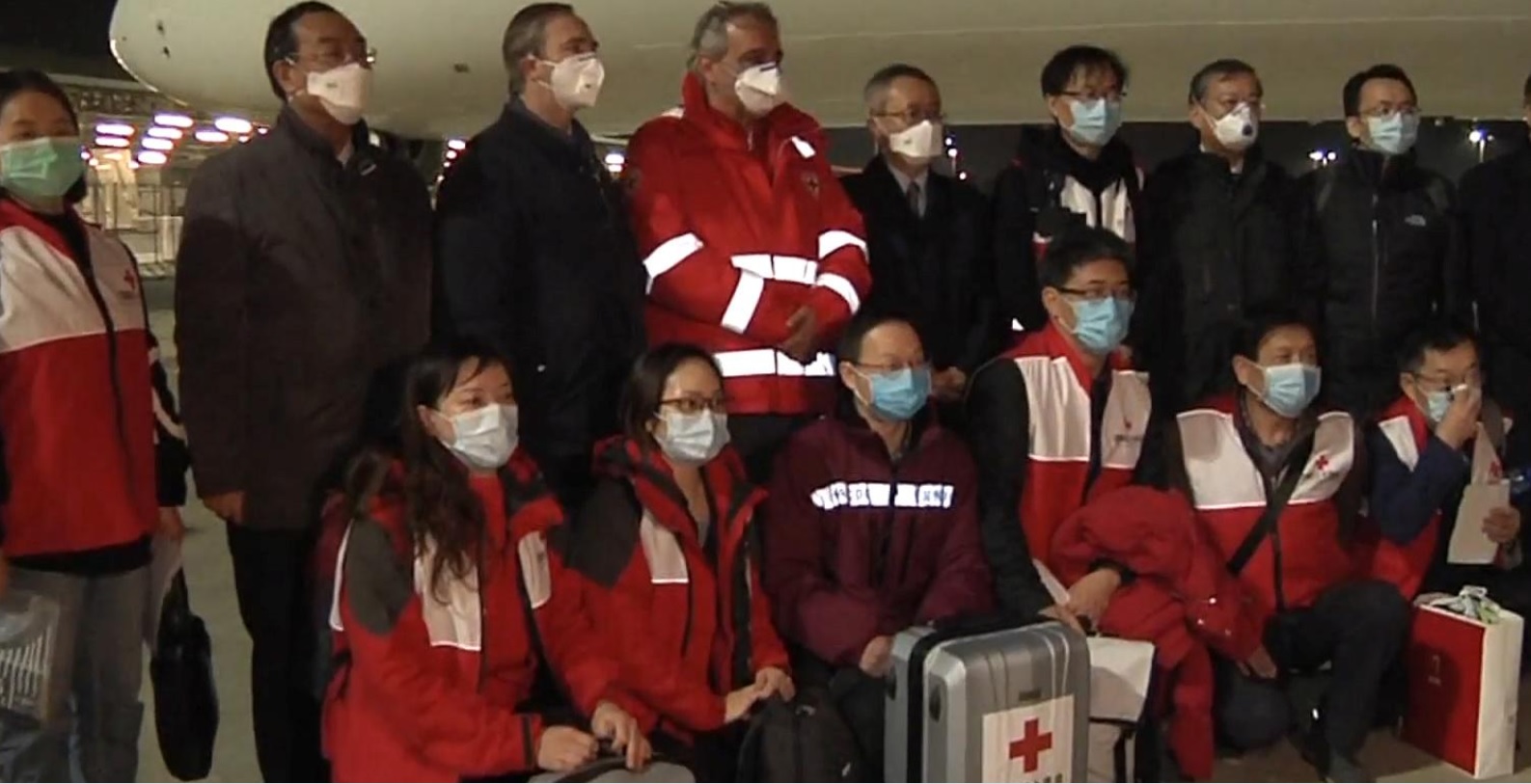
In early March, when Italy asked for help as its doctors, faced with critical medical gear shortages (especially ventilators) had to take exceedingly hard life-or-death decisions, China responded. This was all the more extraordinary as no other European nation came forward.
China offered to sell ventilators, masks, protective suits, and swabs. It is also sending virus experts and making donations to Italy and around the world. With its coronavirus cases dwindling, China is portraying itself as a leader in the fight against the virus. As the New York Times, put it: “Beijing is mounting a humanitarian aid blitz in countries struggling with their own outbreaks. In doing so, it’s stepping into a role the West once dominated.”
This is a problem for Trump in his dealings with China. It used to be a trade competition, now it’s a humanitarian competition and China is winning out.
First, Trump was slow to recognize the danger and respond to the virus. Second, when he finally did, it was too late. Other countries had either stockpiled the needed medical gear or were looking to acquire it and the U.S. had (and has) nothing to offer. By contrast, China did and does.
Trump, as usual, tried to shift the blame and in a tweet, called the new coronavirus, the “Chinese virus”. Thereby immediately earning a rebuke from the Chinese:
As Henry Farrell and Abraham Newman despondently note in their article: “To add insult to injury, the United States may soon find itself receiving Chinese charity: the billionaire co-founder of Alibaba, Jack Ma, has offered to donate 500,000 test kits and one million masks.” And they conclude sadly: “This pandemic is reshaping the geopolitics of globalization, but the United States isn’t adapting. Instead, it’s sick and hiding under the covers.”
It is hard to disagree with them.