Impakter
  • Environment
    • Biodiversity
    • Climate Change
    • Circular Economy
    • Energy
  • FINANCE
    • ESG News
    • Sustainable Finance
    • Business
  • TECH
    • Start-up
    • AI & Machine Learning
    • Green Tech
  • Industry News
    • Entertainment
    • Food and Agriculture
    • Health
    • Politics & Foreign Affairs
    • Philanthropy
    • Science
    • Sport
  • Editorial Series
    • SDGs Series
    • Shape Your Future
    • Sustainable Cities
      • Copenhagen
      • San Francisco
      • Seattle
      • Sydney
  • About us
    • Company
    • Team
    • Global Leaders
    • Partners
    • Write for Impakter
    • Contact Us
    • Privacy Policy
No Result
View All Result
Impakter logo
No Result
View All Result
Columbia University Researchers Use AI to Develop Treatment for Coronavirus

Columbia University Researchers Use AI to Develop Treatment for Coronavirus

Robert Florida - Columbia UniversitybyRobert Florida - Columbia University
March 27, 2020
in Health, Society, Start-up, Tech
0

Columbia University is at the frontier between AI and biotech, especially in coronavirus research. Two graduates of the Data Science Institute (DSI) at Columbia University – Andrew Satz and Brett Averso – are using AI in coronavirus research, relying on computational design to accelerate the discovery of treatments for the coronavirus.

Andrew Satz and Brett Averso are Chief Executive Officer and Chief Technology Officer, respectively, of EVQLV, a startup creating algorithms capable of computationally generating, screening, and optimizing hundreds of millions of therapeutic antibodies. They apply their technology to discover treatments most likely to help those infected by the virus responsible for COVID-19. The machine learning algorithms rapidly screen for therapeutic antibodies with a high probability of success.

Conducting antibody discovery in a laboratory typically takes years; it takes just a week for the algorithms to identify antibodies that can fight against the virus.

Expediting the development of a treatment that could help infected people is critical according to Satz, who is a 2018 DSI alumnus and 2015 graduate of Columbia’s School of General Studies.

“We are reducing the time it takes to identify promising antibody candidates,” says Satz. “Studies show it takes an average of five years and a half-billion dollars to discover and optimize antibodies in a lab. Our algorithms can significantly reduce that time and cost.”

Speeding up the first stage of the process—antibody discovery—goes a long way toward expediting the discovery of a treatment for COVID-19. After EVQLV performs computational antibody discovery and optimization, it sends the promising antibody gene sequences to its laboratory partners.

Laboratory technicians then engineer and test the antibodies, a process that takes a few months thanks to AI, as opposed to several years. Antibodies found to be successful will move onto animal studies and, finally, human studies.

In the picture: Brett Averso and Andrew Satz, CEO and CTO at EVQLV. Photo Credit: EVQLV

Given the international urgency to combat the coronavirus, Satz says it may be possible to have a treatment ready for patients before the end of 2020.

“What our algorithms do is reduce the likelihood of drug-discovery failure in the lab,” he adds. “We fail in the computer as much as possible to reduce the possibility of downstream failure in the laboratory. And that shaves a significant amount of time from laborious and time-consuming work.”

Averso, who is also a 2018 DSI alumnus, says some of the antibodies EVQLV is designing are intended to prevent the coronavirus from attaching to the human body. “The right-shaped antibodies bind to proteins that sit on the surface of human cells and the coronavirus, similar to a lock and key. Such binding can prevent the proliferation of the virus in the human body, potentially limiting the effects of the disease.”

He also noted that the scientific community and the biotech industry are galvanized to forge collaborations that bring about therapeutics, diagnostics, and vaccines as quickly as possible.


RELATED ARTICLES: COVID-19: Link with Air Pollution? Italy’s and China’s Experience |Coronavirus and the Rise of China |Mismanagement of the Coronavirus emergency and the Italian Model |How to Get your workplace ready for Coronavirus – WHO Rules |

EVQLV collaborates with Immunoprecise Antibodies (IPA), a company focused on the discovery of therapeutic antibodies. The collaboration will accelerate the effort to develop therapeutic candidates against COVID-19.

EVQLV will identify and screen hundreds of millions of potential antibody treatments in only a few days—far beyond the capacity of any laboratory. IPA will produce and test the most promising antibody candidates.

Satz and Averso, who met while students at DSI, are deeply committed to using “data for good.” The pair have worked together for several years at the intersection of data science and health care and formed EVQLV in December 2019 to use AI to accelerate the speed at which healing is discovered, developed, and delivered.

The company has already grown to 12 team members with skills ranging from machine learning and molecular biology to software engineering and antibody design, cloud computing, and clinical development.

Both DSI graduates typically put in 100-hour workweeks because they are passionate about and committed to using data science to “help heal those in need.”

“We are building a company that sits at the frontiers of AI and biotech,” Satz says. “We are hard at work accelerating the speed at which healing is discovered and delivered and could not ask for a more fulfilling mission.” 

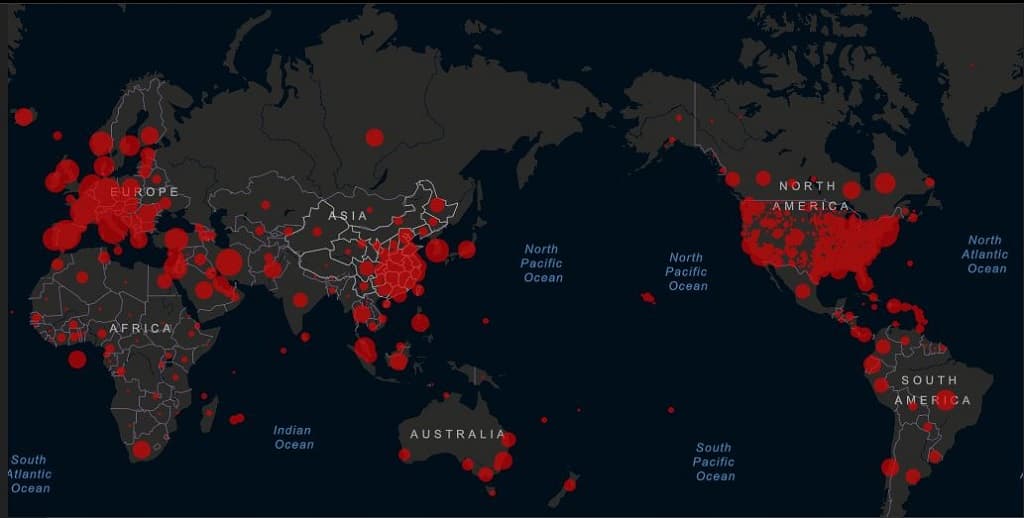
In the picture: The map of Covid-19 spread. Photo Credit: John Hopkins University


EDITOR’S NOTE: The opinions expressed here by Impakter.com columnists are their own, not those of Impakter.com.
Tags: AIColumbia UniversityCoronavirusCOVID-19EVQLVHealthcaremachine learningstartup
Previous Post

The Importance of Connecting People With Nature in Times of Social Isolation

Next Post

Jupe Health Launches Mobile ICU Units

Related Posts

ESG News regarding China restricting industrial renewable exports, UN warning that US climate treaty exit harms economy, UK firms lowering wage forecasts despite inflation, Meta partnering with TerraPower for new nuclear reactors.
Business

To Save the Grid, China Forces Industries to Go Off-Network

Today’s ESG Updates China Limits Grid Exports for New Industrial Solar & Wind: China is encouraging companies to store green...

byRobert Florida - Columbia University
January 9, 2026
Two pharmacist implement inventory management system to improve the workflows in their pharmacies.
Business

Understanding Virtual Verification Workflows in Pharmacies

Pharmacies facilitate the safe dispensing of medications and are an integral part of healthcare. The place of work for virtual...

byRobert Florida - Columbia University
January 9, 2026
Business Growth graph
Business

How to Approach Business Growth with Fewer Risks

Is fast growth always worth the crash that sometimes follows it? Ask any startup founder who scaled too quickly and...

byRobert Florida - Columbia University
January 8, 2026
Is AI Hype in Drug Development About to Turn Into Reality?
AI & MACHINE LEARNING

Is AI Hype in Drug Development About to Turn Into Reality?

The world of drug discovery, long characterised by years of painstaking trial-and-error, is undergoing a seismic transformation. Recent research led...

byRobert Florida - Columbia University
January 7, 2026
AI data centres
AI & MACHINE LEARNING

The Cloud We Live In

How AI data centres affect clean energy and water security As the holiday season begins, many of us are engaging...

byRobert Florida - Columbia University
December 24, 2025
A crowded airport terminal with travelers moving through check-in areas during the holiday season.
AI & MACHINE LEARNING

How AI Is Helping Christmas Run More Smoothly

Christmas this year will look familiar on the surface. Gifts will arrive on time, supermarkets will stay stocked, airports will...

byRobert Florida - Columbia University
December 22, 2025
Can Government Efforts to Regulate AI in the Workplace Make a Difference?
AI & MACHINE LEARNING

Can Government Efforts to Regulate AI in the Workplace Make a Difference?

An overview of AI regulations and laws around the world designed to ensure that the technology benefits individuals and society,...

byRobert Florida - Columbia University
December 18, 2025
How Climate Change Could Help Foster Peace in Yemen
Climate Change

How Climate Change Could Help Foster Peace in Yemen

Yemen's tragedy is traditionally depicted through the limited perspective of humanitarian need and political divisiveness, but there is a greater...

byRobert Florida - Columbia University
December 17, 2025
Next Post
Jupe Health Launches Mobile ICU Units

Jupe Health Launches Mobile ICU Units

Recent News

Diamond Painting Designs

7 Beautiful Diamond Painting Designs You’ll Love Working On 

January 13, 2026
ESG News regarding the DOJ’s investigation into Federal Reserve Chair Jerome Powell, Orsted’s U.S. offshore wind lawsuits, Stegra’s Non-Prime Steel Deal With thyssenkrupp, and Ghana repaid $1.47 of energy debt

US Federal Reserve Chair Under Investigation

January 12, 2026
Steakhouse in Tucson

7 Factors That Define a Premium Steakhouse Experience

January 12, 2026
  • ESG News
  • Sustainable Finance
  • Business

© 2025 Impakter.com owned by Klimado GmbH

No Result
View All Result
  • Environment
    • Biodiversity
    • Climate Change
    • Circular Economy
    • Energy
  • FINANCE
    • ESG News
    • Sustainable Finance
    • Business
  • TECH
    • Start-up
    • AI & Machine Learning
    • Green Tech
  • Industry News
    • Entertainment
    • Food and Agriculture
    • Health
    • Politics & Foreign Affairs
    • Philanthropy
    • Science
    • Sport
  • Editorial Series
    • SDGs Series
    • Shape Your Future
    • Sustainable Cities
      • Copenhagen
      • San Francisco
      • Seattle
      • Sydney
  • About us
    • Company
    • Team
    • Global Leaders
    • Partners
    • Write for Impakter
    • Contact Us
    • Privacy Policy

© 2025 Impakter.com owned by Klimado GmbH