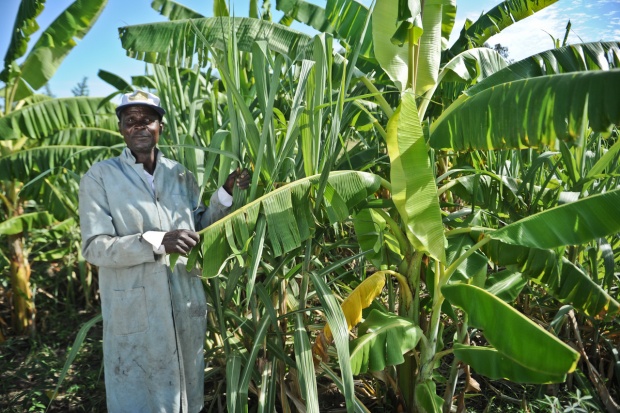
Climate-resilient agribusinesses need a combination of horizontal and vertical scaling to be effective. The example of East Africa.

There are growing private-sector driven efforts to scale up climate-smart agriculture (CSA) interventions in East Africa. These measures are aimed at building climate-resilient farming systems through sustainable intensification across different agroecological zones.
The Climate Resilient Agribusiness for Tomorrow (CRAFT) project is one such initiative. It supports a market-driven scaling agenda through inclusive business models along selected oilseed, pulse and potato agricultural value chains in Kenya, Uganda and Tanzania. The CGIAR Research Program on Climate Change, Agriculture and Food Security (CCAFS) is one of the partners in the CRAFT project that is implemented by SNV Netherlands Development Organization.
Related topics: Developing a more coherent theory of scaling – How to impact climate change adaptation and mitigation – De-risking agricultural value chains
Crops that are included in the initiative are potatoes, green grams, common beans and sorghum in Kenya; soybeans, sesame, sunflower and potato in Uganda; and common beans, sunflower, sorghum and potato in Tanzania.
These crops were selected based on:
- Sufficient private sector interest and capacity for co-investment;
- Adequate domestic consumption to drive market development opportunities;
- Ample evidence of climate change risks projected to impact their value chains; hence the need to develop a climate-resilient strategy.
SNV has co-partnered with several high-potential small and medium enterprises (SMEs) across these value chains. CCAFS is working with SNV to enhance the capacity of SMEs to increase the availability of improved farm inputs, train farmers in CSA production practices and post-harvest management, and deliver climate information services.
Among these SMEs is Equator Seeds Limited (ESL) in Uganda. ESL handles the production, processing, and distribution of improved seeds; provides extension support to out-grower farmers; and operates agricultural equipment hire services. The company will work with SNV to scale up the supply of improved sesame seeds from its current levels of production of about 190 tons per year to 1,000 tons per year. Such seeds will be marketed through agro-dealers to a target population of about 30,000 sesame producers.
Finding the scaling sweet spot for climate-resilient agribusinesses
Reaching large numbers of beneficiaries or clients with a specific technology or practice as described above is how scaling is commonly understood. In the scaling literature, this approach is referred to as horizontal scaling. This type of scaling entails the replication, roll-out or expansion of proven innovations to more people in existing or new markets and contexts.
In the vast majority of agricultural development contexts, however, the adoption and continued use of new innovations by small-scale farmers do not happen in isolation. It requires engaging with various complementary non-technological mechanisms (rules, policies, institutions, etc.) to create an enabling environment for innovations to go to scale.
This process is usually referred to as vertical scaling and focuses on changing or strengthening existing policies and practices by governments, the public, and private institutions.
Successful strategies to scaling tend to combine elements from both horizontal and vertical approaches. This ensures that relevant key actors and multiple levels of governance come together to facilitate the uptake of proven innovations.
An innovation may be “ready” in a technical sense, in that its core components have been successfully tested to meet specific objectives in a specific environment. However, if existing systemic barriers (institutional, structural, policy, etc.) in the intervention context or landscape are not sufficiently understood and adequately addressed, the innovation may fail to go to scale. And the objective of creating climate-resilient agribusinesses is not achieved.
Indeed, CRAFT recognizes the important role that public institutions play in facilitating and implementing climate-resilient agribusinesses, i.e. farming and adaptation to climate change at the national and local levels. Among the project’s core objectives is to support policy efforts to address the most significant institutional and socio-economic barriers for large-scale CSA interventions. Given this, the project’s scaling activities are guided by a private-sector driven agenda that supports business champions to horizontally scale their innovations. To complement this, CRAFT will engage and collaborate with relevant institutions and actors to harness additional support and resources through vertical approaches.
In each implementing context, CRAFT will need to understand well and engage the system dynamics that determine the ‘scalability’ of innovations.
These include incentives, required services, conducive policies and regulations and other relevant characteristics of the sector. For instance, a widespread sale of counterfeit seeds in Uganda’s agricultural sector stifles not only yield potential but farmers’ trust to invest in improved CSA farm inputs. Addressing this problem requires collaborative institutional action to effectively enforce quality standards and regulations in the production, multiplication and distribution of sesame seeds.
Overall, developing effective and realistic scaling strategies demands flexibility in project design and implementation. This allows for the delivery of innovations that answer to local conditions and work within the confines of the wider agricultural systems of a particular context.
About the author: Helena Shilomboleni is a Postdoctoral Fellow and Scaling Specialist at CCAFS East Africa. John Recha is a Climate-Smart Agriculture Policy Scientist and the CRAFT Coordinator at CCAFS East Africa. Jan Ubels is a Senior Strategist at SNV Netherlands Development Organisation. Maren Radeny is the Science Officer at CCAFS East Africa. Dawit Solomon is the Regional Program Leader at CCAFS East Africa.
EDITOR’S NOTE: The opinions expressed here by Impakter.com columnists are their own, not those of Impakter.com. Photo Credit: K. Trautmann (CCAFS)