A new study by energy analysts has found that 2023 marks a new era in electricity production as fossil fuel use peaks.
Subsidies for fossil fuels hit an all-time high in 2022. Yet, according to the Global Electricity Review 2023 by electricity thinktank Ember, greenhouse gas emissions from the power sector, the most prevalent source of atmospheric pollutants, are expected to fall for the first time ever.
This comes as the way we generate electricity is changing – our use of coal saw a minimal increase in 2022 and our use of gas has plateaued, writes Malgorzata Wiatros-Motyka, Senior Electricity Analyst at Ember and author of the report.
Demand for electricity, however, is still growing. But, as the report highlights, energy is at its cleanest point yet with 12% of global electricity in 2022 being produced by solar and wind farms. Clean power production is even likely to exceed the demand in 2023, notes the report. This will be the first time this has happened outside of a recession.
Wiatros-Motyka called this “a decisive decade for the climate” in the report. “A new era of falling fossil emissions means the coal power phasedown will happen, and the end of gas power growth is now within sight,” states Wiatros-Motyka.
The way we produce electricity is transitioning
The G7 meeting this weekend revealed that no G7 country has made sufficient pledges to the United Nations that will curb the 1.5℃ warming of Earth. Clean energy is also expected to be a major talking point at COP28 as the European Union (EU) will call for a major fossil fuel phaseout.
The report cites Russia’s invasion of Ukraine as a significant reason that many countries now want to diversify their energy sources. Among sudden increases in the prices of fossil fuels as well as the security concerns associated with importing oil, coal and gas, there became a reason to develop and use renewables at an accelerated rate.
Rapid increase in wind and solar energy means that cleaner sources, including hydro and nuclear power, now make up for 40% of our energy production. A rise in wind and solar energy is also helping to cover the shortfall left by the transition away from nuclear power and the limitations droughts put on hydroelectric dams.
BREAKING⚡️Power sector emissions may have peaked in 2022, as wind and solar reach a record 12% of global electricity.
Our fourth annual Global Electricity Review presents data from 78 countries, representing 93% of global electricity demand.#GER2023 https://t.co/cOSjMD6YXD pic.twitter.com/EghD5w1qZV
— Ember (@ember_energy) April 11, 2023
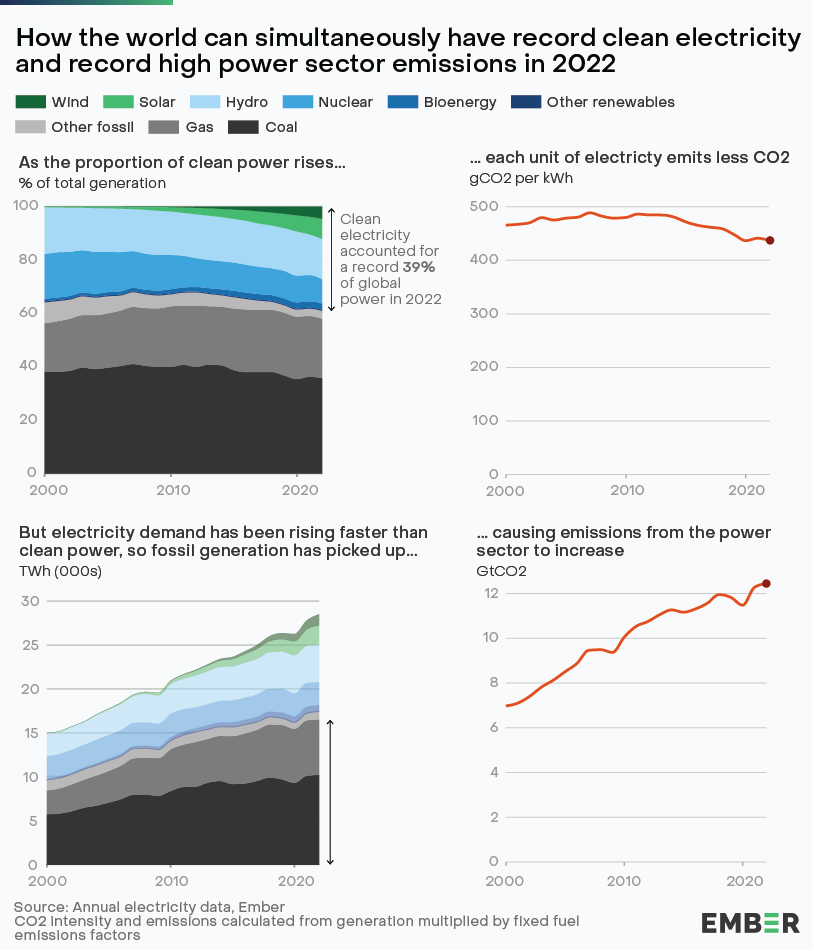
Because we saw a 2.5% increase in global electricity demand, 2022 had both unprecedented levels of greenhouse gas emissions and record growth in wind and solar energy. The reason for this, according to the report, is the use of coal to make up for the shortfall.
“As the proportion of clean power rises, each unit of electricity emits less CO2. But energy demand has been rising faster than clean power so fossil fuel generation has picked up, causing emissions from the power sector to increase,” the report explains in the graph below.
Wiatros-Motyka says the transition is largely dependent on one country: “Whether peaking fossil globally happens in 2023 is largely down to China.”
This is because China is one of the highest polluters in terms of coal power, accounting for 38% of global emissions from electricity generation. Their reliance on coal remains high despite their efforts to implement wind and solar power which account for 14% of their energy production.
Related Articles: Why Canada’s Energy Security Hinges on Renewables, Energy Consumption in the Developing World by 2040: Implications and Goals, Europe’s Energy Crisis: Small-scale Solutions To The Rescue, Solar Em(power)ment is Lighting the Path to Sustainable Development.
Energy in China is six times more in demand than it was 20 years ago and yet China has still been able to decrease their use of coal, which accounted for 78% of electricity in 2000 compared to 61% in 2022. In fact, nearly half of the 26% global growth in wind and solar electricity in 2022 came from China.
To achieve net zero, China will need to get all of its electricity from renewable sources by 2040. For a country that sees yearly CO2 emissions growth of 177 million tonnes each year, this is not an easy challenge.
However, the report remains hopeful as it notes President Xi Jinping’s 2020 announcement that China will aim to peak its CO2 emissions before 2030, remarking that “the rate of solar and wind growth in China is staggering.” In 2022, new solar plants came online for the first time ever, reportedly giving China the capacity to increase solar production by 66%, far exceeding the expected demand.
In the #AEO2023 Reference case, we project an increase in #electricity generating capacity from #renewables of about 380% from 2022 through 2050. #Fossilfuel generating capacity increases about 11% over the same period.
➡️ https://t.co/LwuXOQ71kC https://t.co/GJMiq6wzz7
— EIA (@EIAgov) April 13, 2023
A chance for change
According to the report, clean energy must continue to grow if we are to curb this peak in emissions and ensure that they actually do fall in the coming years, making 2022 the all-time highest in greenhouse gas emissions from the power sector.
Governments are rethinking their dependency on non-renewables as wind and solar power become cheaper and more accessible than fossil fuels due to Russia’s invasion of Ukraine.
There is still more to be done, the report concludes. Reducing the time it takes to get permission to install wind turbines and solar panels and improving grid capacity are still much-needed solutions, as is providing adequate financing in the clean electricity sector.
“Change is coming fast,” writes Wiatros-Motyka, “however, it all depends on the actions taken now by governments, businesses and citizens to put the world on a pathway to clean power by 2040.”
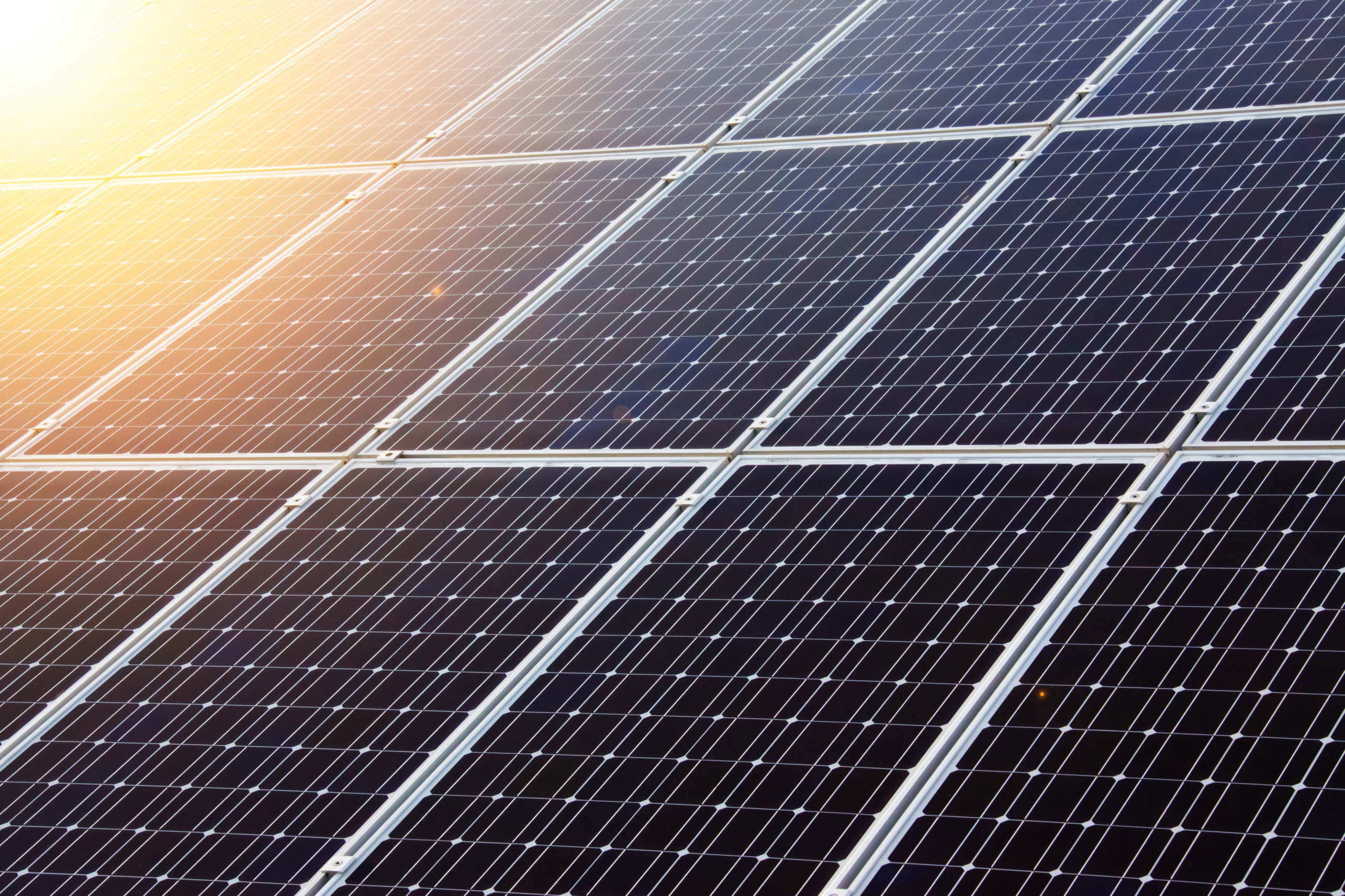
Editor’s Note: The opinions expressed here by the authors are their own, not those of Impakter.com — In the Featured Photo: Solar panels. Featured Photo Credit: Pxhere.