The coffee supply chain is marred by challenges that leave a sour aftertaste. Luckily, within its folds lies the potential for a future steeped in optimism.
Navigating the Coffee Supply Chain and Labour Exploitations
At the start of the supply chain, smallholder farmers frequently bear the brunt of unpredictable coffee prices. According to the International Coffee Organisation, coffee prices fluctuate by over 30% annually, and climate change exacerbates this volatility, leading to uncertain incomes for farmers.
This impact extends beyond their wages, as many farmers resort to monoculture farming to meet consumer demand for coffee. This often results in their plantations being contaminated with harmful pesticides.
It’s worth noting that this isn’t just a few farmers using pesticides to boost their monthly earnings. Since 2019, Brazil has approved 475 new pesticides, over a third of which are not supported in the EU due to their toxicity.
“If we want to enjoy our morning coffee in the future, we’ll need to stop producing it like there is no tomorrow. Pesticides are effective against pests and plant diseases and can provide coffee farmers with a high yield in the short term. But in the long run, you shoot yourself in the foot by destroying ecosystems and health at large,” says Athina Koutouleas, a lead author of a meta-study published in Plant Pathology that reviews research regarding alternative plant protection strategies for coffee.
The coffee supply chain is complicated and often involves human rights abuses such as child labour, unfair working conditions, and inadequate compensation. In Ethiopia, where coffee is a primary export commodity and a significant source of income for millions of people, these issues have persisted for years.
A recent study published in the International Journal of Educational Development found that 90% of households surveyed encouraged their children to pick coffee berries. The COVID-19 pandemic has only exacerbated the situation, with coffee plant buyers placing even more pressure on workers.
In some countries, including Colombia, the government has even lowered the coffee sector’s minimum age for child labour. While it’s easy to blame these policies on the government, it’s important to note that consumer demand for coffee has played a role in perpetuating these issues. When people rush to buy coffee in bulk, they inadvertently support a system that exploits children and workers.
The Supply Chain and the Climate Effects
The use of harmful pesticides to increase crop yield and the expansion of land used for coffee cultivation is damaging our planet. The rise in temperatures beyond the optimal range of 18-22 degrees constantly threatens coffee yields and quality. Alongside this, the spread and intensification of common coffee pests, such as the coffee berry borer, worsen with rising temperatures.
Environmental changes have resulted in discernible shifts in climate patterns in coffee-producing countries. This has caused prolonged dry spells, erratic rainfall, and local water bodies to dry up. The result of this is a sharp decline in coffee production and the disruption of flowering and fruit development.
All of this contributes to a state of uncertainty for the farmers, leaving their futures in an unstable condition.
The temperature increase has also forced coffee producers to switch from shade-grown coffee to sun coffee. Sun coffee requires the clearing of forests due to the erosion of soil and the use of chemical fertilisers.
Over 40% of Colombia, Mexico, Central America, and the Caribbean coffee areas have already converted to this unsustainable method. If this trend continues, affected areas could lose most of their growing regions by 2050 and experience critically low yield levels by 2060.
RELATED ARTICLES: The Cocoa Supply Chain: Looking Beyond the Chocolate Bar | How Investing in Young People Sets Coffee Businesses Up for Long-term Success
Initiatives Brewing Change
Amid the complexities of the coffee industry, some companies are stepping up to make a tangible difference.
The Specialty Coffee Association (SCA), the largest coffee membership group in the world, is leading the way in promoting sustainability. Through its dedication to improving coffee for everyone, the SCA recognises that sustainability is an ongoing journey, not a fixed destination. This approach acknowledges the constantly changing nature of the industry and the need to adapt growing and sourcing practices to meet the challenges of climate change.
As the SCA puts it, “Our goal is not sustainability, but the continuous creation of pathways to improve coffee for all.”
Caravela is another company that is taking on the challenge of making coffee better for everyone involved.
Their vision is centred around smallholder farmers who produce high-quality coffees but are often not fairly compensated. To address this, Caravela has chosen to work primarily with smallholder farmers in Latin America, currently partnering with 400 farmers within its network.
“We have chosen to work primarily with smallholder farmers, as these farmers tend to consistently produce some of the best coffees available but traditionally had to sell their coffee to intermediaries or coyotes, never being able to earn full value for their coffees.” Caravela Coffee
Their approach ensures full transparency and traceability for roaster planters, promoting fairness and accountability in the supply chain. Caravela ensures fair payment for every grower by controlling the supply chain and paying due respect to the land.
Caravela’s efforts demonstrate that companies that source the beans can adopt specialty coffee to promote fairness and accountability.
Recently, Caravela Coffee’s Krisztina Szalai became the Chair of The British Coffee Association. This marks a step towards opening up a conversation that encourages the industry to become more circular.
Nurturing Nature in a Cup
With the rise in specialty coffee production, we must also recognise old-age methods such as agroforestry. Such methods can play a significant role in biodiversity conservation and shaping a circular supply chain in the future.
Last year, Ivette Perfecto of the U-M School for Environment and Sustainability(SEAS) presented a forward-thinking lecture titled “Biodiversity, Coffee Production and Dignified Livelihoods Under a Globalised Economy.”
Within it, she highlighted the intersection of biodiversity conservation with agriculture on coffee farms.
“Shaded coffee farms are important for biodiversity. They represent a high-quality matrix through which wildlife can move and provide habitat for a wide-range of biodiversity.” These coffee farms thus create a refuge of biodiversity” Ivette Perfecto addressing the importance of shaded coffee landscapes in promoting biodiversity
This holds true as long as the international coffee industry respects such spaces and diverse farming methods.
Luckily, we can already see positive changes taking place in the industry. One noteworthy example is Cacao Oro, a company in Nicaragua.
They rehabilitate land and work with indigenous communities through cocoa and coffee agroforestry. The company’s foundation in 2014 was a response to the land degradation effects of coffee and cocoa production in the North Caribbean Coast Autonomous Region(RACCN). Since then, the company has expanded to become a producer of coffee that is 100% slave-free while rehabilitating degraded land.
Their business model involves a large-scale UTZ-certified cocoa and coffee production that fosters a sustainable supply chain. The company operates under the internationally recognised sustainability standards of the Rainforest Alliance. Their efforts have already resulted in planting more than 250,000 hardwood trees since they established agroforestry ecosystems in Nicaragua.
Currently, the company employs over 285 full-time employees who live in farm housing. At the same time, seasonal employment supports workers and their families throughout the area. A team of agronomists and sustainability experts with experience in sustainable coffee cultivation supports this holistic approach.
A Brewing Commitment
Despite numerous environmental and labour challenges, the coffee supply chain can be completely sustainable and circular. The emergence of specialty coffee and the implementation of biodiversity frameworks are already redefining the industry.
As we enjoy our coffee, we should remember the stories behind each cup.
However, just like in all matters related to sustainability efforts, we need to accomplish much work before we can celebrate. The recent launch of FairVoice by Fairtrade, and the European ban on deforestation-linked goods represent tentative steps in the right direction.
What is required now are global efforts, not ones confined to specific regions.
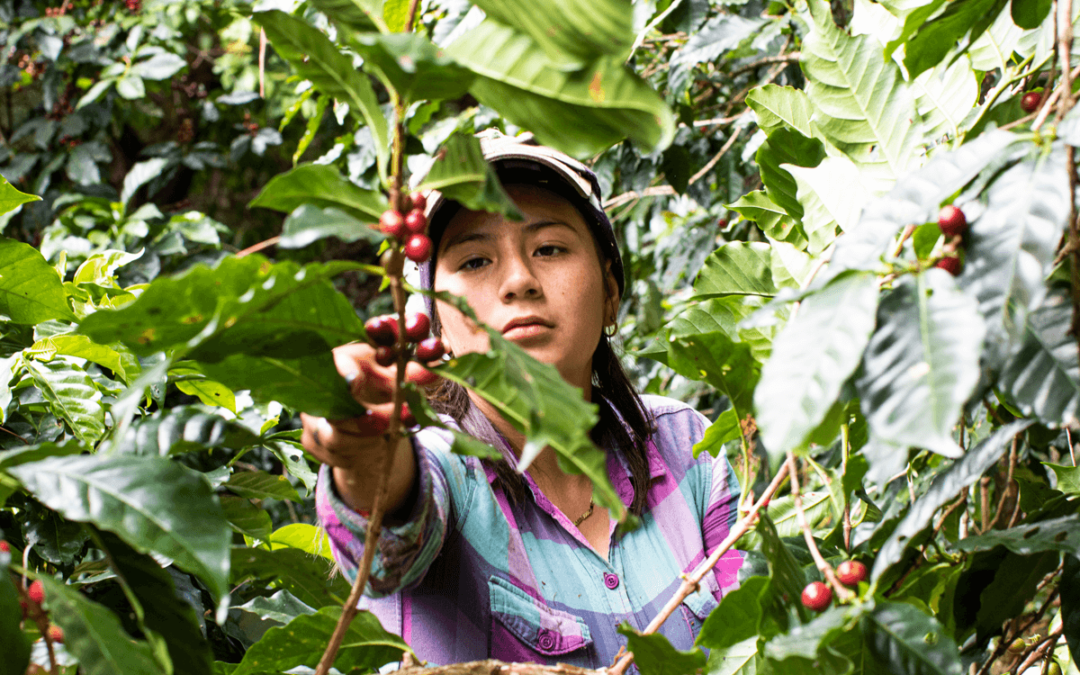
Editor’s Note: The opinions expressed here by the authors are their own, not those of Impakter.com — In the Featured Photo: Farm Worker Picking Coffee Berry. Featured Photo Credit: Caravela Coffee