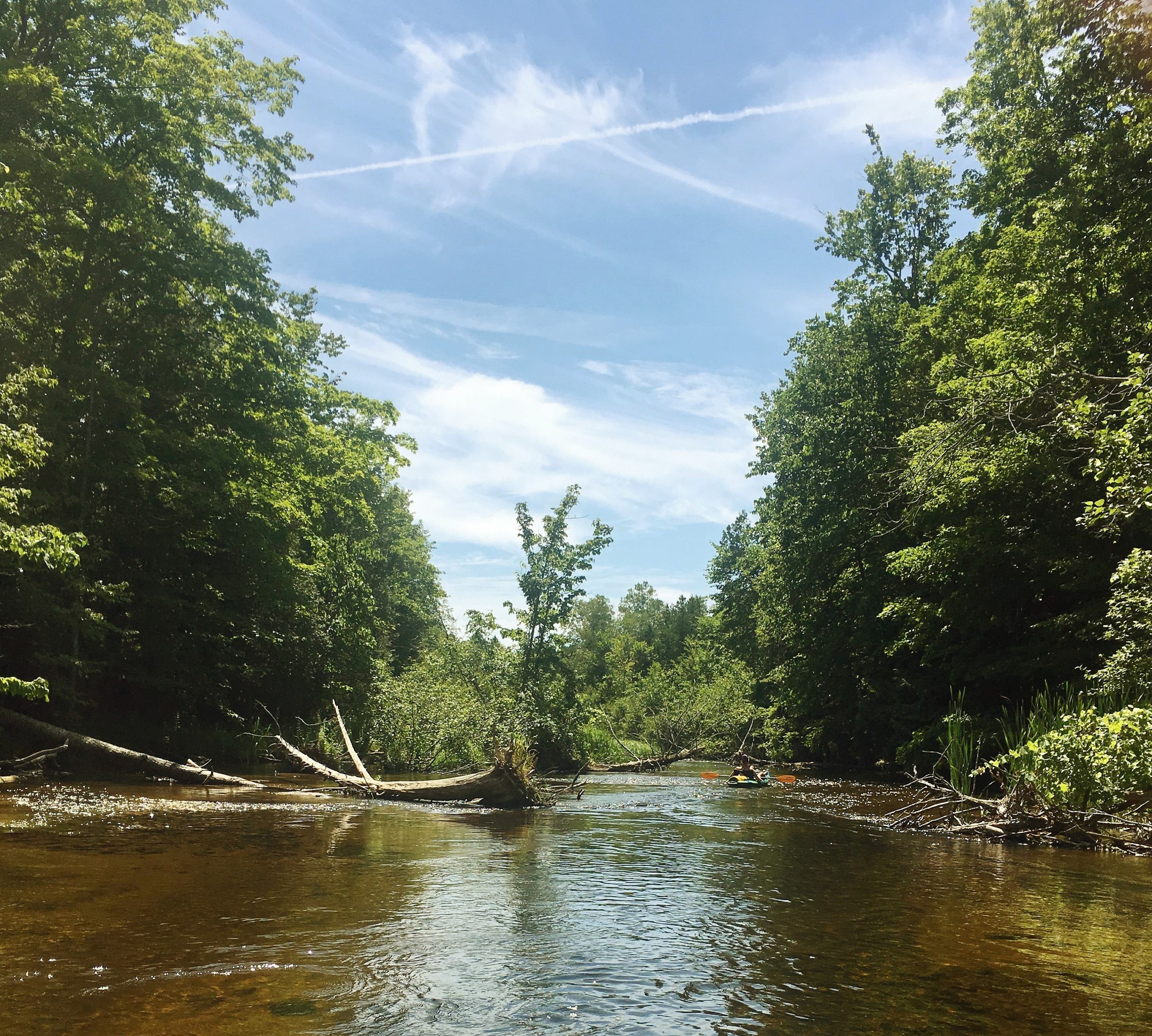
I never had a visitor to my river cabin who left the same person who arrived. Whatever their delight – painting, basket-making, birdwatching, swimming, canoeing, fishing, reading, kayaking, or just plain sitting and staring – something about the Betsie changes everyone who spends time along its banks.
The Betsie River runs for 55 miles from its source in Green Lake to its mouth in Frankfort, a Northern Lake Michigan port.
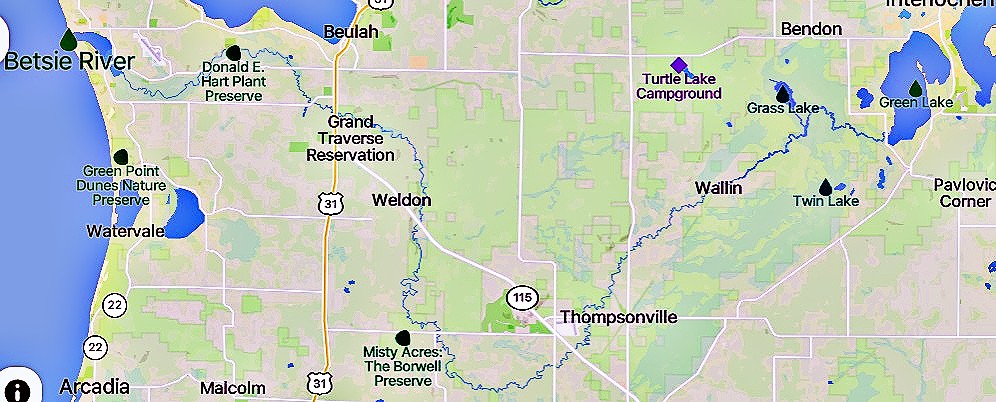
It is a narrow river of sunlit vistas alternating with shady banks, full of birds and frogs and fishes and turtles and people like me who find solace in its meandering course. It is a fisherman’s delight, teeming with Rainbow, Brown, Brook and Steelhead Trout along with Pickerel, Pike, Muskellunge and a stunning summer surge of Salmon.
The river runs free and clear because it is protected under the Natural Wild and Scenic Rivers Act of 1973. With the nearby Boardman and Jordan Rivers also under the act, and the Conservation Resource Alliance (CRA) stewarding even more of our local rivers – our Northern Michigan Watersheds are a wonder of pure water and biodiversity.
The CRA is a non-governmental project supported by a varied group of stakeholders, including businesses like Consumers Energy and sport fishing associations like Trout Unlimited, and the Ottawa and Chippewa tribes, all maintaining the riverine health of our watershed ecology under a River Care program.
My husband Henry and I bought our A-frame Cabin in 1992. We enjoyed our summers there before, alas, he died eight years later, never to know all four grandsons who would caper along its banks, their spirits flourishing from long summer days musing over snails and spiders, butterflies and crayfish, mink and muskrats.
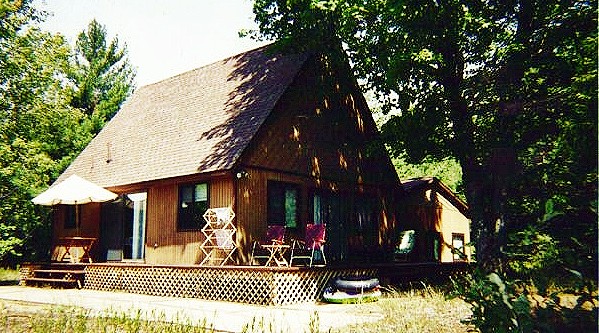
Two of our grandsons, in their twenties now, have kayaked the entire length of the Betsie; lately, a family dog has joined us, with his own door so that he can romp down to the river any time for exuberant swims and sniffs and forest excursions.
There is a kind of assertive forcefulness about the Betsie that gets into the creatures that live here.
When we arrived, we had a determined clan of dam-building beavers who, when the Department of Natural Resources “removed” them so that their deftly engineered constructions would not cause flooding, turned themselves into bank beavers instead, denning underground, building river entrances, and going right on felling whole swathes of trees for winter fodder.
There is also a tribe of river mink that have little fear of humans, scampering much too close to our bare feet for comfort. One summer when the grandchildren were just toddlers, we were haunted by a puma screaming at its slaughter among our deer yards.
Then there are the Robins: These are not your little hop-and-peck backyard friends – Betsie River robins have attitude!
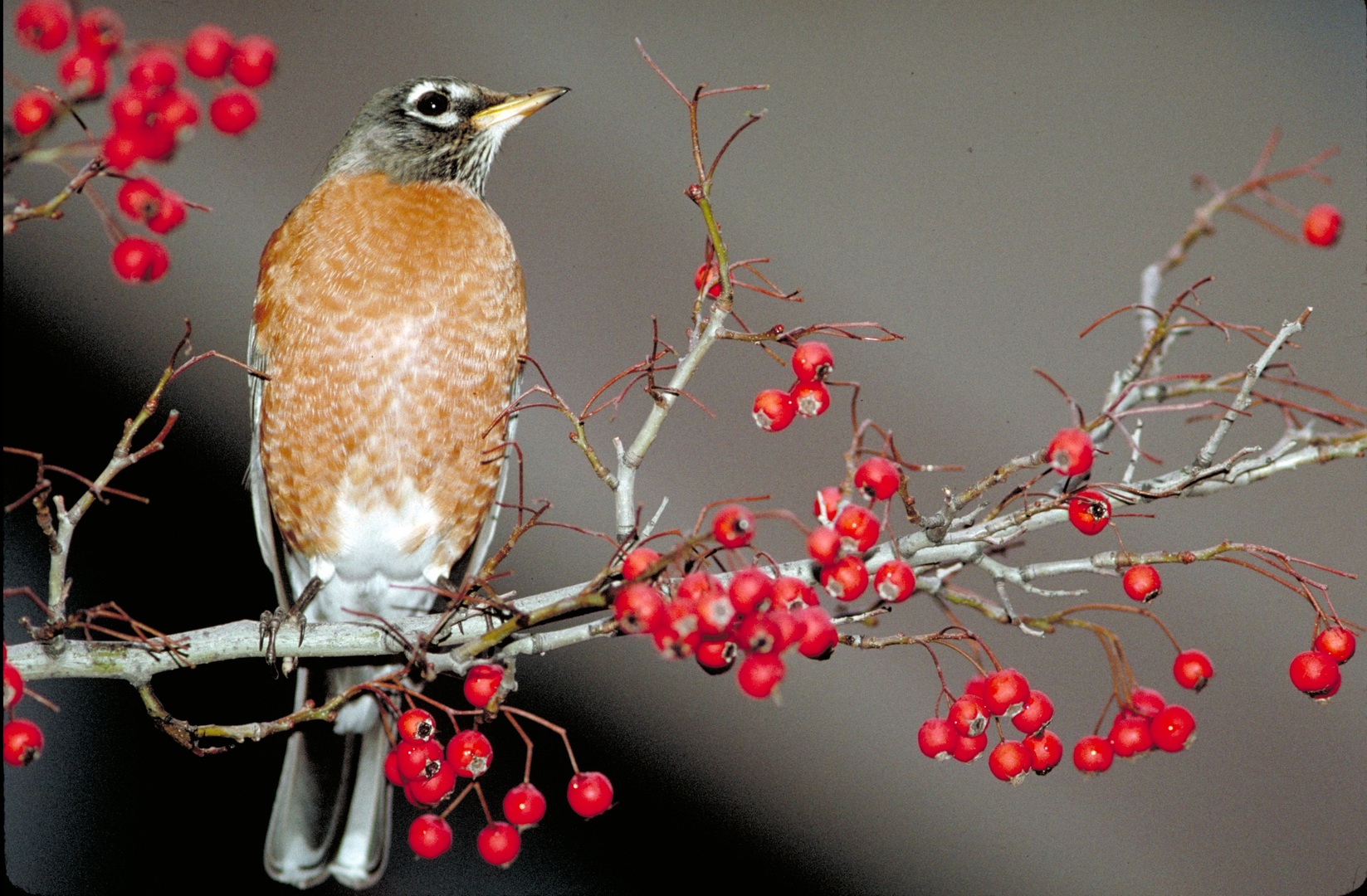
During the breeding season, they streak in and out of their nest trees. If you go anywhere near, they attack from above, like Red-winged blackbirds. They sing in the summer mornings, but these are different songs than their downstate numbers – no mere warbling, but deeply resonant and assertive arias counterpointed against anything local Orioles and Rose-breasted Grosbeaks can come up with.
From midsummer on, gangs of robins rampage along the river, doing the kinds of things you associate with bigger, tougher birds. When there is a hatch of flies, they decide to be Great Crested Flycatchers, soaring on the updraft and swooping down on their prey. Sometimes, they transform themselves into Kingfishers and dive straight down, veer at the very last moment, then soar to a high branch, where they munch their catch and scream like Kingbirds.
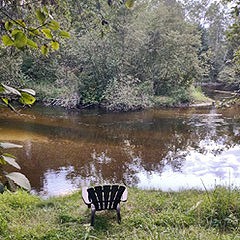 I have been a lifelong birdwatcher, but by the Betsie, my bird lists have given way to a kind of wild-eyed feeling that I have died and gone to heaven. Just being by the river rivets my soul: I become less of a nature observer than a nature contemplative as I lay my binoculars aside to just sit and stare.
One of the things I stare at, whether walking along the banks or drifting in my kayak, is the river bottom, where the clarity of the water renders everything translucent as if seen through a watery but precise microscope: the freckle on the trout’s fin, the stripes on the smolt and the transparent minnows’ inner organs, the geometry of the wood turtle’s shell as it plows along the pebbles, the pebbles themselves in all their tawny variety, and up spouts of bubbles bursting from underground springs.
I take it all in, my mouth open and the agitation of my life replaced by awe at the utter calm rendered by nature’s multiple and minute particulars.
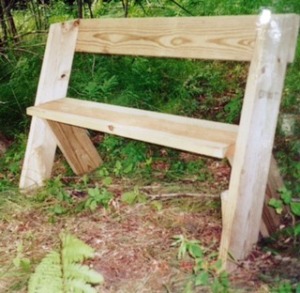 Years ago, I admired a bench some friends had built near their cottage, and they gave me the plans. It turned out to be a meditation bench designed by Aldo Leopold, an American scientist and philosopher, professor at Wisconsin University and author of A Sand County Almanac (1949). The bench holds your back at just the right angle – not straight up or lolling – perfect for sitting and staring.
I hired a carpenter to build mine between two trees along the river bank, at a spot where it is shady even at noontime, and there I go to lose myself in the flourishing banks, a muddy little beach across the way, and whatever catches my wondering eye.
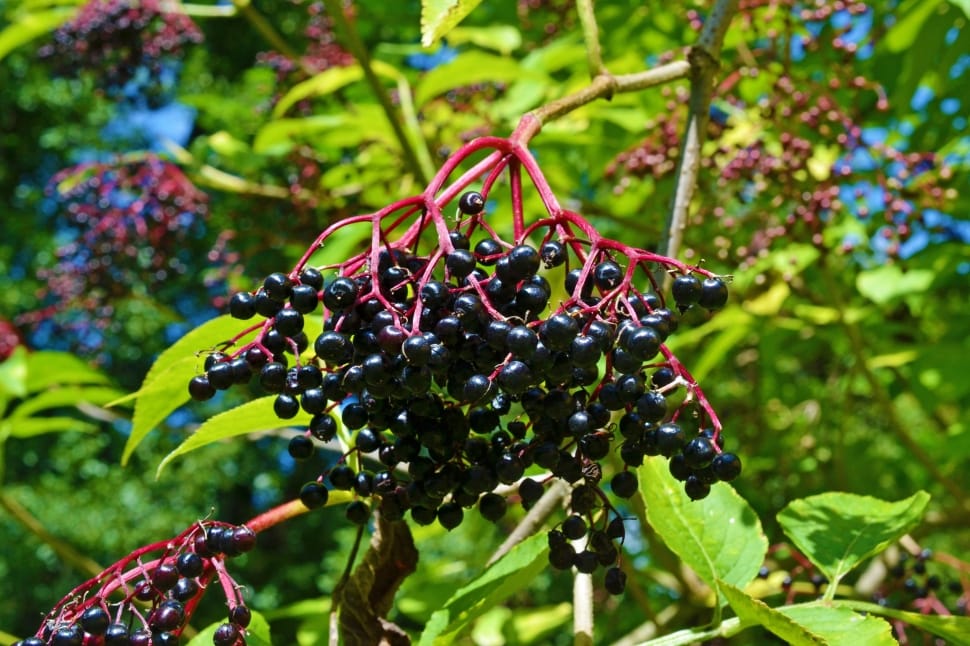
In the spring, Yellow Flags (the original wild Irises) spring from the water among emerald reeds; later on, St. John’s Wort and Vervain, Milkweed and Goldenrod bloom in their season, with effusions of Cardinal Flowers springing up between. In Autumn, the brush is heavy with elderberries, wild grapes, dark blue dogwood berries, and high bush cranberries – all feasted upon by flocks of birds preparing for migration.
Birds that land on the beach across the river from my bench are always blessings. Grackles love the watery pools, and Song Sparrows dart in and out among the tree roots. During mating season, the Common Yellowthroats and Rose-Breasted Grosbeak are in full chorus. Shorebirds sometimes peck tiny crustaceans from the mud, like a Solitary Sandpiper that stopped along its way south one August, every waxy feather demarcated and eyes like little black pebbles taking me in.

One day a slender snake poised among the reeds, brown with yellow dapples; another time, I saw a stick swimming upriver and realized how amphibious our Betsie River snakes seem to be– I have seen the Blue Racer and the Hog-Nosed snake go swimming as well. Muskrats often swim by, trailing leafy branches.
One June, a flock of Swallowtail butterflies gathered on the mud, all piled on top of each other, though whether they were ingesting minerals or making love, I couldn’t tell.
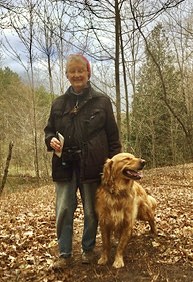 Bowie the dog often emerges from the woods when I am sitting there, and comes over to put his paw on my knee and look up at me with his brown, brown eyes so like the river at its deepest.
Although I take pleasure in his affection, there is something deeply mysterious in his eyes that I can never quite fathom.
There are stairs going down to the water in front of the cabin, where the river has deposited enough sand for a narrow beach. After a bit of wading, there is a nine foot deep swimming hole, cool and dark – the home of a great big fish none of the fishermen have ever been able to catch.
One April opening day the fishermen had all gotten drunk (very unusual, they are a quiet, even meditative lot) and after standing around the hole raucously casting for hours, they finally went home.
As dusk fell, I sat on the stairs to take in the sunset.
Up from the darkness lept the huge Brown Trout, twirling on its tail as if mocking us puny humans. I could see a reddish-brown fin as it arched out of the water, only to dive back down to its dark dwelling, flexing every arrogant muscle, a vision of something vital and deep and overwhelmingly strange.
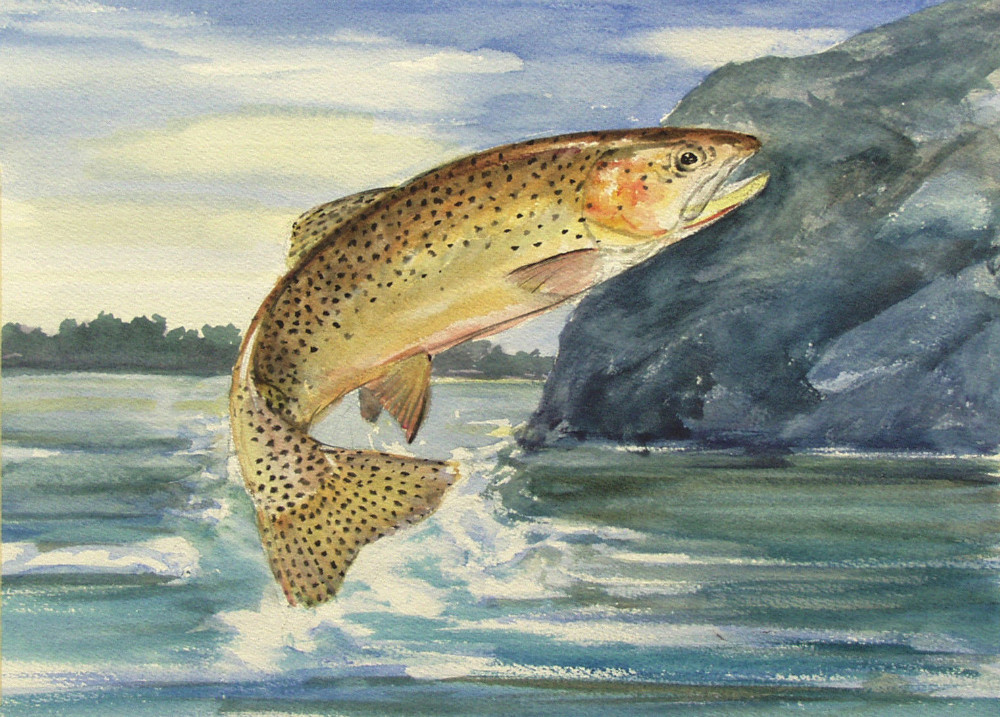
That huge fish is an inexplicable conundrum. The dark from which it comes is unfathomable. The river retains its secrets: when I am there, I am a mystery, even to myself.
Let it be so. Blessed be.
——————————————————————————-
Editor’s Note: The opinions expressed here by the authors are their own, not those of Impakter.com — In the Featured Photo: Betsie River with a kayak in the distance Source: Detail from photo by the Jake 1973, Reddit. Other photos: Unless otherwise indicated, all images by the author.