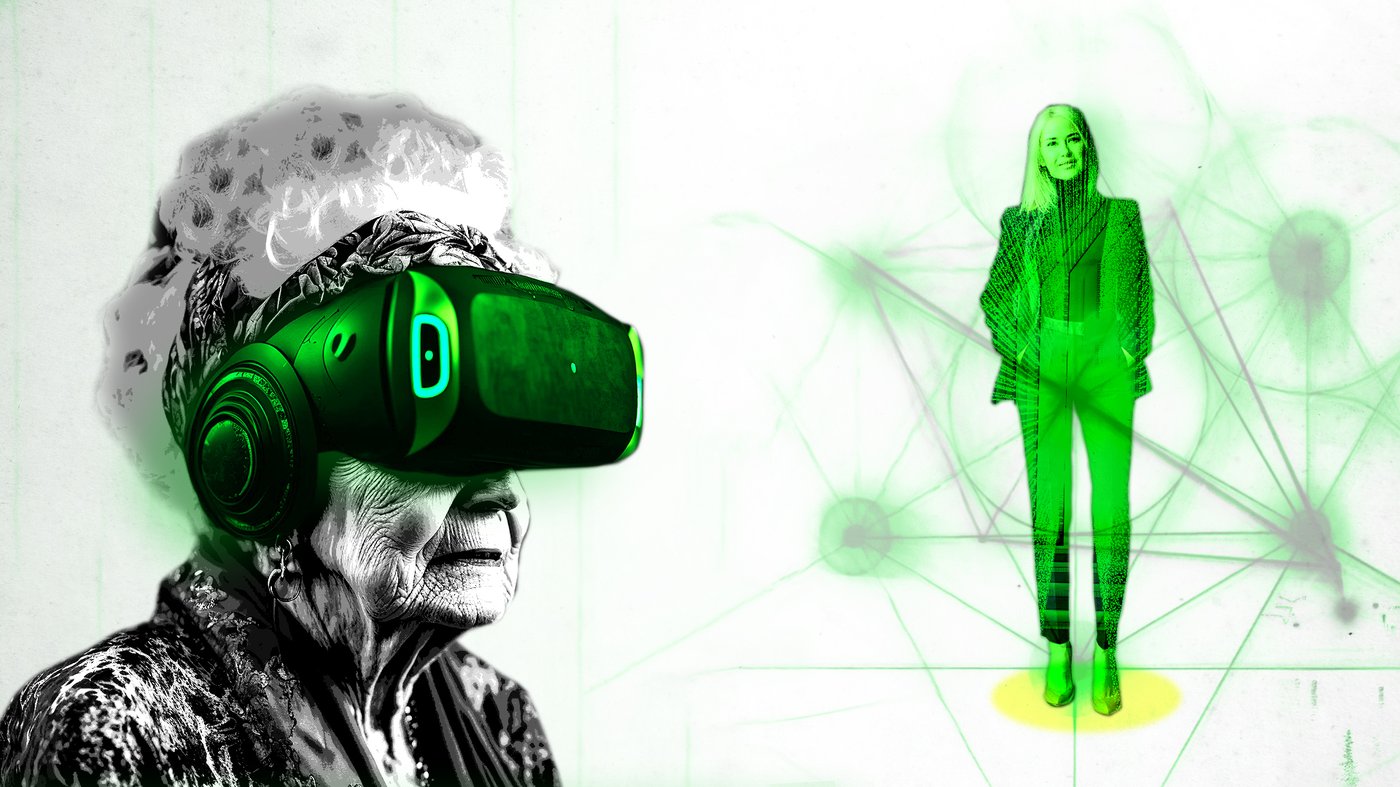


They can walk, talk, sit on your couch and until recently, belonged only in the realm of science fiction.
Soon computer-generated humans could become some of our best friends as more people try to overcome the kind of loneliness that can come with ageing.
Technology is making it possible, but it is our changing demographics that might drive us towards these virtual humans.
Many developed economies in Asia, Europe and North America are also rapidly ageing societies.
For example, more than one-fifth of Australia’s population is projected to be 65 or older by 2066.
This poses major socio-economic challenges, from a reduction in the skilled workforce through to unprecedented pressure on health and social services — and demands some equally significant solutions.
Social isolation is one of the key issues faced by ageing populations.
Most elderly people live either in aged-care facilities or in their own homes but with little to no social interactions with other family members or friends.
Intelligent virtual human companions have the potential to help alleviate this problem.
An intelligent virtual human companion is an avatar — a computer-generated human that can be placed in and integrated into physical worlds like your living room, similar to a hologram seen through augmented reality glasses.
Such a companion is unique because it integrates seamlessly with the physical world so you will see this computer-generated human as if it is a real person, breaking boundaries between real and virtual worlds.
It can look, behave and converse like a human, for example a beloved family member. And it understands and interacts with the environment and other people in the same way a person would.
So it can move around, sit or lie down and chat with others in the same way. It can’t pick up or move things or make a cup of tea — the technology is not there yet.
Unlike robots — which have also been considered a solution to social isolation among the elderly — virtual humans are not expensive, are easy to deploy and are customisable.
They can be shaped in any form and simulate the look and behaviour of anyone — something which isn’t possible with a robot.
This could perhaps explain why, despite significant investments — especially in countries like Japan — the adoption of robotics in aged care has been minimal.
The technology behind intelligent virtual humans has a range of possible applications.
Related Articles: Aging in Rich vs. Poor Countries: How’s Life for Those Over 65? | Imagining an Ethical Place for AI in Environmental Governance | Afraid of Cancer or Getting Old? Soon There Might Be A Pill For It
In ageing societies, virtual humans can play the role of companions as well as help service providers.
With more people relying on telehealth, especially in remote areas that lack facilities and health-care workers, intelligent virtual human technology can holoport doctors, other health practitioners and even patients to where they are needed. Holoportation allows three-dimensional models of people to be transmitted anywhere.
The technology could be used in a similar way for education and training providers or customer support.
Making virtual human companions look and act like real humans, and equipping them with the intelligence necessary for their seamless integration into people’s physical environments and daily lives, is key to their widespread adoption.
Five years ago, this goal sounded more like science fiction.
Today, technological developments in augmented reality, computer graphics, artificial intelligence and machine learning and computer vision are turning it into a reality.
Augmented reality devices are becoming more powerful and more accessible to common users.
Computer graphics algorithms — now empowered with generative AI — enable realistic visualisation of virtual worlds in general and virtual humans in particular.
Computer vision algorithms — which greatly benefited from the deep learning revolution — now achieve unprecedented performance in object recognition and scene understanding, and in recognising and predicting people’s emotions and behaviours.
Advances in AI and machine learning have paved the way to developing machines that can learn from and reason like humans.
All this means life-like virtual human companions equipped with advanced artificial intelligence have huge potential to improve the mental health and quality of life of ageing populations around the world.
But there are still obstacles and challenges to overcome before this becomes a mature technology.
Augmented reality technology, despite many decades of research, is still in its infancy.
Augmented reality devices are physically cumbersome and the images rendered on their glasses are low resolution and low quality compared to what can be done on desktop computers.
And importantly, the health impacts of using augmented reality devices for long hours is yet to be understood.
User privacy also needs to be addressed, since this technology learns from user data and continuously collects it while operating to provide the right and personalised services, but also to refine its knowledge.
From a technological perspective, making virtual humans realistic and intelligent is an ongoing area of research, although significant advances have been made towards achieving this goal.
These include developing novel machine learning techniques for scene understanding, 3D reconstruction and modelling, 4D humans, Bayesian neural networks and spiking neural networks, which are essential towards modelling virtual humans that can reason in the same way humans do.
Despite the benefits they could bring, whether people are ready to accept intelligent virtual human companions living with them and sharing their physical space remains to be seen.
**
Intelligent Virtual Human Companions is a joint research project between the University of Western Australia and Murdoch University, led by Professor Mohammed Bennamoun and Professor Farid Boussaid from UWA and Professor Hamid Laga from Murdoch. It has been funded by the Australian Research Council.
— —
This article was originally published by 360info™.
Editor’s Note: The opinions expressed here by the authors are their own, not those of Impakter.com — Featured Photo Credit: Michael Joiner, 360info Images: Olga Zabegina, Theo Eilertsen & Joshua Sortino via Unsplash.