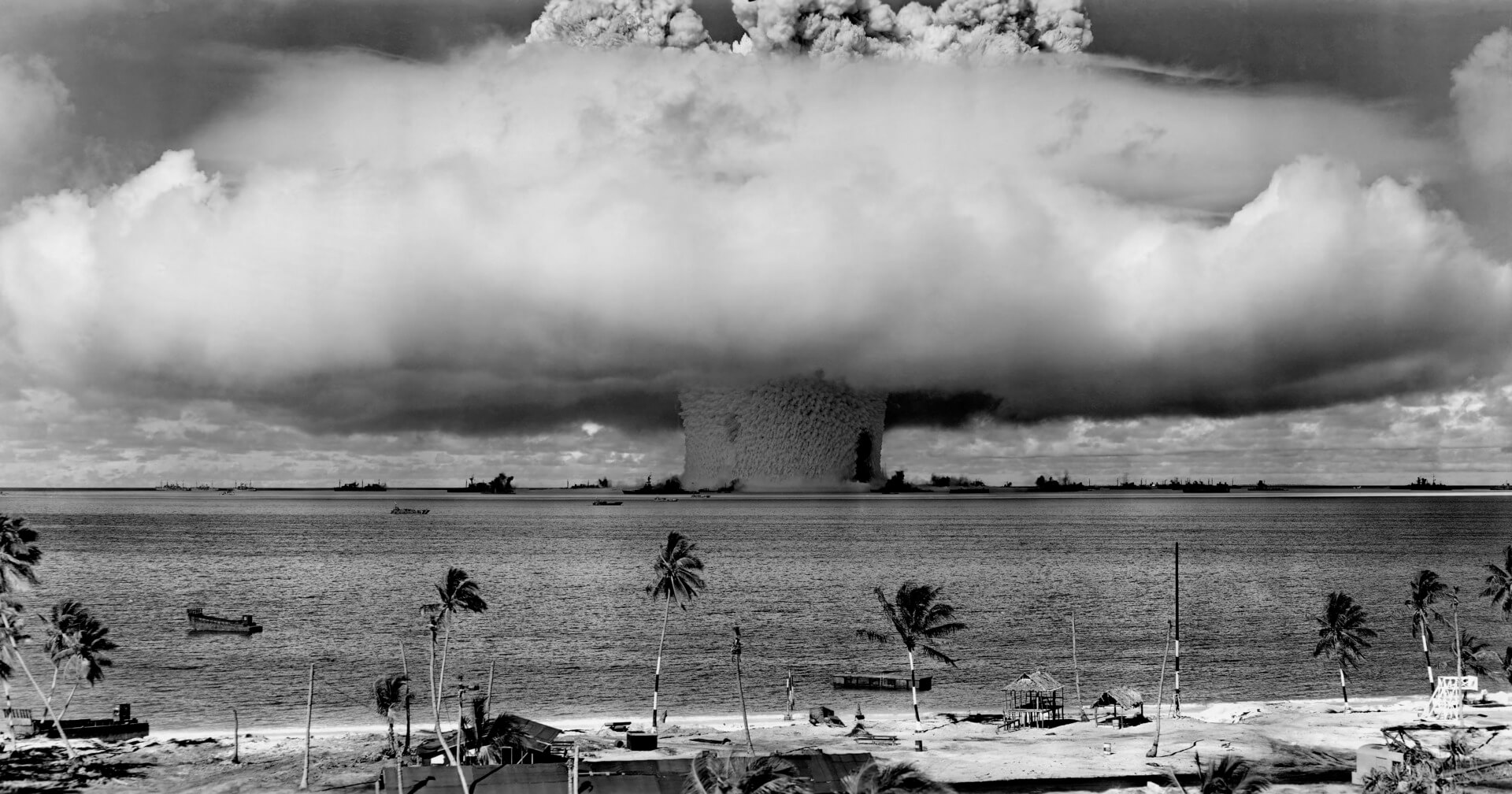
The year 2025 marks the 80th anniversary of the Trinity nuclear tests that ushered in the age of atomic weapons and their first use on the Japanese cities of Hiroshima and Nagasaki.
On this eightieth anniversary, when humanity should have honoured the memory of the atomic bomb victims by consigning these weapons to the pages of history, the world is circling back to a period of tensions, arms race, and renewed fears of nuclear war.
In the anniversary year, the world’s finest scholars and laureates have been forced to appeal to prevent nuclear war and call the ongoing nuclear rearmament a move “in the wrong direction”.
On July 16, an assembly of twenty Nobel Laureates and sixty international nuclear experts in Chicago warned that the “world has never been closer to nuclear war.”
Calling out humanity’s continued reliance on atomic weapons to prevent wars as a “reckless gamble,” the assembly’s historic declaration outlined a nine-point agenda for reducing the growing risks of nuclear war and paving the way for nuclear disarmament.
In 2022, Russian President Vladimir Putin’s veiled threats to use nuclear weapons in the Ukraine conflict dramatically raised fears of nuclear war. Moscow’s blatant violation of the 1994 Budapest Memorandum that guaranteed Kyiv’s territorial integrity gravely undermined the instrument of negative security assurances.
As latent nuclear powers anxiously watch the developments in Ukraine, the outcome is going to be consequential for global non-proliferation stability. From Asia-Pacific to West Asian theatres, the next proliferation wave could result in the fall of many nuclear dominoes.
Besides proliferation, global nuclear deterrence stability, too, is at an all-time low. With the breakdown of decades-old US-Russia arms control treaties, and China’s large-scale nuclear expansion, the world today needs a new arms control architecture.
Until such architecture emerges, the ongoing nuclear arms race will likely fan complex global and regional security dilemmas. To further compound the problem, the ever-increasing sophistication and autonomy in military systems create risks of accidents or inadvertent escalations.
Indeed, the present-day nuclear instability is not a one-off phenomenon. The Cold War period was replete with many tense face-offs and crises. From the conflict in the Korean Peninsula, to the race for testing megaton weapons, to the Cuban and Euro-missile crises, during the Cold War, tensions frequently reached dangerous proportions.
However, the nuclear brinkmanship during the Cold War also engendered petitions for peace and sanity in its wake. Peace movements became instrumental in calling out the dangers of the mindless nuclear race and appealing to reason and sanity in nuclear decisions.
Among the notable petitions of the Cold War was the historic Russell-Einstein Manifesto released in London on July 9, 1955. Signed by eleven eminent scientists, including Albert Einstein before his death in April 1955, the Manifesto made an urgent appeal to reckon with the nuclear weapons catastrophe and save the world from nuclear apocalypse.
Just six days after the release of the Russell-Einstein Manifesto, the Annual Lindau Meeting of Nobel Laureates released another powerful statement, the “Mainau Declaration,” on preventing nuclear war. Notwithstanding the varying ideological affinities of their signatories towards capitalist and socialist blocs, the two statements were unequivocal in their appeal about the dangers of nuclear war.
The Russell-Einstein manifesto’s message: “We appeal, as human beings, to human beings: remember your humanity, and forget the rest,” became timeless and ever-urgent in its appeal for peace for times to come.
Related Articles: Will Theocracies Manage to Avoid Nuclear War? | NATO and Putin’s Nuclear Threats | Spotlight on Two Nuclear Powers: India and Pakistan
Fresh appeals for sanity
With the return of the nuclear arms race and the rising risks of nuclear war in recent times, Nobel laureates and peace groups are, yet again, back with their appeal for peace and sanity.
In 2022, the Nobel Laureates Meeting at Lindau issued a “Call for Peace,” which urged ending the Ukraine war and restoring peace. Then, at the 2024 Lindau meeting, the Laureates, in line with their predecessors’ July 1955 statement, issued the “Mainau Declaration 2024 on Nuclear Weapons.”
The 2024 declaration was unmistakable in its message: “All nations must commit to ensuring that nuclear weapons never be used again. If they are not prepared to do this, they will cease to exist.”
The Mainau declaration was followed by the “Declaration for the Prevention of Nuclear War” issued in Chicago in July 2025 by the Nobel Laureates Assembly. Outlining a nine-point agenda for reducing the risks of nuclear war and supporting the efforts for nuclear disarmament, the Chicago declaration couldn’t have been sharper and pragmatic in its appeal.
In the anarchic world of international relations, emotive appeals are often said to have little to no impact on leaders obsessed with maximising their relative gains. In the realpolitik of hard power, leaders usually regard emotive appeals as unwanted distractions, deflecting them from rational security pursuits. The present-day arms race is typical of such times when hegemonic arms build-up and nuclear use threats are causing grave fear and uncertainty.
When the arms build-ups can no longer be accepted as a rational pursuit but begin to look like insanity, appeals and petitions of reason must emerge.
If the history of the Cold War serves as any guide, peace movements were spawned in moments of fear, forcing leaders to resolve the tensions peacefully. Groups like the Pugwash Movement became critical during the Cold war as they brought scientists from rival ideological blocs together to forge trust and understanding on arms control issues.
Today, the return of fears of nuclear war is yet again driving scientists to work towards its avoidance.
In the age of disruptive technological change, science diplomacy has become more crucial than ever to ensure humanity’s survival and rid the world of a destructive arms race.
The collective of scientists and international security experts, cautioning about the risks of nuclear war, thus marks a pivotal intervention. As we observe the 80th anniversary of the atomic bomb victims, let us honour their message to “remember our humanity.”
** **
This article was originally published by 360info™.