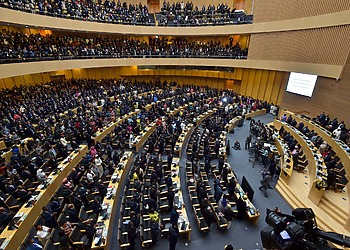
On March 28, the United Nations General Assembly (UNGA) adopted a historic resolution asking the International Court of Justice (ICJ)—the UN’s principal judicial organ—to provide an advisory opinion clarifying what governments’ obligations are under international law when it comes to tackling climate change.
The resolution—sponsored by the small island state of Vanuatu—was adopted by consensus and has drawn praise by media outlets, international law and environment experts, and environmental advocates for its potential to provide much-needed legal clarity in this field.
“Climate justice is both a moral imperative and a prerequisite for effective global climate action,” said UN Secretary-General António Guterres, praising UN member states for adopting the resolution. “The climate crisis can only be overcome through cooperation—between peoples, cultures, nations, generations. But festering climate injustice feeds divisions and threatens to paralyze global climate action.”
The UNGA resolution notes the disparity thus far between the measures governments have outlined in their nationally determined contributions under the Paris Agreement and the actual cuts to greenhouse gas emissions required to stay within that agreement’s temperature limits. It also refers to the need for greater efforts on climate change adaptation.
Under the resolution’s terms, the ICJ has been asked to consider not only what states are legally required to do, under international law, to avert further climate change both now and in the future, but also to assess the “legal consequences under these obligations” when governments, both through what they do and fail to do, “have caused significant harm to the climate system and other parts of the environment.”
This latter request asks specifically that the court consider what this harm has meant for both current and future generations, as well as for those countries who, by virtue of their “geographical circumstances and level of development, are injured or specially affected by or are particularly vulnerable to the adverse effects of climate change.”
The UNGA resolution comes at a pivotal moment for the international climate community, as governments, civil society, academia, and private actors all prepare for the UN Framework Convention on Climate Change’s 28th Conference of the Parties (COP 28) this November. This climate COP will seek the culmination of the first Global Stocktake under the Paris Agreement, showing how close the world is to achieving that Agreement’s objectives and how much work remains.
The Intergovernmental Panel on Climate Change (IPCC), which recently wrapped up its Sixth Assessment Cycle, has already confirmed that the world is far too close to the 1.5°C limit under the Paris Agreement—while indicating that there are proven options available for averting the worst impacts of climate change, so long as governments and other stakeholders act now.
While ICJ advisory opinions are not directly binding on states, they provide an authoritative interpretation of international law, which is binding upon states via custom and treaties. While an exact timeline for the advisory opinion is not yet known, experts indicate that they expect an outcome within a year.
International Law and Sustainable Development
The request for an ICJ advisory opinion follows a series of developments in recent years to advance the achievement of sustainable development objectives and to enable governments to take more ambitious steps on climate change mitigation, adaptation, and finance.
At the normative level, recent examples include the 2030 Agenda for Sustainable Development and its 17 Sustainable Development Goals, adopted by UN member states in 2015, and the more recent UN General Assembly resolution adopted by member states last year on the right to a clean, healthy, and sustainable environment. Although these instruments are not legally binding, they evidence global consensus on the necessity of climate action and importance of sustainable development.
This conversation on states’ environmental obligations under international law has also made its way to other courts and tribunals. For instance, last year, the Commission of Small Island States on Climate Change and International Law made a request for an advisory opinion from the International Tribunal for the Law of the Sea regarding states’ obligations to protect and preserve the marine environment. There are also various climate change cases before the European Court of Human Rights seeking clarity on human rights obligations in the context of climate change.
Related Articles: Could US Oil Companies Be Tried for ‘Climate Homicide’? | Groundbreaking Lawsuit: Shell’s Board of Directors Sued for Climate Inaction | Greta Thunberg Sues Right-Wing Swedish Government Over Climate Inaction | UK’s Net Zero Strategy Found Lacking in Court
The ICJ opinion is likely to have a significant impact in boosting countries’ efforts to implement sustainable development policies. For instance, the ICJ opinion could provide greater detail, texture, and clarity to the benchmarks used for judging states’ sustainable development policies, such as the implementation of the Paris Agreement’s goals. The Court’s opinion could also inspire greater ambition—and action—under international processes that aim to tackle different facets of the climate challenge.
While the outcome of the ICJ process remains to be seen, a crucial step that governments must already be ready for is making sure they can take the advisory opinion and put it into practice in their national policies and regulatory frameworks. This means understanding how governments’ international climate change obligations implicate different sectors, such as energy, investment, mining, infrastructure, agriculture, and fisheries, to name a few examples. It also means analyzing what it means for governments’ subsidy policies and other fiscal measures, as well as reconsidering how international agreements on issues such as trade and investment align with these climate change obligations.
IISD welcomes the UNGA resolution and will monitor the ICJ proceedings closely, with the hopes that the opinion will help in mobilizing efforts to promote sustainable development globally. Since its inception, IISD has worked with developing countries and international organizations to implement international climate change law through various regulatory frameworks, policy advice and nature-based solutions, and provided capacity-building services that have helped developing countries to adopt appropriate climate adaptation and mitigation measures.
— —
This article was originally published by the International Institute for Sustainable Development (IISD) and is republished here as part of an editorial collaboration with IISD.
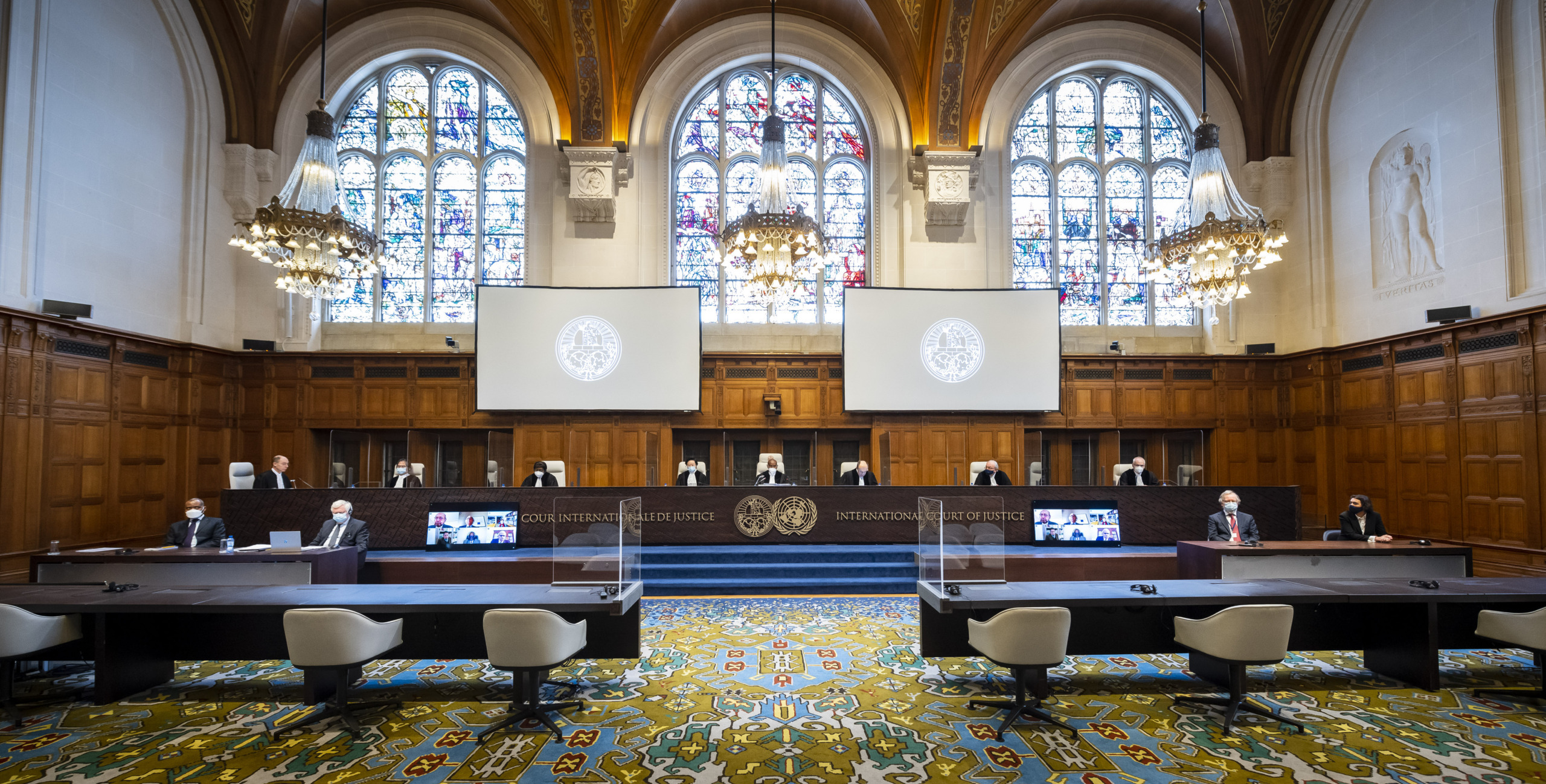
Editor’s Note: The opinions expressed here by the authors are their own, not those of Impakter.com — In the Featured Photo: The judges of the International Court of Justice (ICJ), February 08, 2021. Featured Photo Credit: International Court of Justice (ICJ).