From launching a trade war and engaging in mass deportation of migrants to withdrawing support from the United Nations, Trump is leading the US into uniquely “dangerous times,” warns Columbia U. Professor Sachs, and to avoid conflict we need a new UN 2.0
Lately, the renowned American economist and UN advisor Professor Jeffrey Sachs, head of Columbia University’s Center for Sustainable Development, has been on a whirlwind tour of interviews, trying to put a stop to Trump’s “imperial diplomacy.” A diplomacy that is threatening not only the world’s order and its economic stability with a vengeful trade war and mass deportation of migrant workers, but global peace itself. These are “uniquely dangerous times,” warns Sachs. World War III could be around the corner, and we need a new, revived UN 2.0
I could mention many of the excellent, illuminating points Professor Sachs made in those interviews, for example, this one with the Hindustan Times, as Trump is gearing up for his Alaska meeting with Putin on Friday, August 15, to try and end the war in Ukraine:
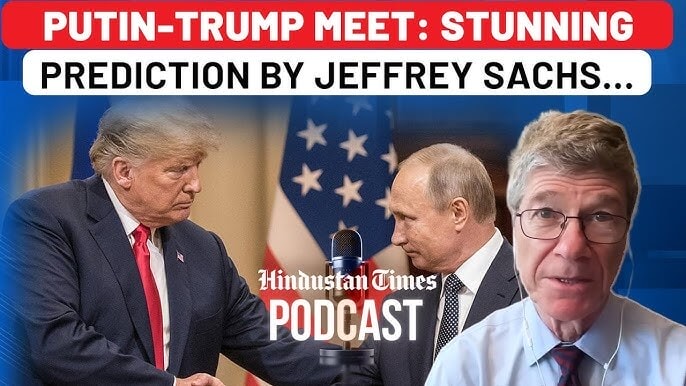
Video interview made on August 10, 2025, available here.
Sachs, at the time, declared he expected nothing to come out of the Trump-Putin meeting, and indeed, now we know he was right. Nothing happened. Perhaps the next few days will bring some positive news, but it’s highly unlikely.
In this video, Sachs repeats what he has said many times before, that the Ukraine war is one provoked by the US. To many, that sounds like a provocative theory, hard to believe. And yet, he has a point: He reminds viewers that the war has deep roots in the past, specifically in a promise the US made to Russia back in the 1990s, that it wouldn’t enlarge NATO and threaten Russia’s borders. That promise, he says, was broken by President Clinton in 1994.
So, the Ukraine war, in its first manifestation with the conquest of Crimea in 2014, was also, he argues, Obama’s war and indeed Trump’s war from his first mandate as well as Biden’s war, as Trump insists it is. Of course, that is why Sachs expects nothing good to come out of the meeting in Alaska, as Trump hasn’t shown any signs that he understands what the real stakes are here.
So what are the real stakes?
To shed light on this question, I will focus on an earlier interview with CGTN Europe that Sachs made on August 9, as here he explores in depth the historic role of the US and why, as he sees it, the world order is currently on the brink of collapse.
His answer in a nutshell: The US is the biggest obstacle to global peace.
That is clearly a provocative opinion that goes against what most of us believe (at least in the developed world), but that is also why it’s worth examining in detail.
Take a moment to listen to him in the clip below; I started the interview nine minutes in, when he explains his views on the US, on its “imperial” behavior on the world stage, and the (diminishing) role of the United Nations, unable to stop either the Ukraine or the Gaza wars – that latter point, I believe is the most important, and it brings in this notion of a revived UN, a UN 2.0 that I will analyze here:
Sachs’ analysis: A paralyzed UN is what’s wrong with the world order today
We can all agree that Trump has undermined the world order that emerged from World War II and that the UN, which was meant to guarantee world peace, is unable to fulfill its role.
As Sachs notes in his interview, “the UN as an organization cannot respond adequately partly because the US puts vetoes in place, partly because the UN doesn’t have a dedicated budget that is adequate to the task, and the United States and other countries don’t pay even the tiny amounts that they’re due under the core UN budget.”
And yet, as Sachs says, we do “need global governance to stop nuclear proliferation, to protect the earth’s physical systems from our self-destruction, and to end wars.”
If not the UN, then who?
For the current sorry state of affairs, Sachs places the blame squarely on the United States. Even if other countries drag their feet, the US comes out as the “country least aligned with the UN Charter.” Every year, he explains, he does “a study measuring each government’s alignment with the UN Charter, General Assembly, UN Security Council, and UN agencies. And the US comes out last of the 193 member countries.”
The UN is not effective because the United States is in open war with the UN. It’s an “open battle on every front,” as the US:
- Uses its veto in the Security Council to stop war to prevent the emergence of peace, for example, in the Middle East or to implement the two-state solution.
- Walks out of the Paris climate agreement.
- Leaves UN organizations like UNESCO and the World Health Organization.
- Doesn’t pay its dues to the UN.
- Doesn’t sign UN treaties.
The conclusion is obvious: “all of this has weakened the UN.”
And the solution is equally obvious: “The UN needs a UN 2.0.” And he urges us: “Don’t be cynical and give up on the UN. Understand its vital role in the world and strengthen the UN.”
What would a new UN 2.0 look like?
To upgrade the UN system and make it effective requires extensive reforms; there are many ideas swirling about, but Sachs highlights three fundamental reforms that he believes could make a real difference and they are certainly worth mentioning here:
- The UN needs its own adequate financing: Sachs recommends that “taxes be put on international shipping, on international aviation, on international financial transactions, on emissions of carbon dioxide, and on other tax bases that should provide directly the revenues that one needs for global governance.”
- The UN Security Council is to be upgraded with a total overhaul of the veto process so that “one country cannot willfully oppose the overwhelming consensus of the global community, which is exactly what the United States is doing today, for example, in the question of Israel’s genocide in Gaza.”
- A UN parliament alongside the UN General Assembly should be instituted: The aim is to “make the UN bicameral: two chambers, one that is one country, one vote, and one that is more representative of the population in a kind of global parliament.”
Related Articles: Is the UN in Danger of Financial Collapse? | End the United Nations? Bad Idea | NATO and Putin’s Nuclear Threats
What it takes to make a better, safer world emerge
On the American side, Sachs sees two necessary conditions that need to be fulfilled, and here they are in his own strong words (bolding added):
- “One is that the rest of the world will finally say to the United States: You don’t run the show. This is basic. It’s what President Lula said recently. He said, ‘We don’t need an emperor.‘ Referring to President Trump’s demands on Brazil and other places in the world.
- And second, when the American public opinion, which supports the UN and wants an end to the wars, finally regains some political power, because in the US, public opinion plays almost no role right now. This is a government by decree ruled by the military-industrial complex, irrespective of the will of the American people, who want peace, who want mutual accommodation, who don’t want the wars in the Middle East or Ukraine or in East Asia, but their voice doesn’t register right now.”
So once support comes from both “the BRICS and other countries,” we can finally hope to get a “multipolar world,” or as he puts it, “actually I should be more precise: we can get to a law-abiding multilateral world. We already are in a multipolar world, but we can get to a multilateral world with an effective UN charter if the BRICS, the African Union, ASEAN, and other countries in the world say we do not want an emperor.” (bolding added)
One can only agree that both conditions are essential and necessary to achieve a “law-abiding multilateral world with an effective UN.”
This said, and oddly enough, Professor Sachs doesn’t go far enough: He never appears to consider any possible role for Europe. He sees support coming from the BRICS, ASEAN, the African Union, but not the EU.
Maybe that will surprise you; it certainly shocked me.
This is a grave error, but not Prof. Sachs’ alone. Overlooking the role of Europe on the international scene appears to be a quite common blindness among both academics and politicians in America: They tend to systematically ignore Europe, setting it aside as weak and ineffective, not worth even thinking about.
For Americans, oddly enough, our current “multipolar world” contains only three giants: first, the US (of course!), then China, and last (but not least) Russia. The others — the EU, UK, India, Japan, Canada, Australia, South Africa, Brazil, etc. — are second-tier and don’t count, full stop.
This is very strange and a huge miscalculation, considering that Russia is hardly a “giant”: It’s on a par, economically, with a country like Italy (same GNP level), and yet Italy, as far as the US is concerned, is merely a small country that simply doesn’t exist on a geopolitical plane. Not so with Russia, which has become an American obsession since Soviet times.
In fact, Professor Sachs, along with the whole American intelligentsia and political class, tends to systematically underestimate Europe’s economic strength, including its military strength, conveniently ignoring that this is the one region of the world — Western Europe — with not just one but two nuclear powers: the UK and France. Small nuclear powers, to be sure, but given the very nature of nuclear devastation, you don’t need many bombs to make yourself heard: one is enough.
The role of Europe in the international geopolitical game and the UN 2.0
At this point in time, the stakes are incredibly high: Both global peace and the environment and resources that sustain humanity’s continued existence on this planet are at risk. Something like this — the double challenge and the global scale of the threats – has never happened before in human history.
We are at a turning point. Many warn that, with the acceleration of global warming, the 6th Extinction has arrived; others predict (like Sachs) that Taiwan is a flashpoint that will cause World War III, as the US keeps sending armaments to Taiwan.
So can we hope that humanity will survive? Will Europe wake up and walk up to the plate? Will it finally stop submitting to the US?
I say this because it’s something Italy’s Prime Minister Meloni systematically does, bowing down to Trump; as even the EU Commission President von der Leyen does, supposedly out of “courtesy” even though polite, submissive attitudes are clearly the wrong approach to deal with a bully like Trump – hence the disappointing results of the tariff negotiations, with 15% level of tariffs agreed upon, surely to Trump’s delight.
Only if the EU starts playing its diplomatic game correctly, aligning itself with China not only on the climate issue (as it has done so far) but also on the global peace issue and economic matters to counter the US trade bluster, can we hope to see the rise of an effective Europe on the world stage. A Europe able to restore world peace and protect the environment from the devastation of climate change.
Only then…Is it too much to ask for, Mrs. von der Leyen?
Transcript of Prof. Sachs’ interview, August 9, 2025 (bolding added),
starting at 9:01 minutes, Prof. Sachs speaking:
So how can one rule out anything in this kind of context? You have a President of the United States with an attention span of 15 minutes who makes threats and ultimatums to other countries, who is complicit in a genocide that is ongoing in Gaza. It’s not a pretty picture. It’s quite a dangerous picture. What has kept us out of war is the prudence of China and of Russia, actually.
Because Russia has not retaliated even when, clearly, the Western security agencies supported Ukraine, for example, to attack part of Russia’s nuclear triad just a few weeks ago. Well, this is such an unbelievably reckless kind of action that the West takes, but the Russian response was not to escalate that further.
What’s missing in all of this, I have to say, is true diplomacy. True diplomacy is not that the United States dictates that you must have an unconditional ceasefire in 10 days. That’s not diplomacy. True diplomacy is you sit, you discuss, you negotiate, you listen to the other side, you take into account the concerns of the other side, and you find mutual accommodation. One of the things about the Ukraine war, for example, is the Americans’ demand for an immediate, unconditional ceasefire.
The Russians say, well, there are root causes of this war, notably NATO enlargement. The coup that the US helped to lead in February 2014, which brought this regime to power in Ukraine, and so forth. The United States doesn’t want to discuss any of those root causes. That means no diplomacy.
Or look at the war in Gaza. Israel is starving 2 million people in front of our eyes. People are dying every day. They go to the food emergency points, and then the Israeli soldiers shoot at them and kill them in cold blood in front of the cameras. No denying it. Then you have Israelis bragging about all of this.
So there’s a genocide that’s underway. What does the US say? The US uses rhetoric. Release the hostages. Release the hostages, Hamas. But it doesn’t willingly get to root causes, Israel’s occupation of Palestine, and the need for a two-state solution, which more than 180 countries of the United Nations believe in.
So again, if you don’t discuss the real political issues, if you just make demands, that’s not diplomacy, and it’s also not conducive to peace.
QUESTION: Speaking of diplomacy, Jeffrey, the end of the Second World War led to the founding of the United Nations. Do you believe that postwar institutions like the United Nations still reflect the realities of today’s multipolar world?
ANSWER: We need the United Nations more than ever because our interconnectedness is greater than ever.
We need global governance to stop nuclear proliferation, to protect the earth’s physical systems from our self-destruction to end wars.
So the reason for the UN is stronger than ever. The effectiveness of the UN is very low right now.
And understand that I work at and with and for the UN, and I say this with great sadness: that we need the UN more than ever, but it is not effective, and the reason it’s not effective is that the United States is in open war with the UN.
The US is the country that is least aligned with the UN Charter. I do a study each year measuring each government’s alignment with the UN Charter, General Assembly and UN Security Council, and UN agencies. And the US comes out last of the 193 countries.
So the country that essentially invented the UN, because this was the brainchild of our greatest President, Franklin Roosevelt, is now in open battle with the UN. Open battle on every front.
It uses its veto in the Security Council to stop war to prevent the emergence of peace, for example, in the Middle East or to implement the two-state solution. It walks out of the Paris climate agreement. It doesn’t pay its dues to the UN. It leaves UN organizations like UNESCO and the World Health Organization. It doesn’t sign UN treaties.
So all of this has weakened the UN. The UN needs a UN 2.0. In other words, don’t be cynical and give up on the UN. Understand its vital role in the world and strengthen the UN.
QUESTION: What is the UN 2.0, and do you think what happened to the League of Nations will happen to the UN?
ANSWER: Now the League of Nations is, of course, the dire possibility that we face. What happened with the League of Nations is that it was founded in 1921, and then when the crisis of the 1930s came, it proved inactive and incapable of maintaining the peace.
And now we have the UN in the face of an ongoing war in Ukraine, in the face of the catastrophe in Gaza, in the face of the growing environmental crisis in which the UN treaties play a central role. And the UN as an organization cannot respond adequately partly because the US puts vetoes in place, partly because the UN doesn’t have a dedicated budget that is adequate to the task, and the United States and other countries don’t pay even the tiny amounts that they’re due under the core UN budget.
UN Security Council resolutions come and go without being enforced. So all of this means that we need an upgraded UN system. The UN needs its own adequate financing.
I have recommended that taxes be put on international shipping, on international aviation, on international financial transactions, on emissions of carbon dioxide, and on other tax bases that should provide directly the revenues that one needs for global governance.
I have advocated repeatedly for the UN Security Council to be upgraded. Of course, for the whole veto process to be overhauled so that one country cannot willfully oppose the overwhelming consensus of the global community, which is exactly what the United States is doing today, for example, in the question of Israel’s genocide in Gaza.
There are many other reforms that have been recommended for the UN, including even a UN parliament alongside the UN General Assembly. In other words, making the UN bicameral: two chambers, one that is one country, one vote, and one that is more representative of the population in a kind of global parliament. I think this is a very good idea, actually.
QUESTION: And do you think that will help stabilize world governance after the reforms you suggested?
ANSWER: The most basic point is that we have moved from a bipolar Cold War to a self-proclaimed unipolar US world to a truly multipolar world. That’s the world that we’re in right now. But we don’t have multilateralism. We don’t have the ethics, the spirit, the diplomacy, or the UN institutional mechanisms for a safe and fair, and law-based multipolarity.
So the world’s different now, 80 years after the end of World War II. We can see why the UN is essential and also why it’s not working. The United States clings to its self-declared hegemony or primacy at great risk to the whole world.
So when you ask: Will we get to something new? We will when the need for it is clear to everybody, and when the US opposition finally wanes, and it will wane for two reasons:
- One is that the rest of the world will finally say to the United States: You don’t run the show. This is basic. It’s what President Lula said recently. He said, “We don’t need an emperor.” Referring to President Trump’s demands on Brazil and other places in the world.
- And second, when the American public opinion, which supports the UN and wants an end to the wars, finally regains some political power, because in the US, public opinion plays almost no role right now. This is a government by decree ruled by the military-industrial complex, irrespective of the will of the American people, who want peace, who want mutual accommodation, who don’t want the wars in the Middle East or Ukraine or in East Asia, but their voice doesn’t register right now.
So we can get to a multipolar world if the BRICS and other countries say yes, actually, I should be more precise: we can get to a law-abiding multilateral world.
We already are in a multipolar world, but we can get to a multilateral world with an effective UN charter if the BRICS, the African Union, ASEAN, and other countries in the world say we do not want an emperor.
We do not take demands from any one country. We want to operate by the international rule of law. And if, at the same time, we can regain some measure of accountability of the US military-industrial complex.
Editor’s Note: The opinions expressed here by the authors are their own, not those of Impakter.com — In the Featured Photo: World War III image by Freepik
Updated August 17, 2025