This is the sixth article in the series “The Good Council”, based on the podcast from the World Future Council. It gives a behind-the-scenes look at the organization’s trajectory, from revolutionary idea to reality, and offers insights on its current agenda. The Good Council podcast provides inspiration, laughter, and food for thought through intergenerational dialogue between its founders, senior Councillors, and young entrepreneurs and activists from around the globe.

What are best practices and sustainable solutions for our common future? How can we leave the planet in better shape for future generations? These are the questions the World Future Council has set out to answer.
The World Future Council aims to give our children and grandchildren a healthy planet with just and peaceful societies – now and in the future. To achieve this, the foundation identifies, develops, highlights, and spreads future-just solutions for current challenges humanity is facing and award them with the unique Future Policy Award. The Council consists of fifty eminent global changemakers from civil society, science, politics and business. They meet annually at the World Future Forum to discuss the most urgent challenges and policy solutions to them.
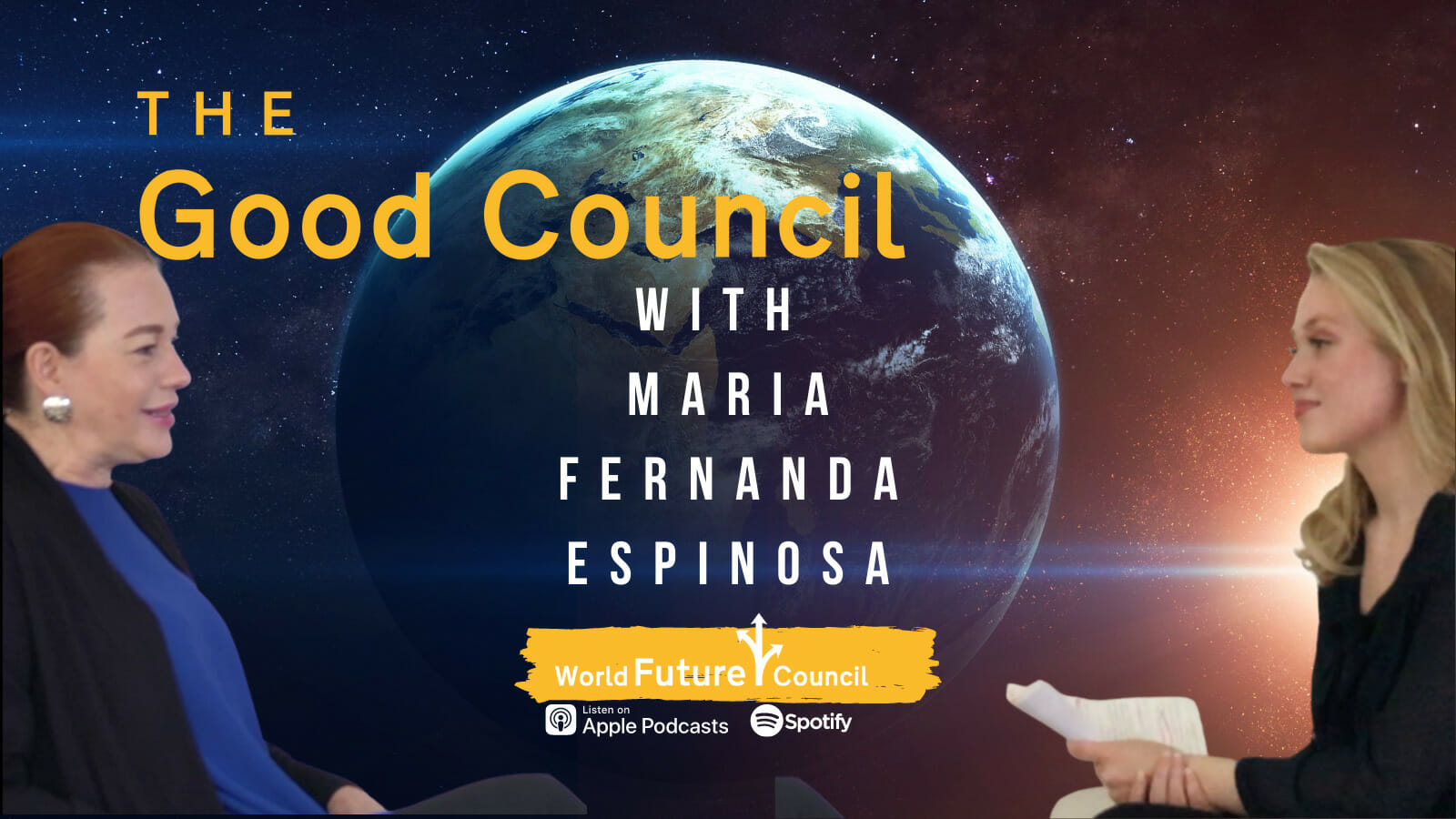
For the eighth episode of The Good Council, young WFC-member Annika Weis had a conversation with María Fernanda Espinosa, President of the United Nations 73rd General Assembly, as only the fourth woman to hold that office in UN history and Councillor of the World Future Council.
A trailblazer for women across the world, Maria Fernanda Espinosa held positions in government in Ecuador and at the higher echelons of global diplomacy for sustainable and peaceful development, women’s rights and gender equality, and universal health coverage. She’s an example of someone with determination and strength who never lost her personal convictions and empathy for others. In this episode, we’re looking back at where she came from, where she’s been, and where she’s going…
Annika: An important topic we want to talk about today is gender-equality. What is it like being a woman in power?
Maria: It’s a tough call, and there are higher expectations when you are female. There are so many women out there, trailblazers, breaking the glass ceiling, etc. And they must perform twice as well as any male in the same position. We must never be silent when we realize that there is discrimination in all its forms. And I was very vocal myself saying, why didn’t you comment about my speech in front of the military? Why did you instead make a comment about what I was wearing? Or asking a journalist if he would have asked the same questions to a man in the same position. We should never give up or just accept that that’s the way things are. We should never take discriminatory practices and narratives for granted. It is simply not an option, especially for women in decision-making positions, for young women changemakers. We must continue struggling, partnering, and building networks of people that want to make the world more equal and less unjust.
Annika: If you look at your successful career, is there anything you’d like to tell your younger self?
Maria: I think one of the moments in my life when I was growing up, that was decisive is when my mom said to me: “Listen, no one is going to knock on your door and tell you, here you have this opportunity. You have to fight for it, you have to shape your own future.”. And – I think that was a game changing lesson. I always knew that I had to fight for my dreams, and to follow my principles and values, and put all my passion and energy into the things that I wanted to do. I think we have to be mindful that we, as I said, still live in a world that is not gender-equal, that has transactional inequalities when you’re a woman from the global south, a woman of color, an indigenous woman. The dreams you pursue, the commitment you have to improve your life and the life of others are choices, political and personal choices.
A: Could you please explain how all of these issues are interconnected: Gender equality, climate change, the rights of young people and women, and the destruction of natural habitats and peace?
M: I think we live in a world of paradox. I am always amazed to see the level of technological development that humanity has reached. We are also much more interconnected. The opportunity to access knowledge and technology is huge. And yet, we are unable to have comprehensive responses to these interconnected crises. Because as a society, we are unable to use what we have in our hands—in terms of knowledge, science, technology—to address and solve the critical challenges that humanity faces. And there is a strong connection between the climate crisis, the extinction crisis, the inequalities crisis. What I often say is that these are symptoms of this dysfunctional system. All the crises we experience are systemic and require structural transformations. Therefore, what we need to heal is the relationship between society, the economy, politics, and nature.
Of course, we also need leadership. But I’m not a person that believes in messianic leaders that are going to miraculously fix everything for us. It’s shared leadership! It is exercising our role as committed and responsible citizens, young change-makers, academic scientists, the private sector, and of course, governments, but we cannot leave governments alone to solve all the problems that we are facing. Co-responsibility and co-building, I think are perhaps the keywords.
A: Let’s move on to your work at the World Future Council. In being a member with the World Future Council, what fascinates you about the WFC?
M: I think that the World Future Council is a very powerful organization working on transgenerational justice, especially transgenerational environmental justice. But at the same time, I think it is the right setting and the right means to empower young people to have their own voices, to be the change makers that they want to be and that they deserve to be. The World Future Council has also a critical role to play in connecting policy with informed decision making and bringing together thinkers, activists and scientists from all regions together for sustainable development.
A: You were on the panel at the launch event of the World Future Council’s Youth Forum, Youth:Present—which this intergenerational dialogue between you me is also a part of—what do you think about the activities, and political and civic participation of young people today?
M: I cannot even imagine having collective responsibility for improving and reshaping our world and for building forward better, without the agency, the intelligence, and the creativity of younger generations. Many still believe It’s nice to have a young person at an event and to tick the box and to say, yes, they are part of this table, dialogue, conversation, etc. So, what is challenging is to go from a tokenistic engagement of young leaders and changemakers, to a genuine need for good quality decisions that are taken at all levels in the multilateral arena, in national decision-making, at the local level. Young changemakers, young actors have to be part and parcel of the decision making process in public life. I know how much quality, how much legitimacy, decisions that are taken in this intergenerational form have, so it’s a win-win.
A: What’s your hope for future generations?
M: I am convinced that younger generations are going to see the reverse in climate change and climate stabilization. Younger generations should be able to live in a more peaceful and equal world. And for that to happen it is not enough to have a group of people working here or there. I believe we need a new global, intergenerational social contract, or multiple social contracts. We really need to come together to change course. Because it is hard to understand that we have the resources, we have the technology, we have the knowledge—and yet, we continue to be a society that is so unequal, so unfair, for some. Young people from all sectors and regions, countries, perspectives, backgrounds should unite to reshape the world, to build forward better. Our world has become one of constant crises, despair, and mistrust. We have now the opportunity to work together to co-create under a set of shared values and principles, starting with human rights and the integrity and survival not only of the human species but of all living creatures. When I see these young leaders speak up, act, and transform, I feel that we are in good hands and therefore the future will definitely be better.
Every other week we will see the Councillors get together with young activists and changemakers from around the globe, who are also part of WFC’s youth forum Youth:Present. New episodes are released every other Monday, from 6 September 2021. www.worldfuturecouncil.org/the-good-council/.
Editor’s Note: The opinions expressed here by Impakter.com contributors are their own, not those of Impakter.com. — In the Featured Photo: Maria Fernanda Espinosa in conversation with The Good Council’s Annika Weis. Photo credit: Annika Weis.