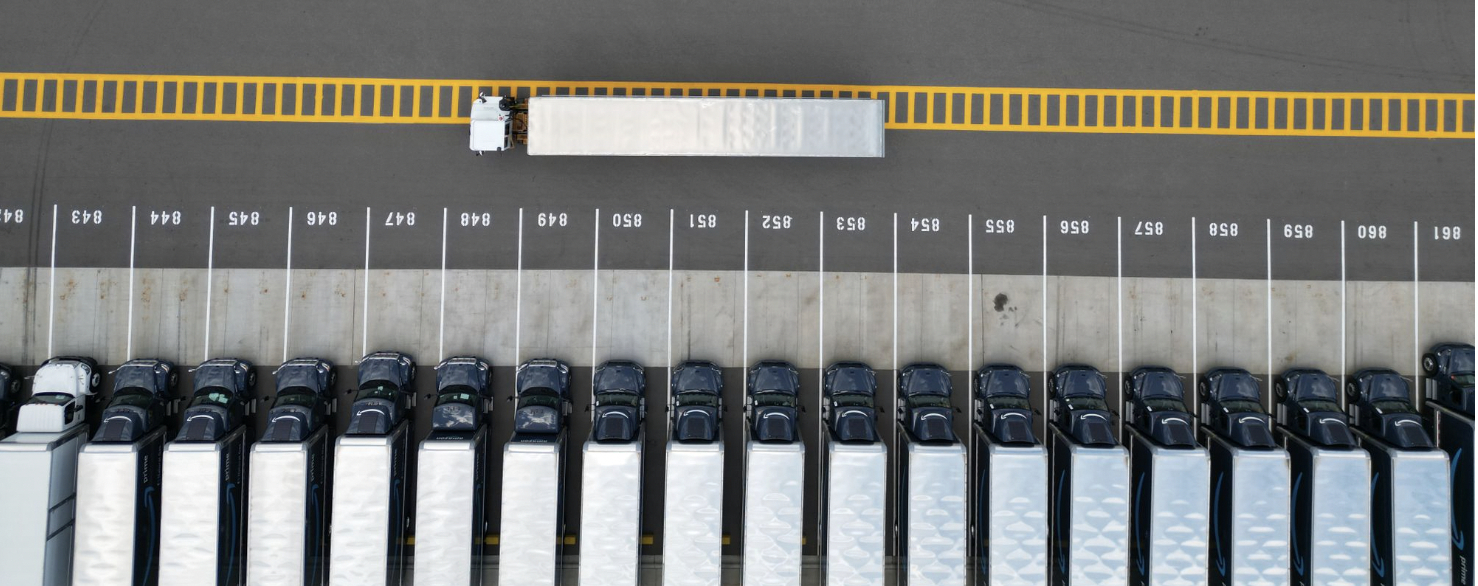
The logistics industry has already lived through its fair share of revolutions; Chris Roe, MD at Amazon Freight UK & EU tells Impakter about one of his customers whose previous supply chain once moved goods by horse. We’ve come some distance since then, but with AI accelerating and regulations shifting, the industry is in the middle of another transformation. What should we expect? That was the focus of a recent fireside chat between Roe and Tamara Basic Vasiljev, LinkedIn’s Head Economist for EMEA.
In this article, Chris and Sarah Perras unpack these challenges in more detail, with a focus on what our shared predictions might mean for the logistics industry across Europe.
Freight networks are changing
For years, many shippers were comfortable relying on a small number of carriers and long, fixed contracts. It felt stable. But disruption is now the norm and that model is breaking down. The Red Sea crisis in early 2024 rerouted roughly 90% of container traffic that normally transits the Suez Canal and, in 2026, the previously low-key Strait of Hormuz suddenly became world-famous. Events like this, once rare, are repeating with increasing frequency.
“What I see in conversations with shippers is a shift from loyalty-based carrier relationships to portfolio thinking,” Chris explains. “They’re building flexibility into their networks, bringing in different partners and looking for ways to scale capacity up or down as conditions change.” The European road freight market alone represents over €400 billion annually, and even a small shift in how that spend is managed has enormous implications.
Policy is accelerating the change. The EU’s revised Trans-European Transport Network (TEN-T) regulation, agreed in 2024, sets binding targets for rail freight corridor capacity and cross-border performance by 2030. The Sustainable and Smart Mobility Strategy goes further, targeting a 50% shift of road freight journeys over 300km onto rail or inland waterways by 2050.
“This isn’t new”, Chris notes “Our customer who once used horsedrawn carts also sent rafts of goods down the Ohio river. What’s different is the scale. And none of this reduces the importance of road freight. It will still carry the majority of European goods. But the balance is shifting and the most resilient supply chains will be the ones that knit together road, rail and waterway, with digital tools providing a single view across all of it.”
For most organisations, this won’t be one dramatic move. It will be a series of deliberate adjustments over the next five years.
AI working alongside people
AI tends to get discussed in extremes: either it replaces everyone, or it’s too far away to matter. Chris pushes back on both.
“Neither is true. What we actually see inside logistics operations is far more practical and far more interesting,” he says. At Amazon Freight, AI and machine learning already support network design, routing and load planning. These systems can evaluate thousands of options in seconds and surface patterns that would take a human team days to identify. But they don’t make decisions alone.
“Our planners use these tools to sharpen their own judgement. AI generates options based on historical patterns and expected demand; people bring what they know about individual customer needs, local constraints and commercial context.” McKinsey estimates that AI and advanced analytics could unlock $1.3 to $2 trillion in annual value across supply chain and logistics globally. In Chris’s experience, most of that value will come not from replacing human decision-making but from augmenting it.
“I think of AI less as an autopilot and more as multiple extra pairs of eyes. A set of copilots,” he says. “It handles the heavy analytical work so that people can focus on the trade-offs that actually require judgement: customer relationships, safety calls, cost vs. speed decisions. The role of the human shifts from processing every detail to concentrating on the decisions that matter most.”
The organisations that will get the most from AI in logistics, Chris argues, are those that invest in three things: clean data, employee confidence with new tools and a culture that keeps human judgement at the centre.
Entrepreneurship, adaptability and the future of work
AI isn’t only changing how logistics networks run. It’s reshaping how people build careers. LinkedIn’s 2024 Work Change Report indicates that 70% of the skills used in the average job will change by 2030. The World Economic Forum puts it similarly: 44% of workers’ core skills will be disrupted in the next five years.

This is already visible in the physical world of logistics. Roles that once focused mainly on manual tasks now involve digital platforms and data interpretation; even in parts of the industry that seemed far removed from technology five years ago. At the same time, accessible software is lowering the barrier for smaller operators and specialists to compete.
Chris gives a concrete example. “One of our shippers, Systemise Fulfilment, aggregates parcels and freight from various customers and ships truckloads with Amazon Freight to non-Amazon destinations. Neither Systemise nor Amazon Freight alone could have served those end customers, but together we deliver for them as reliably as we do for anyone shipping to Amazon FCs or anywhere else.” That kind of collaboration, he argues, is the future of this industry.
The challenge is connecting this growing pool of capacity into structures that are safe, reliable and aligned with Europe’s economic and environmental goals. Done well, the result will be a more diverse and resilient ecosystem of providers.
Threaded through all of this is ‘adaptability’. LinkedIn chose it as their word of 2024, and it resonates strongly in logistics. Deep expertise still matters enormously, but the ability to learn new tools and move between roles is becoming equally important.
“Within Amazon Freight, we encourage people to keep building their core skills while staying curious about how their work fits into the bigger picture,” Chris says. “Being open to change isn’t a nice-to-have any longer. It’s a requirement.”
A more resilient, human-centred logistics system
As Europe moves into a new economic cycle, cost pressure, regulation and geopolitical uncertainty will continue to shape logistics decisions. But there is also a larger opportunity here too.
The EU logistics sector accounts for approximately 5% of EU GDP, and how it evolves over the next decade will affect far more than supply chains alone. The convergence of AI, new regulation and shifting workforce expectations creates a chance to build systems that are not only more efficient but genuinely more resilient and more sustainable.
Related Articles
Here is a list of articles selected by our Editorial Board that have gained significant interest from the public:
“That means designing for shocks, not just efficiency,” Chris reflects. “Using technology to improve outcomes for workers and the wider community, not just to cut headcount. Taking the hard lessons from recent disruption and turning them into structural improvements rather than just patching what broke.”
The future of European logistics won’t be decided by technology or regulation alone. It will come down to the choices made now: about collaboration, investment and how new tools are put to work across the industry. Those choices will shape how goods move, and how people experience work and opportunity in this sector, for a generation.
** **
All external links have been chosen by Impakter.
Editor’s Note: The opinions expressed here by the authors are their own, not those of Impakter.com — Cover Photo Credit: Giant Asparagus.