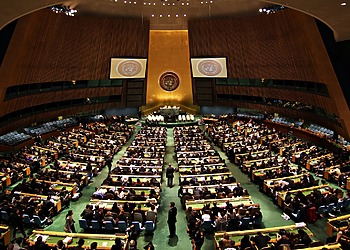
The Iran War is now front and center, but other devastating wars continue in Ukraine, Gaza, Sudan, Myanmar, and the Sahel. Major‑power rivalry has returned with a vengeance, with multinational corporations now rivaling states in influence and wealth. Global governance — once the aspirational architecture of a cooperative world — feels increasingly far beyond our reach.
Benjamin Franklin said regarding the U.S. Constitution, “A republic, if you can keep it.” Regarding the global legal framework, one might say: “rules governing international conduct do exist — if we can keep them.”
Two juridical institutions worth looking at represent efforts by the international community to impose some order from chaos, namely the International Court of Justice (ICJ), created in 1945 as the UN’s principal judicial organ and venue for disputes between states, and the International Criminal Court (ICC), in force since 2002, designed to prosecute individuals for genocide, war crimes, crimes against humanity, and aggression. Both courts were born of horrendous events, the first in the aftermath of World War II, the second, spurred by genocide in Rwanda and the former Yugoslavia. Both were designed to restrain power. Now, both face existential questions about their relevance.
(Not a “court,” but there is also the International Centre for Settlement of Investment Disputes (CSID), an organization of the World Bank Group, limited to international investment disputes between investors and host member States to be resolved through conciliation, arbitration, or fact-finding.)
The two international courts, the ICJ and ICC, have different funding sources and resources. The ICJ receives roughly $8 million annually to support its 15 judges and staff, funded through regular UN assessments. The ICC has an annual budget of approximately $187 million, funded by UN member states, with a staff of roughly 800. Neither amount is overwhelming in the context of overall international financing; as such, these costs are modest.
The ICJ is criticized for glacial timelines that stretch disputes into multi‑year sagas. The ICC is faulted for its limited jurisdictional reach, political vulnerability, and inability to prosecute many of the world’s most powerful actors.
Despite these weaknesses, arguably, these courts still matter — somewhat. Their rulings can shape diplomatic narratives to some degree, they influence the application of sanctions, they limit travel abroad by indicted leaders (for example, Vladimir Putin), and they provide a legal basis for future accountability efforts. Whether these two institutions are worth keeping in a world where so few abide by the basic tenets of international law depends on how you see their past performance and future prospects of making a difference. Of grave global consequence in this regard, the President of the United States has explicitly stated, “I don’t need international law…[my] power constrained only by ‘my own morality.’”

The International Criminal Court: Its Mandate Is Larger Than Its Reach
When the ICC began its activities in The Hague in 2002, it was hailed as a historic breakthrough. For the first time, a permanent court would prosecute individuals — presidents, generals, warlords — when national systems failed or refused to act. The Rome Statute that created the ICC defined four core crimes: genocide; crimes against humanity; war crimes; and the crime of aggression.
At the core of its raison d’être, the court was designed to be independent, impartial, and universal. As of 2026, the ICC has 124 member states, compared to 193 UN member states. Missing from the list are the most powerful, namely the United States, Russia, China, India, Israel, Turkey, and Saudi Arabia.
Further, the ICC cannot prosecute crimes committed on the territory of non‑member states unless the United Nations Security Council refers the situation (which Russia, China, France, the United Kingdom, or the U.S. can veto) or a non‑member state voluntarily accepts jurisdiction. So far, this limitation has resulted in an unsatisfactory record, as reflected below:
Ukraine (2022–present): Ukraine is not a full ICC member but accepted jurisdiction in 2014 and 2015. Thereby, it enabled the ICC to issue arrest warrants, including the 2023 arrest warrant for Russian President Vladimir Putin. Russia, however, as a non-member, refuses to cooperate. (Enforcement is impossible unless Putin travels to an ICC member state willing to arrest him.)
Gaza and Israel (2023–present): Palestine is an ICC member, but Israel is not. The ICC, therefore, has jurisdiction over crimes committed on Palestinian territory, regardless of the perpetrator’s nationality. Although this conflict has prompted UN Security Council resolutions, the Security Council has not exercised its authority under the Rome Statute to refer the situation to the ICC.
Sudan (Darfur): The ICC issued warrants for former President Omar al‑Bashir in 2009 and 2010. He traveled for years without arrest, even to ICC member states. Only after Sudan’s 2019 revolution did the possibility of surrender emerge — and, even then, political instability has stalled progress. Atrocities by the Rapid Support Forces in its civil war continue.
Myanmar (Rohingya): Myanmar is not a member, but Bangladesh is. The ICC has jurisdiction over crimes that began in Myanmar but continued on Bangladeshi territory (such as forced deportation). This narrow legal hook allows only partial accountability.
Iran (present): Iran signed the Rome Statute in 2000 but never ratified it and, as a result, is not considered a member state; nor is it bound by the Statute, unless it were to accept the Court’s jurisdiction under Article 12 (3) of the Rome Statute. (Given the current situation, a UN Security Council option for ICC jurisdiction is highly unlikely.)
These cases largely show that warlords, ousted dictators, and rebel commanders are vulnerable. Sitting presidents of powerful states are not.
In addition to the scope of the ICC’s reach, there is controversy over the ICC’s leadership and prosecutorial decisions, with the chief Prosecutor, Karim Khan, having faced charges related to both professional actions and personal misconduct. Namely, he has been accused of sexual misconduct (he temporarily stepped down). In 2025, the U.S. sanctioned several ICC judges and officials for “illegitimate actions” regarding U.S. personnel in Afghanistan and arrest warrants for Israeli officials.
The Case for ICC Relevance
Notwithstanding the above, the ICC contributes by:
- shaping global narratives (ICC arrest warrants delegitimize leaders and influence diplomatic calculations).
- preserving evidence for future justice (when arrests are impossible, the documentation can build the foundation for a future case).
- pressuring governments to conduct their own investigations and serve as a public forum for victims.
But ICC weaknesses — limited jurisdiction, political vulnerability, and reliance on state cooperation — have resulted in an institution falling far short of what was hoped when it was established over one-quarter of a century ago.
The International Court of Justice Decisions at Glacial Speed
The International Court of Justice is the UN’s principal judicial organ. Unlike the ICC, which prosecutes individuals, the ICJ adjudicates disputes between states. Its jurisdiction is based on treaties that grant it authority, and it can take up cases with ad hoc state consent or issue advisory opinions in specific cases. That said, the ICJ cannot force states to appear before it unless they have already agreed to its jurisdiction. Nor can it enforce its rulings without UN Security Council support — where the same geopolitical vetoes apply.
The Pace of Decision-Making
The ICJ is notorious for its slow pace. Cases often take three to five years, sometimes longer. Even urgent disputes — such as genocide allegations — can take months before provisional measures are issued. With today’s conflicts evolving much more rapidly, such extended delays render many decisions politically obsolete. Below are a few examples of high-profile cases yet to be resolved:
The Gambia v. Myanmar (2019–present): The case over the Rohingya genocide has stretched on for years, with procedural delays and political upheaval in Myanmar complicating progress.
Ukraine v. Russia (2022–present): Ukraine accused Russia of abusing the Genocide Convention to justify its invasion. The ICJ issued provisional measures ordering Russia to suspend military operations. Russia ignored them. The merits phase continues in 2026.
South Africa v. Israel (2024–present): South Africa’s genocide case against Israel over the war in Gaza became one of the most politically charged ICJ proceedings in decades. The court issued provisional measures in early 2024, but the full case is expected to take years, long after the conflict’s dynamics have changed.

Reasons for ICJ’s Slowness
The ICJ was designed for an earlier, more deliberative era — one where states negotiated for years before resorting to litigation. As it was originally formulated and as it has conducted its operations, structural factors contribute to the lengthy times to reach final decisions, including:
- complexity of evidence in state‑to‑state disputes.
- need to translate and document materials carefully presented.
- procedures that allow extensive written submissions.
- limited judicial capacity (15 judges handling global disputes).
- and diplomatic sensitivity, which encourages caution.
Fundamentally different now is the reality that crises move at morph speed, much faster than the ICJ seems able to respond. (Vastly improved communications and available technology would seemingly give the ICJ the tools to expedite decisions.)
A late judgment is better than none.
Even such slow decision-making processes can have an impact by:
- shaping international opinion (ICJ rulings become reference points for diplomats, journalists, and civil society);
- affecting sanctions and trade decisions;
- creating legal precedents that, over time, can shape the behavior of states; and
- providing a peaceful forum for disputes because there are many instances in which adversaries prefer litigation to escalation.
In short, while flawed, the ICJ remains the only global court where states can litigate disputes with each other under international law.
Related Articles
Here is a list of articles selected by our Editorial Board that have gained significant interest from the public:
Why These Courts Still Matter
The vision of a rules-based international order after the Cold War has largely faded or increasingly been ignored. Major powers continue to compete, regional conflicts are increasing, and multilateral institutions have lost considerable strength. Both ideological groups and large private-sector entities are vulnerable to disinformation, which erodes trust in global norms.
Nation-states invoke international law only when it suits them and ignore it when it does not. Paralleling the U.S. President’s comments, Secretary of Defense Pete Hegseth, in a recent briefing on the Iran War, has called for “no quarter for U.S. enemies,” a potential violation of international law.
Such selective approaches by the U.S. (and there are many other countries) undermine the courts, while at the same time highlighting their symbolic power. Indeed, when states file ICJ cases or initiate ICC investigations, they implicitly acknowledge the courts’ legitimacy — even as they resist accountability for themselves.
Reform, Reinvention, or Irrelevance?
For the ICC, there have been various ideas for “reform,” including enhancing victim participation and clarifying the crime of aggression. Although these ideas show potential, the key reform needed is universal jurisdiction, which currently faces overwhelming political obstacles.
For the ICJ, some improvement proposals include new fast‑track procedures for urgent cases, clearer enforcement mechanisms, and the adoption of new technologies. Again, these are all potentially beneficial avenues to pursue, but any reform would require state consent, which is highly unlikely.
In short, prospects for substantial reform are “wishful thinking” given today’s geopolitical environment. These courts will not compel major or even lesser powers to adhere to accepted international norms, principles, or laws, but they do stand as representations of our better angels and voices for global accountability. Far from ideal, there is still value in maintaining these institutions. “If we can keep them”…
Editor’s Note: The opinions expressed here by the authors are their own, not those of Impakter.com — In the Cover Photo: The judges of the International Court of Justice (ICJ), February 08, 2021. Cover Photo Credit: International Court of Justice (ICJ).