Chocolate is bittersweet: it’s warm, savory taste melts in the mouth, is a great topper to any dessert and can make anybody’s day a light brighter – and yet, it is one of the leading causes of deforestation and child labor in West Africa.
According to a new report called The Cocoa Barometer, environmental and social problems in cocoa supply chains will continue if farmers do not have the living wages to fight against deforestation and child labor.
The cocoa report came just a day after the European Union (EU) agreed on a new law preventing companies from selling products that are linked to deforestation, such as cocoa and chocolate, to the EU market.
Living wages needed, report states
The VOICE Network group of civil society organization’s latest report analyzed cocoa-producing countries and found many farmers are stuck in poverty-stricken areas, unable to combat rampant deforestation and child labor caused by the cocoa industry.
One of the first topics the report touches on is living wage, or the lack of it. Despite being compensated for using sustainable practices, farmers are still unable to combat deforestation and child labor without being paid a living wage.
According to The Cocoa Barometer, two of the biggest chocolate producers, French chocolate manufacturer Cemoi and Swiss multinational food and drink giant Nestle, both have measures in place to pay farmers more money for using sustainable practices:
“Cemoi claims to pay a premium for quality and sustainability of 10 to 20% of the cocoa price, and Nestlé has its Income Accelerator Programme which pays extra incentives for households that undertake specific sustainability efforts.”
However, the report states these measures are and will continue to be ineffective if companies do not start to invest in Good Purchasing Practices and if governments do not start to develop and implement Good Governance Policies.
Part of the reason living wages are impossible for farmers to acquire is that the cocoa industry as a whole has refused to change purchasing practices aimed at avoiding higher prices.
Although the report vouches for an increase in chocolate prices, they state that “there are no approaches that only look at price to solve the income gap… While raising prices might not help the struggling farmers to completely reach a living income, it will nonetheless help them increase income, sometimes by significant percentages.”
To address lack of adequate income, in 2019 Ghana and the Ivory Coast, which produce 60% of the world’s cocoa supply, formed an export cartel introducing a $400 (380.70 Euros) per ton Living Differential Income. The goal was to bring the price of cocoa up enough to cover the cost of production.
Big chocolate companies, such as Barry Callebaut, Cargill, Ferrero, Hershey, Lindt, Mars, Mondelez and Nestlé, welcomed the initiative. However, out of public view, these companies have done everything possible to avoid paying the premium and raising costs of their products, which account for 90% of the industry’s $130 billion in annual profits.
According to the report, the living wage in Côte d’Ivoire is US$11 per day and in Ghana is $13.50. Although this may seem like an adequate salary, with the additional labor costs, it is impossible for farmers to make a profit as it would take an additional 10 hired labor days per hectare to produce 100 extra kilos of cocoa to cover production costs.
Additionally, the majority of workers in West Africa work on a temporary basis without employment contracts and thus do not make these wages which are already low to begin with. In fact, as early as ten years ago, workers on cocoa farms in Côte d’Ivoire and Ghana made only 150 to 300 Euros ($157.41- 314.83) a year.
Cocoa is one of the leading causes of deforestation and child labor
Particularly in Ghana and Côte d’Ivoire regions of West Africa, cocoa production is one of the driving forces of deforestation. In fact, the World Wildlife Fund for Nature (WWF) found that in 2017, 70% of the world’s cocoa beans were grown in West Africa and that 70% of the country’s illegal deforestation is due to the cocoa industry.
Research published by Mighty Earth in February 2022 revealed that since January 2019, Côte d’Ivoire and Ghana have lost nearly 60,000 hectares of forest — an area equivalent to the size of Madrid.
Deforestation impacts the environment in many different ways:
(1) it leads the loss of biodiversity and habitat;
(2) inhibits the livelihood of people who rely on the forest for food, medicine and building materials; and
(3) exposes lethal pathogens to humanity.
Forests are part of an ecosystem’s circular economy by the way they absorb carbon and contribute to healthy soil and water quality as well as flood prevention and a number of other ecosystem services. Without a doubt, deforestation has an impact on the health of the environmental and regional communities where it is rampant; the coffee industry not being exempt to the impacts of deforestation.
In fact, if deforestation and other contributing factors to climate change continue, by 2050, large parts of West Africa will be unsuitable for cocoa production.
Child labor is also a leading concern in the cocoa industry with 1.5 million children in Côte d’Ivoire and Ghana working in the industry. Out of 1.5 million children in the cocoa workforce, 95% are exposed to the worst child labor conditions including performing hazardous activities and being subjected to harmful pesticides.
Governments in both Ghana and Côte d’Ivoire have attempted to raise awareness through campaigns, yet without national policies in place to restict child labor, these efforts remain ineffective.
EU passes law to prevent unethical chocolate
On Tuesday, the EU agreed on a new law set to prevent cocoa, coffee, beef, soy and other products linked to deforestation from being sold to the EU market. For years, the EU has been the world’s largest importer of cocoa, accounting for 60% of cocoa imports.
The new legislation will apply to soy, beef, palm oil, wood, cocoa, coffee, leather chocolate and furniture. EU lawmakers also requested to include rubber, charcoal and other palm oil products.
When the EU first came up with the idea, ambassadors from France, Spain, Italy and other smaller countries objected to the legislation, citing the value chain and civil liabilities were too wide and too ambitious.
One of the concerns regards the due diligence statement required by companies in the new law. The new law will demand companies make a due diligence statement showing where and when their commodities were produced as a means of proving that they had not been grown on deforested land after 2020. If companies don’t comply, they could face hefty fines of up to 4% of their companies’ turnover in the EU market.
Yet many are concerned this due diligence obligation will limit companies’ ability to utilize their established business relations.
According to Trase, a review of commodity deforestation and expansion, “55% of Ivorian cocoa, two-thirds of which is exported to the EU and the U.K., comes from untraceable sources.”
The due diligence statement supports only ethical business relationships and will put these “untraceable sources” in the past; in essence putting cocoa in a precarious situation, where production could decrease.
Countries like Brazil, Indonesia and Colombia also opposed the legislation saying it will be burdensome and costly because of how difficult it is to monitor certification.
https://twitter.com/selormmorrison/status/1570156544120979457
In Brazil, many claim the legislation does not go far enough to protect “other wooded areas” that have trees but aren’t as dense and closed off. Areas such as the 600,000 square kilometers of woodland in the Cerrado savanna, the fastest-growing area of agriculture in Brazil, will not be protected by the law.
Brazil and other European advocacy groups criticized the requirement of companies to prove they respect indigenous people’s rights only if their land is legally protected in the producer country. Brazil’s Foreign Ministry hopes to further examine the legislation once it is published.
Despite the risks, countries such as France later showed high support for the directive, viewing it as an important way to concentrate on the “upstream” part of the supply chain shared by EU member nations.
Earlier this year, the EU, Ivory Coast and Ghana pledged to follow a roadmap to make cocoa production more sustainable. The roadmap aims to implement President von der Leyen’s zero-tolerance approach to child labor, tackle deforestation and force due diligence on companies to promote corporate sustainability. At the moment, it is unclear whether the roadmap will be included in the new legislation.
As the EU wrestles with what should be included in the new law, the next step is for EU member nations and the European Parliament to formally approve the legislation.
Discussion surrounding years of abuse in the coffee industry is a good starting point, and the EU’s efforts to recognize and regulate such abuses is one of the first steps by global giants to change a flawed system.
However, there is still much work to be done on the legislation, in order to change a system that has been built to disadvantage those who do the most for the global food network.
Chocolate is bittersweet, and is likely to stay this way for a while.
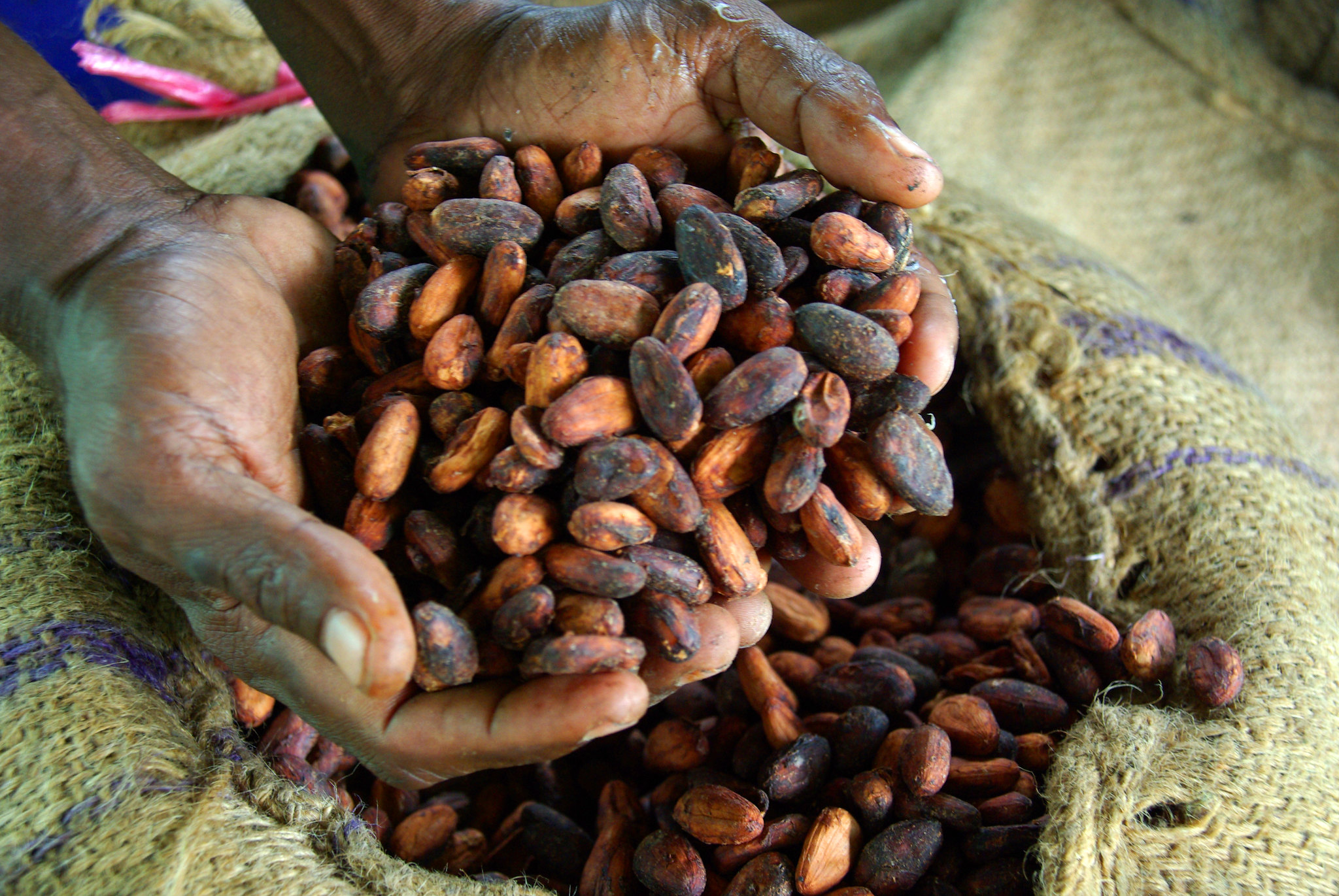
Editor’s Note: The opinions expressed here by the authors are their own, not those of Impakter.com — In the Featured Photo: Cocoa farmer David Kebu Jnr holding the finished product, dried cocoa beans ready for export on June 25, 2013. Source: Department of Foreign Affairs and Trade, Flickr.