Live business moguls, including Elon Musk, are questioning the U.S. Federal Reserve Bank’s existence. It’s enough to make the avoiders of the Titanic…well, regret not being able to rollover their legacy.
The soul searching comes on the heels of the Federal Reserve’s unprecedented loss: its net income shriveled by 201.2 billion in the fiscal year ending in October, 2024. This after an already record-breaking loss of 114.3 billion U.S. dollars in the fiscal year ending in October of 2023. The independent bank, whether despite or because of its privatized characteristics, appears to be in a freefall. This catastrophe purportedly stemmed from managing the U.S. short-term interest rate.
How could the Fed get it so wrong?
None of the big three credit agencies saw it coming, just as they failed to predict the downfall of Silicon Valley Bank last year, failed to predict the 2008 financial crisis…. Once again, the larger issue of systemic credit rating legitimacy looms.
Rating agencies look at financials to assess credit worthiness, but they also aspect market reality, by shaping the borrowing environment for a company or country in their orbit. An overly benevolant credit rating translates into lower borrowing rates, enabling entities to access cheap funding to grow their infrastructure and production, potentially exposing investors to more risk than they bargained for.
But what about U.S. credit rating agencies themselves, which are private entities exposed to shareholder value pumping and the kinds of “narrative” lies that might strangle mainstream news outfits…are they sus?
If we take a comparative view, we see minor discrepancies between agencies within the U.S., and startling differences as soon as we look at agencies overseas.
Wait! What? Where?
Foreign credit rating agencies are hard to find since they are downplayed in Western media. Western academics criticize Eastern credit rating agencies, singling them out, for example, without mentioning more than one agency per critique, as if to suppress knowledge of alternatives, rather than elucidate options. A more balanced view of the major credit rating agencies, taking the example of ratings on U.S. sovereign debt:
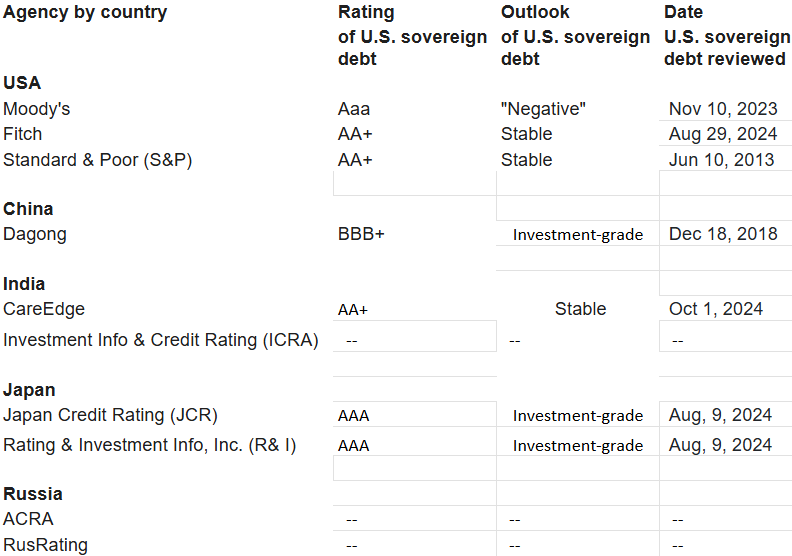
China’s premier credit rating agency, Dagong Global Credit Rating, has downgraded the United States’ sovereign rating from A- to BBB+. This puts the U.S. economy on the same level as Peru, Colombia, and Turkmenistan. While Moody’s maintains an Aaa rating for the U.S., and S&P Global rates it AA+, Dagong ― with its 500 employees, including over 200 doctorate or masters degree analysts and 50 postdocs in its six regional headquarters and 34 branches ― disagrees.
In the U.S., a negative outlook is typically not assigned specific letter grades. Instead, negative adjectives are communicated through statements or reports from the credit rating agency, hence Moody’s calling the Aaa credit rating in the specific case of the U.S. “negative.”
Those in the U.S. might be tempted to say, Our credit agencies are better than theirs, but China represents the largest foreign percentage of the U.S.’s customer base historically: China accounted for 10.8% of U.S. treasury debt owned, as of October 2023, according to the U.S. Treasury Department, Treasury International Capital (TIC) System. Another rational: It would behoove the U.S. to meet the standards of the investors it is attempting to woo.
Dagong aspected U.S. tax cuts as a significant factor in the downgrade. In Dagon’s eyes, the switch from generating revenue through taxes to generating revenue from “quantitative easing” (printing, inflating, and essentially borrowing from holders of U.S. dollars worldwide), which Dagon estimates to add over $1.4 trillion to the $35.9 trillion national debt, weakened the U.S.’s ability to repay its debt. The agency expressed concern over the U.S.’s increasing reliance on debt to fuel economic growth, warning that this could erode the country’s long-term solvency. This view has not only seen, but actively shaped the flow of investments.
Related Articles: Historic Milestone: US Debt Exceeds $30 Trillion | Stocks Plummet as Fitch Downgrades US Credit Rating | What Is the BRICS Bank and Why Is It Not Considering New Projects in Russia?
After its founding in 2006, BRICS hatched the idea of a credit rating agency. Meanwhile, contemporary geopolitics has shown that in a multi-polar world, a multiplicity of viewpoints is at a premium. Since 2018, talk of a centralized credit rating agency has subsided. Probably because economic powerhouses like China, India, and Russia already have their own trusted credit rating agencies, usually subject to government oversight.
India’s CareEdge Ratings is part of the global credit rating landscape through its partnership with ARC Ratings, a British Virgin Islands company. CareEdge has formed strategic alliances with international agencies like the Japan Credit Ratings Agency (JCR) and the Russian credit rating agency ACRA, further expanding its global reach, and influence. Japan, which suffers from the biggest debt balloon per capita in the world, aspects U.S. sovereign debt as more pristine than how the U.S. sees itself. Whether JCR’s influence has any crystallatory regard in reality, remains to be seen. Perhaps JCR’s whole system is inflated; bringing their rating of the U.S. in line with other agencies’ ratings would probably mean they would have to also lower their rating of Japan.
Several nations, including India, have expressed concerns about the credibility of credit ratings assigned by US-based rating agencies. Critics argue that these agencies often lack transparency in their methodologies, fail to adequately capture the fundamental strengths of economies, and exhibit bias against emerging markets. Despite India’s position as the world’s fifth-largest economy and its impeccable record of debt repayment, it has been assigned a relatively low credit rating by the big three U.S. (“global”) agencies, raising questions about the objectivity and accuracy of their assessments.
The cheese stands alone
Some countries’ credit rating agencies do not venture into rating U.S. sovereign debt. Russia’s ACRA and RusRating, and India’s CRISIL mind their own business, focusing on rating national issuers and domestic debt. Perhaps they recognize the futility of trying to separate politics from international ratings?
We are at a crossroads
Enter a period of swiftly changing institutions: the fluidity with which BRICS is assembling, and the U.S. is reacting and reassembling, is staggering. Ever resourceful individuals are chipping away at the machine. Republican Senator Mike Lee of Utah said in a post on X, “The Executive Branch should be under the direction of the president. The Federal Reserve is one of many examples of how we’ve deviated from the Constitution in that regard. Yet another reason why we should #EndTheFed.”
Former congressman Ron Paul, who ran for president several times, published a book in 2009 entitled End the Fed. Republican Rep. Thomas Massie of Kentucky and Lee have each introduced corresponding bills aiming to shift the nation’s central bank’s responsibilities to the Treasury Department.
The existential Federal Reserve question coincides with clamour over violations of the cornerstone First Amendment right to freedom of speech. Even the most naïve might well wonder what risks the rating agencies might be hiding. O Muse, lift us.
Editor’s Note: The opinions expressed here by the authors are their own, not those of Impakter.com — Cover Photo Credit: Author.