Impakter
  • Environment
    • Biodiversity
    • Climate Change
    • Circular Economy
    • Energy
  • FINANCE
    • ESG News
    • Sustainable Finance
    • Business
  • TECH
    • Start-up
    • AI & Machine Learning
    • Green Tech
  • Industry News
    • Entertainment
    • Food and Agriculture
    • Health
    • Politics & Foreign Affairs
    • Philanthropy
    • Science
    • Sport
  • Editorial Series
    • SDGs Series
    • Shape Your Future
    • Sustainable Cities
      • Copenhagen
      • San Francisco
      • Seattle
      • Sydney
  • About us
    • Company
    • Team
    • Partners
    • Write for Impakter
    • Contact Us
    • Privacy Policy
No Result
View All Result
  • Environment
    • Biodiversity
    • Climate Change
    • Circular Economy
    • Energy
  • FINANCE
    • ESG News
    • Sustainable Finance
    • Business
  • TECH
    • Start-up
    • AI & Machine Learning
    • Green Tech
  • Industry News
    • Entertainment
    • Food and Agriculture
    • Health
    • Politics & Foreign Affairs
    • Philanthropy
    • Science
    • Sport
  • Editorial Series
    • SDGs Series
    • Shape Your Future
    • Sustainable Cities
      • Copenhagen
      • San Francisco
      • Seattle
      • Sydney
  • About us
    • Company
    • Team
    • Partners
    • Write for Impakter
    • Contact Us
    • Privacy Policy
No Result
View All Result
Impakter
No Result
View All Result

Oil Shocks and Crashes: Where Are We Headed With the 2026 Crisis?

Past oil shocks reshaped energy policy and fuel use. With electric transport and renewable power expanding rapidly, the latest disruption may reinforce trends already reducing the world’s reliance on oil

byPeter Newman AO - John Curtin Distinguished Professor of Sustainability, Curtin UniversityandRay Wills - Adjunct Professor at The University of Western Australia
March 11, 2026
in Energy, Politics & Foreign Affairs

On March 9, oil prices crossed US$ 100 a barrel for the first time in almost four years as the war in the Middle East between the US and Israel on one side and Iran on the other continued to escalate with no immediate end in sight.

Oil price shocks triggered by conflict in the Middle East have historically reshaped global energy systems. But the latest tensions around the Strait of Hormuz are unlikely to produce a long-term return to high oil prices.

The first oil crisis in 1973 shaped the lives of baby-boomers. The price of oil quadrupled overnight as Arab oil exporters targeted Canada, Japan, the Netherlands, the UK and the USA. The second oil crisis, in 1979, followed the Iranian Revolution and panic buying set in as the oil price shot up. Then the 1980-88 Iran-Iraq war reduced global oil supply even further, so the price rose dramatically right through the 1980s.

The latest outbreak of war in the Middle East has led to oil tankers being trapped in the Straits of Hormuz, and key producers such as Qatar, Iraq and Kuwait cutting production.

Our reading of both the data and history is that this crisis will reinforce the shift away from oil. If the current war blows out and creates a prolonged oil crisis of months rather than weeks, there will be more downward pressure on oil use — and an equal acceleration in China of electric car production at home, with an associated surge in exports.

The first oil shock disrupted daily life across many Western countries. Fuel shortages led to rationing, long queues at petrol stations and emergency conservation measures in several cities in the United States and Europe. One of us experienced the oil crisis in the USA where San Francisco fell apart as fuel became scarce, 5 km long queues started at gas-stations and people began stealing from neighbours’ cars.

Australia was not targeted. But the ensuing global inflationary spiral began the pressure to look at using less oil. Former prime minister Malcolm Fraser hooked Australia to global oil prices to help us keep more aware of volatility in the market. Fuel efficiency standards became mainstream and drove public awareness of oil dependence to new heights.

Long term plans to get off oil were dropped in 1990 when oil prices crashed back to the $40 range and business-as-usual returned to car sales and use. But in 2008 it rose to a record $147 as China began its growth spurt and US production declined. The resulting global inflation again triggered a collapse in economies and oil fell to the $30s in a few months.

These crises and crashes were not good for economies and thus the need to get off oil became a major global concern. Market volatility in critical functions like transport is never good for economies and when it was clear that a global climate policy also required oil to be replaced then the logic to get rid of fossil fuels became overwhelming. In 2016 the Paris Agreement accelerated the race to electrify transport through the net zero transition.

Related Articles

Here is a list of articles selected by our Editorial Board that have gained significant interest from the public:

  • The Potential Health Impacts of a Prolonged War in Iran
  • The Strait of War: A World on the Brink as Iran and the US Ignite the Global Energy Crisis
  • War and the Environment: The Lasting Impacts

Towards a decline for oil?

An article by Professor Hussein Dia in The Conversation suggests we must accelerate the switch for all transport from oil to electricity. Certainly, there are plenty of people now driving big oil-guzzlers that will be very worried about their decision.

Others saw that the situation had changed as demand was now much less than in previous decades and there was indeed “a global glut of oil.” It is possible that the days of sustained triple-digit oil prices may be over.

Our approach to the future is to trace fossil fuel use and renewables to see how rapidly the energy transition is happening and to predict the future by taking the trends forward using the inflections to guide the exponential trends rather than taking simple linear predictions. The figure shows these trends.
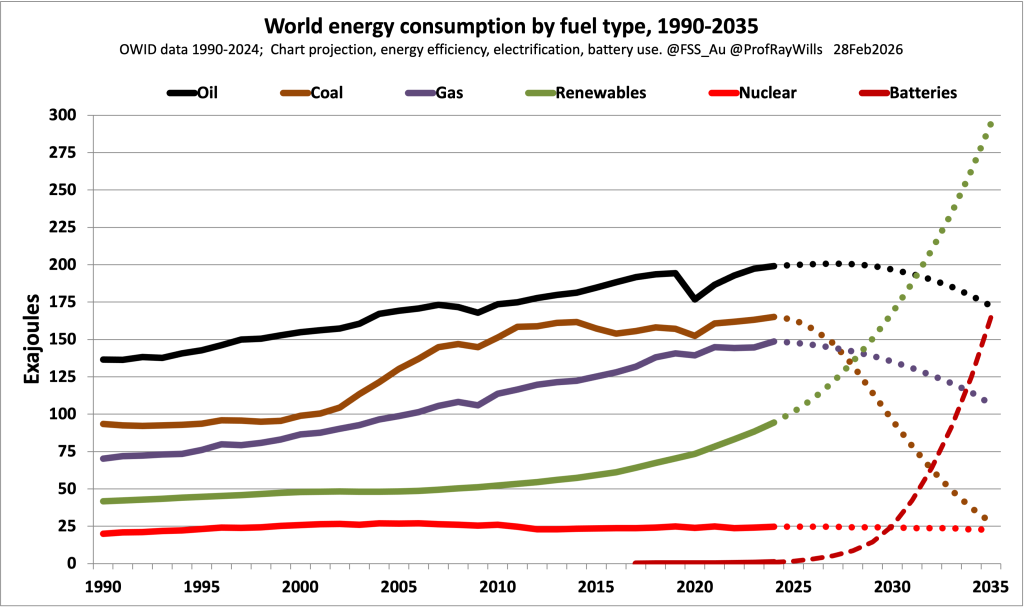
Fossil and renewables consumption 1990-2025 and projection to 2030. Source: Wills and Newman, 2025.

From our projections, renewable energy is quickly gaining momentum and will become the dominant global fuel source by 2030.  The decline in oil as transport systems become electrified and fuelled by renewables suggests oil is headed for dinosaur status.

As demand erodes, oil prices are likely to trend back towards something like $US 40-60 per barrel in the 2030s, not because the world has become more secure for oil, but because oil simply becomes less and less central to how we move people and freight.

For governments, cities and firms, the strategic response to the latest oil crisis cannot simply be to ride out the spike and hope for another crash. They must double down on electrification of transport, backed by rapidly expanding renewable generation and storage.

The world is choosing to depend on sunshine, batteries and wires rather than on unstable sea lanes and combustible geopolitics. The sooner we complete that choice, the less each new oil shock will matter.

** **

This article was originally published under Creative Commons by 360info™. 


Editor’s Note: The opinions expressed here by the authors are their own, not those of impakter.com — In the Cover Photo: Wasp-class amphibious assault ship USS Boxer (LHD 4) sails in the Pacific Ocean, Feb. 27, 2026. Cover Photo Source: U.S. Navy photo by Mass Communication Specialist Seaman Trace Gorsuch.

Tags: clean energyEnergy tranzitionIranIran warIsraelMiddle EastNet ZeroOiloil crisisOil pricesoil shocksParis AgreementStrait of HormuzUnited Stateswar
Previous Post

Fuel or Fiction? How Formula 1 Could Make or Break Sustainable Fuels

Next Post

Solar Power From Space: How Close Is It to Reality?

Related Posts

Space‑Based Solar Power test
Energy

Solar Power From Space: How Close Is It to Reality?

March 11, 2026
Fuel or Fiction? How Formula 1 Could Make or Break Sustainable Fuels
Business

Fuel or Fiction? How Formula 1 Could Make or Break Sustainable Fuels

March 11, 2026
ESG news regarding the EU calling Europe’s nuclear phase-down a strategic mistake, the UK launching a net-zero carbon buildings standard, Spain’s Repsol considering new investors for its U.S. renewables business, and Denmark’s Vestas securing a UK offshore wind turbine order.
Business

Europe’s Nuclear Phase-out Called a “Strategic Mistake” by EU Chief

March 11, 2026
Next Post
Space‑Based Solar Power test

Solar Power From Space: How Close Is It to Reality?

Recent News

Space‑Based Solar Power test

Solar Power From Space: How Close Is It to Reality?

March 11, 2026
Oil Shocks and Crashes: Where Are We Headed With the 2026 Crisis?

Oil Shocks and Crashes: Where Are We Headed With the 2026 Crisis?

March 11, 2026

Impakter informs you through the ESG news site and empowers your business CSRD compliance and ESG compliance with its Klimado SaaS ESG assessment tool marketplace that can be found on: www.klimado.com

Registered Office Address

Klimado GmbH
Niddastrasse 63,

60329, Frankfurt am Main, Germany


IMPAKTER is a Klimado GmbH website

Impakter is a publication that is identified by the following International Standard Serial Number (ISSN) is the following 2515-9569 (Printed) and 2515-9577 (online – Website).


Office Hours - Monday to Friday

9.30am - 5.00pm CEST


Email

stories [at] impakter.com

By Audience

  • TECH
    • Start-up
    • AI & MACHINE LEARNING
    • Green Tech
  • ENVIRONMENT
    • Biodiversity
    • Energy
    • Circular Economy
    • Climate Change
  • INDUSTRY NEWS
    • Entertainment
    • Food and Agriculture
    • Health
    • Politics & Foreign Affairs
    • Philanthropy
    • Science
    • Sport
    • Editorial Series

ESG/Finance Daily

  • ESG News
  • Sustainable Finance
  • Business

About Us

  • Team
  • Partners
  • Write for Impakter
  • Contact Us
  • Privacy Policy

© 2026 IMPAKTER. All rights reserved.

No Result
View All Result
  • Environment
    • Biodiversity
    • Climate Change
    • Circular Economy
    • Energy
  • FINANCE
    • ESG News
    • Sustainable Finance
    • Business
  • TECH
    • Start-up
    • AI & Machine Learning
    • Green Tech
  • Industry News
    • Entertainment
    • Food and Agriculture
    • Health
    • Politics & Foreign Affairs
    • Philanthropy
    • Science
    • Sport
  • Editorial Series
    • SDGs Series
    • Shape Your Future
    • Sustainable Cities
      • Copenhagen
      • San Francisco
      • Seattle
      • Sydney
  • About us
    • Company
    • Team
    • Partners
    • Write for Impakter
    • Contact Us
    • Privacy Policy

© 2026 IMPAKTER. All rights reserved.