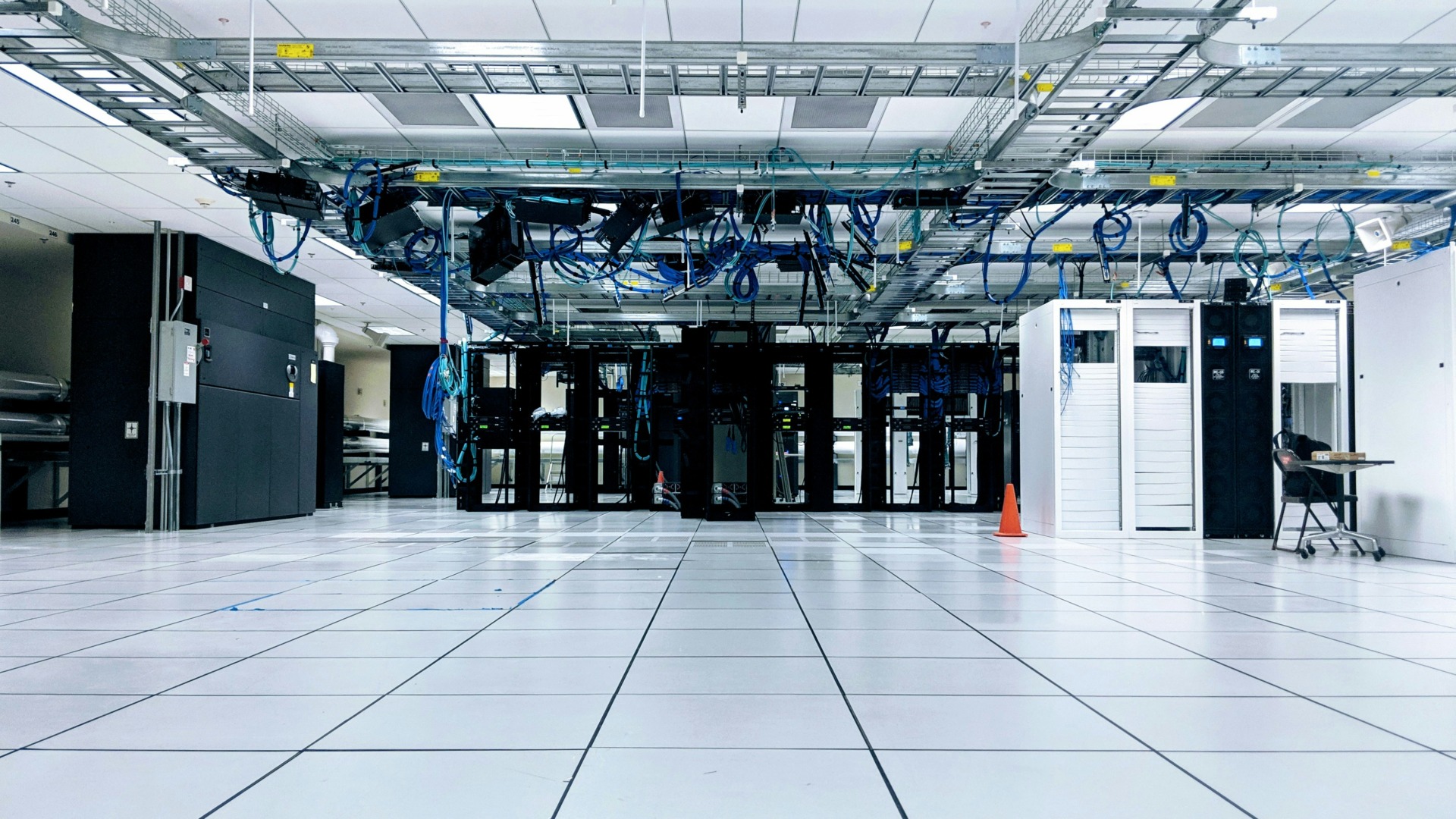
The story is everywhere: AI is using gigantic amounts of electricity. Every time you type something into a chatbot, every image you generate, every suggestion you get from AI, all add up to a concerning total infrastructure cost. Data centres are expanding rapidly. It seems simple: if people use AI ten times more, it will need ten times the electricity, but the problem is more complex, and the main scarce resource for data centres might not be electricity at all.
Electricity and computing demand are connected, but they are not the same. There is a third variable that changes the whole perspective: the amount of energy each computer task requires. As AI evolves, it gets more efficient. The cost of each task decreases, so while the number of tasks increases, electricity demand grows more slowly.
Electricity is just part of the problem. AI needs to be worth the energy it uses. The idea that AI will use more electricity exponentially assumes it will keep evolving, but technology does not usually grow in a straight line. It grows by getting more efficient, while being worth the cost and working around problems.
AI compute growth is mistaken for electricity growth
Many discussions about AI, electricity, and data centres assume that, with rapid growth in AI usage, the electricity required to process all of it increases rapidly as well. However, if in 2026 people chat with various large language models (LLMs) 10 times more, it does not mean that the electricity required to process that increases tenfold as well. Electricity and compute are correlated, but there is another variable that often gets overlooked.
The energy per compute unit is key to understanding progress in AI. With time, AI becomes more efficient, and energy per compute decreases; as our use of AI increases, the strain on a data center from a single input — asking it to summarize a 3-hour podcast in 100 words, for example — decreases.
Modern advanced cooling systems can cut cooling energy use by 20-40%, while the latest AI GPUs are becoming increasingly advanced and effective. A new NVIDIA Rubin Ultra NVL576, coming out in 2027, will have a thermal design power (TDP) of 3,6 kW, with a maximum capacity for a fully configured rack of 600kW. For comparison, modern peak capacity is around 240 kW; at the start of this decade, 15 kW was the peak capacity, which was highly effective. A logical question arises: why can’t one just take 20 racks with 30kW each to achieve the same 600kW, and where are the energy savings?
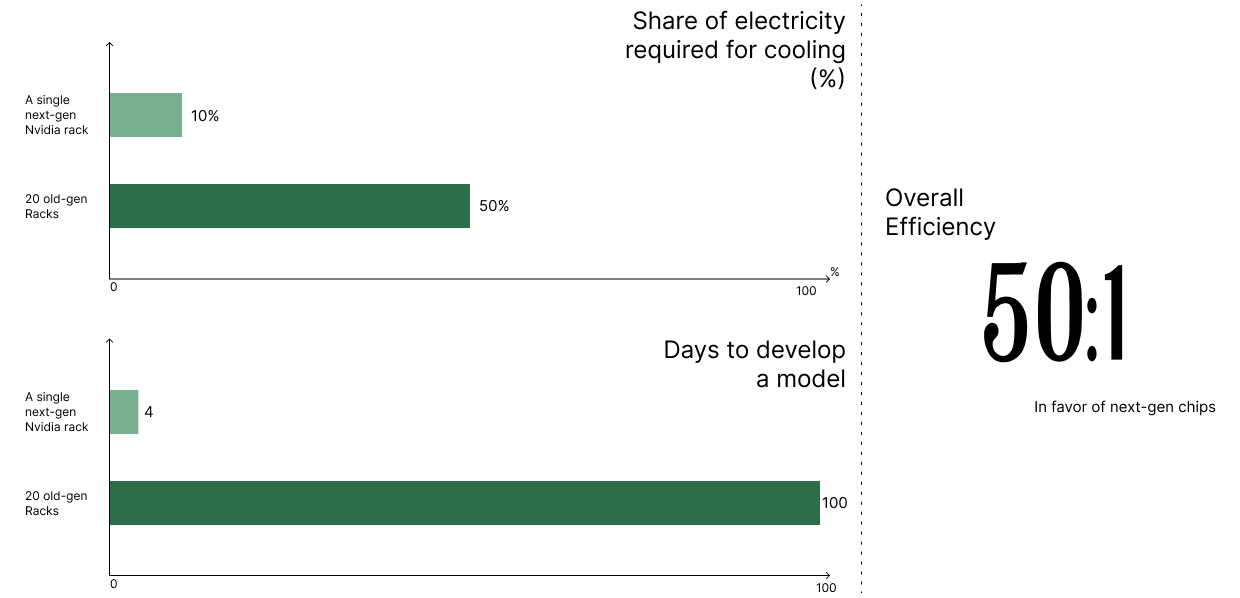
A higher-capacity rack is significantly faster and has energy efficiency 10-50 times higher. Several factors contribute to this.
Firstly, the cooling adds half to the overall output in older racks, so for each 600kW, 300kW is added to the electricity expenditure from the air conditioning. By comparison, in newer racks, water cooling adds a tenth to the overall cost — for each 600kW, merely 60kW is needed for cooling. That’s 25-30% saved just on infrastructure.
The main savings come from performance per watt, meaning that one Rubin rack consuming 600kW performs not as 20 racks of 30kW, but as hundreds, measured in floating-point operations per second (FLOPS). Accounting for that, a model trained in 100 days on older racks can be trained in four days with one next-gen rack. The efficiency of a 600 kW system in a single rack is approximately 20-50 times higher than that of an equivalently rated group of older racks. The primary savings are achieved not by reducing current consumption, but by dramatically reducing the time and cooling losses.
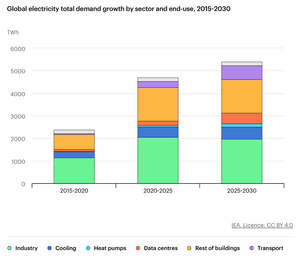
By 2030, data centers will consume twice as much electricity as they do now, according to the IEA’s projections. Their scenarios already account for efficiency improvements in hardware and software. Still, data centres would consume 3% of total electricity, up from 1,5%. A huge amount, however it is necessary not only for AI. While AI drives significant new, high-density infrastructure construction and accounts for about 65-70% of new demand, traditional data centers remain essential for cloud storage, IT systems, website hosting, database management, and daily digital tasks. Data centre expansion is necessary to store and create in the digital space in general, the growth of which we can’t stop.
The economic gain from AI work
Every kilowatt-hour used by AI must be justified in terms of productivity, revenue, cost savings, or a gain in competitive advantage. Data centres do not consume electricity because they power impressive technology; they consume it as it generates economic return. Data centres scale when firms and investors see the gains outweighing operating costs.
At this point, we can see AI struggling with edge cases, multi-step tasks, hallucinations, etc. It still requires human oversight in most cases. In most professional settings, AI requires oversight, edits, or corrections. This supervision limits the expansion of this technology to our abilities. We are not at the point of fully replacing people with AI for entire tasks. According to a recent Remote Labor Index study, the performance of AI agents “sits near the floor, with a maximum automation rate of 3.75% on RLI projects.” That indicates that, more than 96% of the time, a human professional does a better job when given the same task, and this matters a lot in the context of energy demand. If the ceiling remains that low, AI’s integration and, consequently, electricity consumption remain bounded.
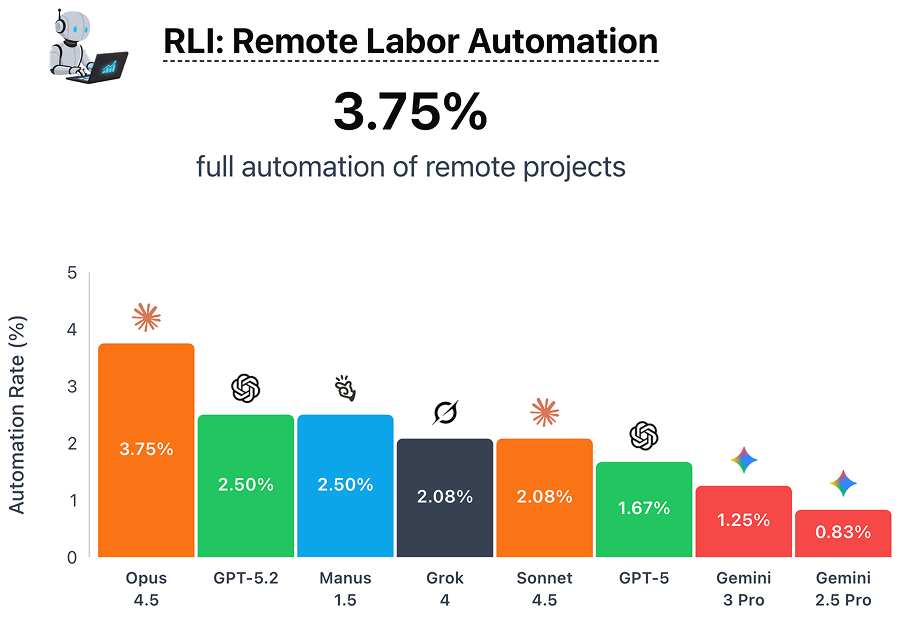
If AI can fully replace an employee, the firms can start scaling at a dramatic speed, demanding exponential amounts of electricity. Full replacement means companies can expand into new markets extremely quickly without additional spending. The desired progress would exceed levels previously achieved with human employees. However, if AI can only support or augment a human worker, computing demand scales proportionally with human activity, indicating gradual integration. A situation where people are in control is inherently more manageable and predictable. In large tech companies, for example Google, the vast majority of developers use AI, but nobody trusts it completely. Tools scale far more slowly than autonomous labor. These tools increase output per employee if one adapts to the novelty.
In general, there are multiple crucial aspects to AI progress beyond electricity efficiency, demand, and data centres’ electricity usage. Transforming towards full autonomy requires organisational restructuring, retraining, and legal frameworks, not to mention huge capital investments. People will reach the limit of AI’s usefulness before it accounts for a large proportion of global electricity output. In other words, economic friction, like underfunding, may constrain AI before electricity does.
There is also a deeper paradox: the more complicated the tasks we give to AI, the larger proportion of time humans have to spend on analyzing, correcting, and changing the results — and the less justified the large-scale automation becomes. High compute costs without proportional economic gain might cap the AI development completely. This tendency might introduce a new goal for the field: more efficient models tailored to specific use cases rather than general-purpose systems.
Related Articles
Here is a list of articles selected by our Editorial Board that have gained significant interest from the public:
The main AI limit is not electricity, it is memory
Apart from electricity, memory is a crucial piece of the AI workflow. No large language model, image generator, or even recommendation system would exist without vast amounts of memory. Big tech companies need dynamic random-access memory (DRAM) to store and move data, as well as to keep up with high-speed processing. There are several major flaws with the modern memory market.
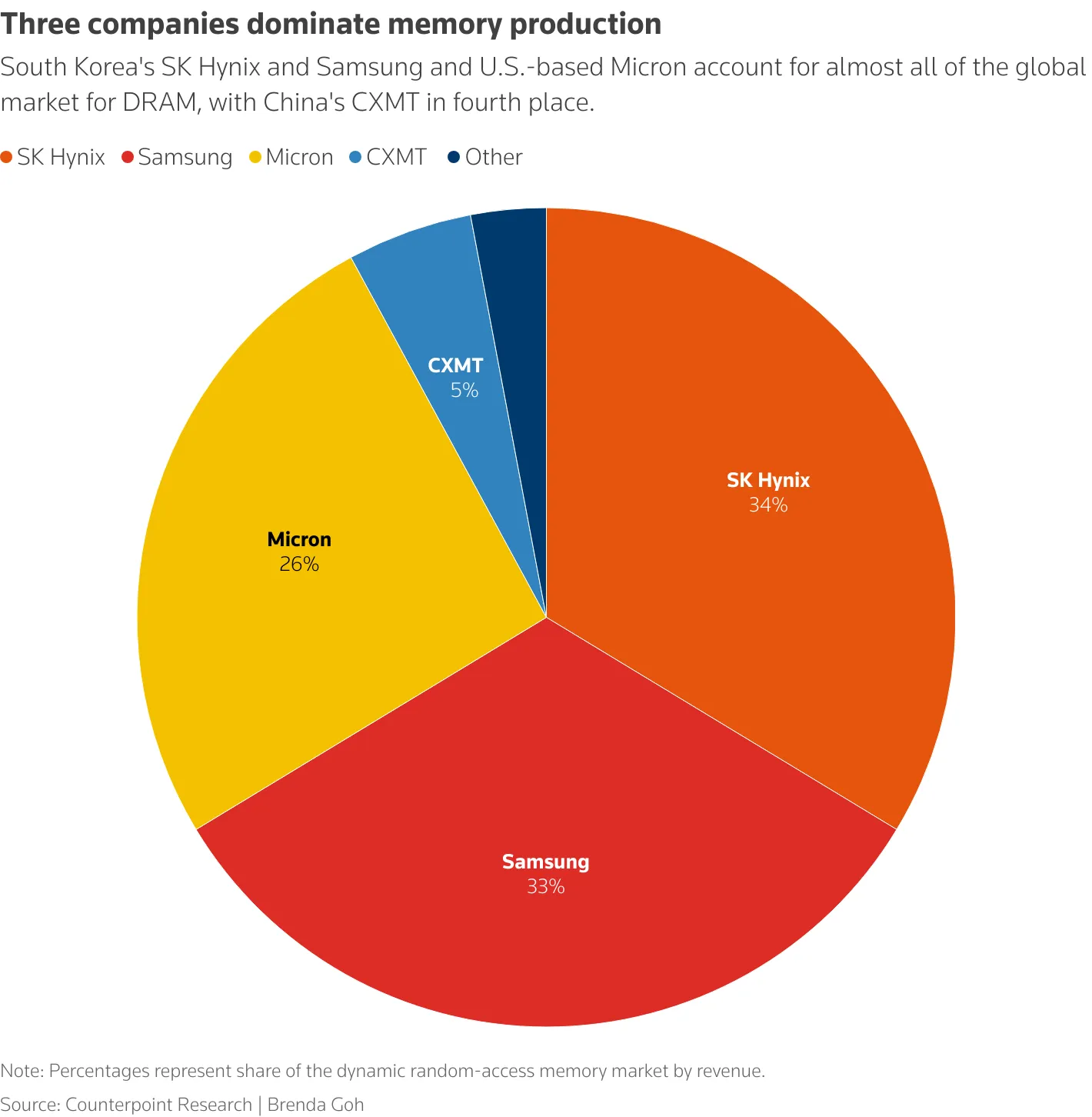
One of the most critical issues in the memory industry is that only three companies hold around 93% of the market. It’s a clear case of oligopoly, but it is not caused by industry giants hungry for profits. It’s a result of an extremely challenging production process for energy chips, with a supply chain planned years in advance. Only a few industry giants can cover these costs. It is not possible to produce more with several months’ notice. As AI grows unpredictably, supply shortages occur, leading to rapid price spikes.
Modern AI models require enormous amounts of memory for three main reasons: first, size. Large models store and access billions of parameters with high-bandwidth memory (HBM). Second, parallel processing requires synchronised memory for optimal performance. Lastly, data centres use error-correcting code memory during long training runs to prevent data corruption. This needs to be extremely precise, because training mistakes are more costly.
HBM has become the main success factor in the latest AI era. It is also a major source of trouble for suppliers. HBM is harder to produce, more expensive, and consequently produced in smaller amounts. Memory is now a priority for big tech, which led to a market price shock at the end of 2025.
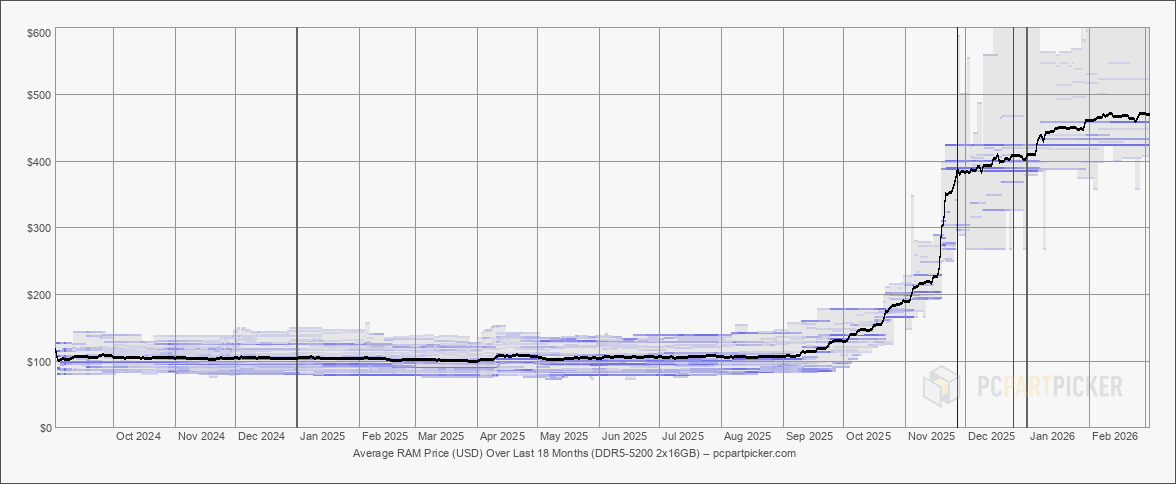
For almost a year, consumer prices for DDR5 memory chips remained stable at around $100. Due to demand shock and constrained supply, this price quadrupled in just a few months and still hasn’t stabilized. The complicated production of memory chips can either limit the progress in the AI industry or make it unreasonably expensive. Given the intense race and huge investments, it’s fair to say that the industry has made its choice.
A new semiconductor plant making memory chips can cost $10-20 billion and take several years to start operating. DRAM requires advanced lithography and extreme precision with defect rates measured in parts per billion. The producers remain cautious, despite booming demand, as overexpansion now can lead to brutal crashes when demand softens.
Memory contracts signed today reflect expectations about future profits. If those expectations prove overly optimistic, today’s scarcity could become tomorrow’s overproduction. Historical patterns prove that DRAM markets are cyclical. High prices lead to expansion. Expansion leads to oversupply. Oversupply leads to collapse.
The RAM story is revealing: AI boom reallocates physical resources without creating alternatives. This situation leaves regular consumers with sky-high prices and reduced supply. Capital and investments are going to large enterprises.
Full equation of data centres consists of many variables
The full equation of the data centres includes many variables. The debate over AI and electricity assumes that more AI will lead to exponentially greater energy consumption. However, the situation is far more complicated. Improvements in hardware efficiency, better cooling systems, and more special-purpose models mean that the energy required for each computational task continues to fall. In contrast, the number of tasks continues to rise. Thus, the energy required from the electricity grid for AI will rise, though not in the explosive fashion often predicted.
Energy is just one of many things that will shape the future of AI. AI can’t grow due to factors such as the economy, human oversight, organizational changes, and key hardware components like memory. In the end, whether AI will become the most important factor in global electricity use will depend less on what the technology needs in theory and more on whether it can deliver economic value at scale. The electricity grid itself may not be what stops AI from growing; it could be the bigger economic and physical systems that support it.
Editor’s Note: The opinions expressed here by the authors are their own, not those of impakter.com — Cover Photo Credit: Taylor Vick