Impakter
  • Environment
    • Biodiversity
    • Climate Change
    • Circular Economy
    • Energy
  • FINANCE
    • ESG News
    • Sustainable Finance
    • Business
  • TECH
    • Start-up
    • AI & Machine Learning
    • Green Tech
  • Industry News
    • Entertainment
    • Food and Agriculture
    • Health
    • Politics & Foreign Affairs
    • Philanthropy
    • Science
    • Sport
  • Editorial Series
    • SDGs Series
    • Shape Your Future
    • Sustainable Cities
      • Copenhagen
      • San Francisco
      • Seattle
      • Sydney
  • About us
    • Company
    • Team
    • Global Leaders
    • Partners
    • Write for Impakter
    • Contact Us
    • Privacy Policy
No Result
View All Result
Impakter logo
No Result
View All Result
heat

How Dangerous Is Extreme Heat to Humans?

Heat is the silent killer of thousands each year and is only going to get worse

Steven Sherwood - Professor and Deputy Director of the Climate Change Research Centre at the University of New South WalesbySteven Sherwood - Professor and Deputy Director of the Climate Change Research Centre at the University of New South Wales
August 19, 2023
in Climate Change
0

The media reporting around heatwaves that have hammered the northern hemisphere has been unequivocal: the simultaneous record-breaking heat has “pushed the limits of human survival.”

Perhaps more alarmingly, “the UK may become too hot to endure within three decades,” which would surely be a concern to the 97 percent of humanity who live in places with hotter summers than the UK.

The good news: Britons won’t have to move to Sweden by 2050. The bad news: deadly heat is already here, is getting worse, and soon may become a vastly bigger problem than it is even now in nearly every part of the world.

Heat is the silent killer that is responsible for more deaths than any other natural disaster: several severe European heat waves in recent decades, including last summer, have claimed tens of thousands of excess deaths.

Death tolls in developing countries are not properly counted and probably much larger.

But worse is coming and we need to prepare for it.

The average surface temperature on Earth is now at its highest level since records began and probably before the last ice age.

Recent heat waves show clear fingerprints of global warming, more so than any other climate change impact such as flood or drought. And global warming will continue at least until we reach net zero.

There is a fundamental limit to the body’s coping ability: it is a fixed goalpost.

Research in 2010 demonstrated that a “wet-bulb” temperature of 35°C or higher would make it impossible for humans to exhaust metabolic heat, due to our fixed core body temperature.

It proposed this was an effective survivability limit.

The wet-bulb temperature measures the ability to cool by evaporation; it equals normal temperature if relative humidity is 100%, and otherwise is lower. 35°C is extreme — most places on Earth never experience wet bulbs above 30°C.

But enough global warming could push heat waves in many areas past 35°C. This upended the widely held assumption at the time that humans could adapt to any amount of increased heat, i.e., that the goalposts would move. This goalpost will not.
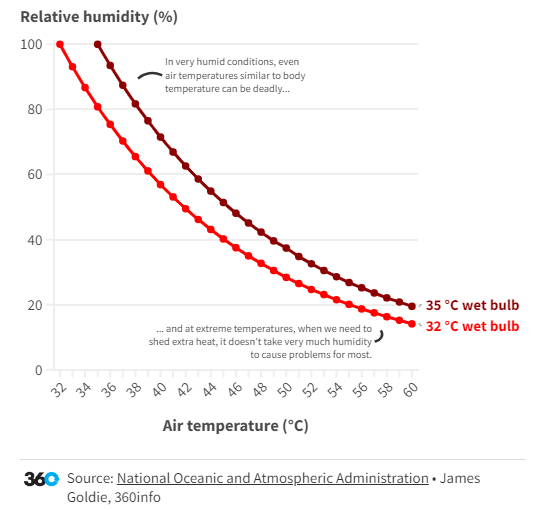
Wet-bulb temperature is used by meteorologists and climatologists to quantify heat stress. It is a combination of heat and humidity: a high wet-bulb can occur in humid places at lower temperatures, as well as in dry places at extremely high temperatures.

New studies are beginning to chart out the road to 35°C.

One study in the US last year found that young, healthy subjects exposed to very hot conditions started to enter hyperthermia (inability to regulate core body temperature) well below 35°C wet bulb, closer to 32°C or less.

This is an important reminder that 35°C was a theoretical upper limit, not a practical one.


Related Articles: Surviving Extreme Heat in the Slums | Heat Levels Expected to Reach Record Highs in the Next 5 Years: Are We Prepared? | July Heat: Is It Our Fault?

On the other hand they would undoubtedly have found a higher tolerance had they done the study in India or Brazil, because physiology does adjust to heat over time (up to a point).

The UK has a long way to go before reaching 32°C and could acclimatise for a while. Wet-bulb temperatures above 32°C appear only very rarely today in coastal areas of the Middle East and for very short periods, but these will gradually spread as warming continues.

The heat will force us to change how we live, for example shifting outdoor summertime activities to nighttime or just eliminating them.

Severe heat may already be putting people off traveling to Europe or other locations in the summer.

Researchers at the University of Sydney are developing a heat warning system, and conducting exposure studies similar to the US one. It looks like we’ll soon have a clearer picture of the direct effects of severe heat on physiology.

It remains challenging to measure or predict extreme heat’s overall cost to the community in terms of health, work and quality of life.

To do this, climate and health researchers need to develop models that factor in human behaviour and adaptation along with physiology, weather, and climate information. We also need to understand what will happen to nature, and seek ways to protect wildlife.

Above all we need to reach net zero carbon emissions as soon as we possibly can to arrest the continuing rise in heat.

— —

This article was originally published by 360info™.


Editor’s Note: The opinions expressed here by the authors are their own, not those of Impakter.com — Featured Photo Credit: James Goldie, 360info.
Tags: Extreme HeatHeatwet-bulb
Previous Post

Saying Yes to Life’s Challenges

Next Post

Humor Me!

Related Posts

Paris Agreement Cuts Global Extreme Heat Risk in Half
ESG News

Paris Agreement Cuts Global Extreme Heat Risk in Half

Today’s ESG Updates Paris Climate Pledges Could Halve Extreme Heat Days: Commitments under the agreement have reduced projected global extreme...

byLena McDonough
October 16, 2025
heat stress
Climate Change

3 Things to Know About Heat Stress and How to Prevent It

The World Meteorological Organization reported that 2024 was the first entire year with global temperatures exceeding 1.5° Celsius above pre-industrial...

byThe Food and Agriculture Organization of the United Nations (FAO)
September 3, 2025
ESG news regarding ECB President Christine Lagarde warns Trump’s attempt to control the Fed poses serious risks to global economy, UK records hottest summer in 2025, Levi’s warns Trump’s tariffs and anti-American sentiment could impact UK denim sales, Revolut valuation jumps to $75B
Business

Trump’s Push to Control Fed a ‘Serious Danger’ to Global Economy

Today’s ESG Updates Lagarde Warns Trump Threatens Fed Independence: The ECB head says moves to fire top Fed officials could...

byAda Omar
September 2, 2025
global warming
Climate Change

World Could Breach 1.5°C Target in 3 Years, Report Shows

New report confirms that global warming continues to accelerate Deadly heatwaves across Western Europe marked this the hottest June on...

byMaaz Ismail
August 2, 2025
Europe experienced heatwaves in June and July, caused by climate change and heat domes
Climate Change

Europe’s Heat Domes: Why This Summer Is the Hottest Yet

Between June 23 and July 2, approximately 2,300 people died from heat-related causes across Europe. Researchers from Imperial College London...

bySarah Perras
July 30, 2025
Nearly 2/3 of Europe’s Heatwave Deaths Linked to Human-Caused Global Warming
ESG FINANCE

Nearly 2/3 of Europe’s Heatwave Deaths Linked to Human-Caused Global Warming

Today’s ESG Updates Fossil Fuels to Blame for Nearly ⅔ of Deaths in Europe’s June Heatwave: New study attributes the...

byLena McDonough
July 9, 2025
climate change inflation
Climate Change

How Does Climate Change Impact Inflation?

A recent study, conducted by European Central Bank (ECB) experts in collaboration with researchers from the Potsdam Institute for Climate...

byMatt Davies
March 26, 2024
Hottest November on record
Climate Change

Last Month Was by Far the World’s Hottest November on Record

November 2023 was by far the hottest November on record globally in analyses dating back to 1850, said NOAA’s National...

byYale Climate Connections
December 26, 2023
Next Post
Humor Me!

Humor Me!

Recent News

The Best Virtual Office Address In London For Your Startup

How To Choose The Best Virtual Office Address In London For Your Startup

December 5, 2025
Granddaddy Purple Strain

Where Granddaddy Purple Strain Gets Its Iconic Grape Flavor

December 5, 2025
ESG news regarding Deforestation Mandate Being Pushed; EUs Acceleration on Hydrogen and Net Zero Revolution; AT&T Will End All DEI; UK Watchdog Blocks Nike and Lacoste Ads Over Green Claims.

U-Turn in Europe: Deforestation Mandate Pushed Back Again

December 5, 2025
  • ESG News
  • Sustainable Finance
  • Business

© 2025 Impakter.com owned by Klimado GmbH

No Result
View All Result
  • Environment
    • Biodiversity
    • Climate Change
    • Circular Economy
    • Energy
  • FINANCE
    • ESG News
    • Sustainable Finance
    • Business
  • TECH
    • Start-up
    • AI & Machine Learning
    • Green Tech
  • Industry News
    • Entertainment
    • Food and Agriculture
    • Health
    • Politics & Foreign Affairs
    • Philanthropy
    • Science
    • Sport
  • Editorial Series
    • SDGs Series
    • Shape Your Future
    • Sustainable Cities
      • Copenhagen
      • San Francisco
      • Seattle
      • Sydney
  • About us
    • Company
    • Team
    • Global Leaders
    • Partners
    • Write for Impakter
    • Contact Us
    • Privacy Policy

© 2025 Impakter.com owned by Klimado GmbH