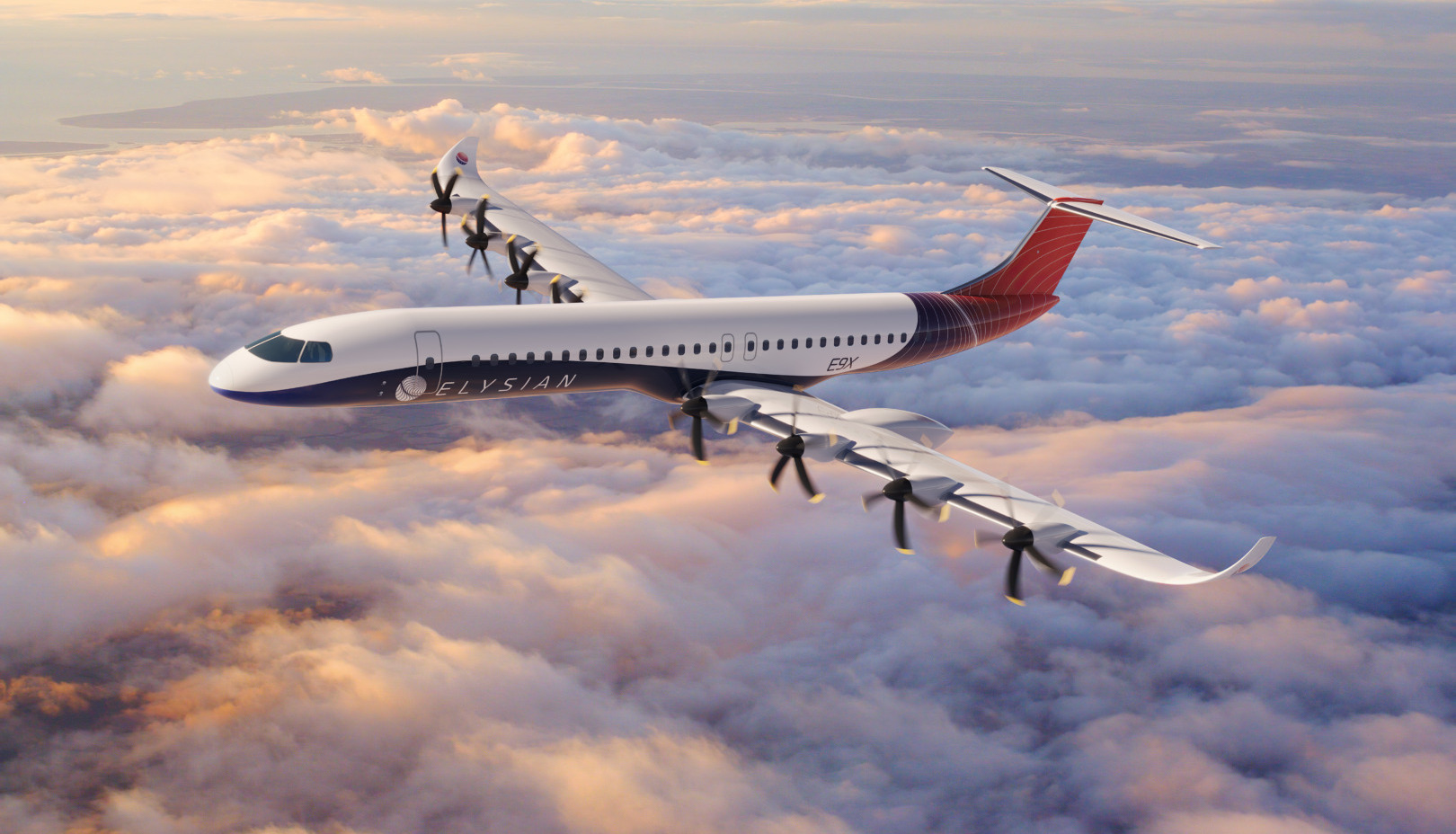
At this year’s SciTech Forum, the world’s biggest aerospace technology event organized by the American Institute of Aeronautics and Astronautics, Dutch startup Elysian Aircraft announced that it is developing a battery-electric aircraft that could cover greater distances and carry more passengers than previously thought possible.
“Contrary to common belief, large battery-electric aircraft can carry much more energy and are aerodynamically more efficient than originally assumed,” said Rob Wolleswinkel, the startup’s co-founder and chief technology officer.
Current limitations
As senior researcher at the International Council on Clean Transportation (ICCT) Jayant Mukhopadhaya told ABC News, the consensus among industry experts was that, because of the size and weight of batteries, battery-electric planes would not be able to carry more than 20 passengers or travel over 310 kilometers (200 miles) without having to land and charge.
“Despite leaps-and-bounds improvements in battery technology in the past three decades, batteries remain inadequate to the task of electrifying most of passenger aviation,” write the authors of the ICCT’s 2022 report on electric aircraft, which concludes that electric aircraft “will be limited to short range flights (< 500 km) in the foreseeable future.”
Reynard de Vries, Elysian’s director of design and engineering at Elysian Aircraft, explains that these limitations are “actually based on a handful of calculations that people did.”
“They said, ‘Let’s take the best possible short-range aircraft today, like a good turbo prop, and let’s try to electrify that — what happens if instead of using fuel, I would use batteries?’ And indeed, if you would run the numbers on that, you would see that it’s a very poor-performing aircraft. The range will be limited,” de Vries said.
Defying current limitations
At the time of writing, the highest number of passengers any electric plane on the market or in development promises to carry is 19.
The plane Elysian Aircraft is making, the E9X, is expected to be able to carry 90 passengers and travel up to 800 kilometers (500 miles). With future battery improvements, the startup anticipates that this range could increase to 1,000 kilometers (621 miles).
“Currently, flights up to 1,000 km make up 50% of all scheduled flights worldwide and are responsible for about one-fifth of all aviation-related CO2 emissions,” Elysian writes.
If this range boost is achieved, Elysian could provide much-needed help in tackling emissions from “one of the most challenging sectors to decarbonise,” as the International Energy Agency (IEA) described the aviation industry.
“With an aircraft like this, that has no emissions, you can already tackle a significant part of the total problem,” said the startup’s co-CEO and chief business officer, Daniel Rosen Jacobson.
Importantly, thanks to the high passenger capacity, Elysian’s aircraft “presents an economically viable and competitive alternative to conventional aircraft,” the startup writes.
Efficiency-wise, Elysian’s E9X even outshines hydrogen- or SAF-powered aircraft, achieving up to five times higher efficiency per passenger kilometer according to the startup. This remarkable feat, the startup says, matches the energy efficiency of an average electric car with 1.2 passengers.
Related Articles: Ampaire Electric Planes: Interview With Kevin Noertker | Aviation Flying High on Alternative Sources of Power | The Electric Seaplane: Interview with Tomas Brødreskift, Founder of Equator Aircraft | ‘Flight100’ Completes First-Ever 100% Sustainable Aviation Fuel Transatlantic Journey | 3 Electric Flight Companies
So what is it about the E9X that could enable it to carry that many people and cover such distances? Two things.
Lighter batteries, which boast a power density of 360 Wh/kg. This battery technology places Elysian’s batteries ahead of those used in Tesla cars, effectively addressing the weight challenges faced by electric aircraft due to their lower energy density.
The other feature is the design of the plane, which, as Wolleswinkel explains, takes inspiration from jets from the 1960s:
“Instead of a turboprop aircraft, we considered first-generation narrow-body jets as a reference point. While these jets were fuel-inefficient, they were designed for long ranges and carried a high energy mass relative to the total aircraft mass. That served as inspiration for our electric aircraft design.”
The E9X’s Design
Elysian’s technology is based on the findings of two scientific studies, “A New Perspective on Battery-Electric Aviation, part I and II.”
Conducted in collaboration with the Delft University of Technology in the Netherlands, the studies were authored by Elysian co-founders Rob Wolleswinkel and Reynard de Vries, and Maurice Hoogreef and Roelof Vos from the Delft University of Technology.
The first “re-examines the assumptions that lead to the current perception of limited applicability of battery-electric aircraft,” demonstrating that an electric plane can be bigger and cover a much higher range than previously thought.
The second study introduces the design for a battery-electric plane that can carry 90 passengers and travel 800 kilometers “on battery power alone.” Here’s what’s different about this design.
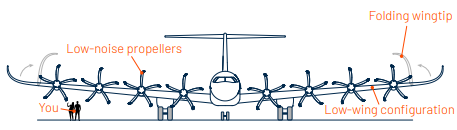
Larger wings, smaller body: This “reduces drag with ~15%, purely by these different dimensions, without any additional advanced aerodynamic technology,” the startup explains.
Batteries in the wings: A strategic design choice that optimizes weight distribution and makes the plane body lighter, contributing to the overall efficiency of the aircraft.

Low-wing configuration: “Thanks to distributed electric propulsion (DEP), the propeller diameter can be reduced, enabling a low-wing configuration with gear attached, which leads to a shorter, lighter landing gear and lighter fuselage,” Elysian writes.
Folding wingtips: An innovative feature that adds flexibility to the aircraft. “Given the large wingspan, foldable wingtips are used to optimize aerodynamic performance and fit within gate span constraints.”
“We expect Elysian to make a significant contribution to discovering the boundaries of battery electric flying by taking a refreshingly new look at the combination of technology and design,” said Senior Lecturer Aerospace Engineering at Delft University of Technology, Joris Melkert. “We wholeheartedly support their systematic and scientific approach and look forward to their solutions to the technological challenges ahead.”
Who’s behind the project?
With funding from aerospace investor Panta Holdings and French financier Caravelle, startup Elysian Aircraft was founded in 2023 by Rob Wolleswinkel, Reynard de Vries, and Daniel Rosen Jacobson.
Rob Wolleswinkel, Elysian’s co-CEO and Chief Technology Officer, is a former senior partner at the Boston Consulting Group with a background in Aerospace Engineering. A part-time pilot at Zeusch Aviation, Wolleswinkel used to work at Fokker Aircraft and the Royal Netherlands Air Force.
The other Co-CEO and Chief Business Officer, Daniel Rosen Jacobson, is an angel investor and former Google executive. Before taking on the role at Elysian, Jacobson worked with Panta Holdings on sustainable aviation. Reynard de Vries, with a PhD in Aerospace Engineering, hybrid and electric aircraft design in particular, is the startup’s Design and Engineering Director.
As to partnerships and alliances, Elysian Aircraft collaborates with important players: the Royal Netherlands Aerospace Centre (NLR), Twente University, and Deutsches Zentrum für Luft- und Raumfahrt (DLR).
The Road Ahead
“While these findings indicate that the feasibility of large-scale battery-electric aircraft is within reach, several technical challenges must be resolved during the development of such aircraft,” writes Elysian.
While Elysian provides evidence that “the feasibility of large-scale battery-electric aircraft is within reach,” it also stresses that technical challenges remain.
Some of these challenges include battery cell development and integration, thermal management, reserve energy system design and certification, and high-voltage power transmission.
Still, Elysian Aircraft says the E9X is “[s]et to take to the skies by 2033.”
“We think that we can deliver a plane by 2033 that can compete on costs to actually be a good economic decision for airlines, and not just a sustainable one,” Jacobson said.
Editor’s Note: The opinions expressed here by the authors are their own, not those of Impakter.com — Featured Photo Credit: Elysian Aircraft.