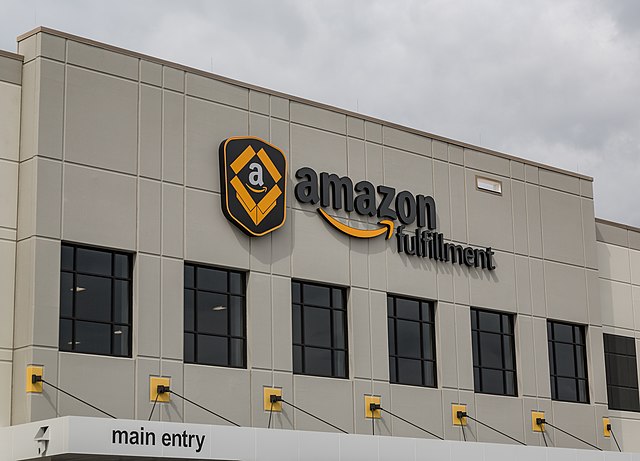
In some of the driest areas of the world, Amazon, Microsoft, and Google operate data centers that use large amounts of water. A recent investigation by The Guardian newspaper and SourceMaterial found that the tech giants are planning to expand their data centers across the United States and abroad, potentially impacting already water-scarce areas.
As artificial intelligence (AI) surges and cloud computing becomes the backbone of the digital global economy, the infrastructure powering this transformation — data centers — is under increasing scrutiny. While these facilities drive technological innovation, they also require huge computing power and vast amounts of water to cool their servers, raising serious sustainability concerns.

Photo Credit: Charlie Fong.
Amazon, Microsoft, and Google — three of the most powerful tech firms — are leading a worldwide expansion of data centers, with hundreds of centers planned globally. There are currently 11,800 operational data centers around the world, with over 5,000 in the United States, according to industry intelligence company Cloudscene.
These data centers are less problematic when located in parts of the world that do not struggle with water scarcity. However, Microsoft stated in 2023 that 42% of its water usage came from “areas with water stress.” Google released data in the same year showing that 15% of its water usage came from places with “high water scarcity.” No similar figure was released by Amazon.
“These data centers […] consume water — where do they take it from? They take it from you, of course.”
Lorena Jaume-Palasí, founder of The Ethical Tech Society, underscored the long-term implications. “The question of water is going to become crucial. Resilience from a resource perspective is going to be very difficult for those communities,” said Jaume-Palasí., referring to the communities whose water resources cannot afford to be shared with these tech firms’ data centers.
In Spain’s northern region of Aragón, Amazon has proposed three new data centers adjacent to existing ones. These centers are licensed to draw over 755,000 cubic metres of water per year — enough to irrigate more than 500 acres of corn, a vital crop in the region. However, experts say the real impact will be even greater.
According to projections, the three data centers will use more electricity than the whole Aragón region combined. This will likely increase the water needs of the data centers in practice.
Chechu Sánchez, a farmer in Aragón, fears the consequences: “These data centers use water that comes from northern Aragon, where I am. They consume water — where do they take it from? They take it from you, of course.”

Photo Credit: European Union, Copernicus Sentinel-2.
Despite rising temperatures, drought, and an increasing number of heat-related deaths in Spain, Amazon has asked local officials to approve a nearly 50% increase in water usage at existing facilities. Critics say the request was pushed through quietly over the Christmas period to avoid scrutiny.
Aurora Gómez, part of the activist group Tu Nube Seca Mi Río (“Your Cloud Is Drying My River”), has called for a moratorium on new data centers in Spain. “They’re using too much water. They’re using too much energy,” said Gómez.
While Amazon says it plans to be “water positive” by 2030, offsetting its water use through local projects, some internal voices question the ethics of the approach.
“I raised the issue in all the right places that this is not ethical,” said Dr. Nathan Wangusi, a former Amazon water sustainability manager. “I disagreed quite a lot with that principle.”
Both Microsoft and Google have made similar commitments to water sustainability. Yet experts point out that water offsetting doesn’t work like carbon offsetting. While one tonne of carbon can be balanced globally, water scarcity is localised.
“Carbon is a global problem — water is more localised,” said Dr. Aaron Wemhoff, an energy efficiency specialist and associate professor at Villanova University. “Improving access to water in one area does nothing to help the community that has lost access to it far away.”
Related Articles: Apple, Google, Meta and Microsoft’s Data Centre Emissions May Be 7.62 Times Higher Than Reported | Hungry for Data, Starving the World | How Green is Your Screen Time?
In the United States, the issue is playing out in fast-growing data center hubs like Mesa, Arizona. Despite Maricopa County facing “extreme drought” conditions, Meta and Google are expanding their footprint there. Meta is opening a new $1 billion data center in Mesa, and Google is developing an additional two. One of its data centers has a permit to use as much water annually as 23,000 local residents use on average.
“We have to be very, very protective around the growth of large water users,” said Mesa City Council member Jenn Duff.
Google claims it won’t use its full water allotment and plans to incorporate air-based cooling.
“Cooling systems are a hyperlocal decision,” said Chris Mussett, a Google spokesperson, citing the company’s “climate-conscious cooling” strategy that weighs water and energy usage together.

Looking ahead, the scale of data infrastructure could balloon further. In January, U.S. President Donald Trump announced “Project Stargate” — a $500 billion joint venture between OpenAI, Oracle, SoftBank, and Emirati investors — to construct AI-ready data centers across the U.S.
The same week, Chinese AI company DeepSeek unveiled a new model designed to use far less computing power — and, by extension, less water — than its Western competitors. It highlighted growing competition not just in AI capabilities, but in efficiency.
Both Google and Microsoft have floated ambitious concepts like air-cooled or “zero water” data centers, but the technology has yet to be proven at scale.
“I’ll believe it when I see it,” said Jaume-Palasí. “Most data centers right now are going from air cooling to water cooling because liquid is more efficient when you try to cool down high-density racks, which are the ones that are mostly being used for AI.”
For communities living near these centers, the pressure is mounting. Water once used to grow crops or sustain households is increasingly redirected to support global digital infrastructure.
“Neither people nor data can live without water,” said Gómez. “But human life is essential, and data isn’t.”
Editor’s Note: The opinions expressed here by Impakter.com columnists are their own, not those of Impakter.com — In the Cover Photo: Oljato-Monument Valley, Arizona, United States, October 29, 2017. Cover Photo Credit: Ganapathy Kumar.