
Today’s ESG Updates
- Global Carbon Emissions Hit Record High as Natural Sinks Weaken: The Global Carbon Project report intensifies the urgency of COP30 climate talks.
- Amazon Defends AI Energy Surge as Catalyst for Decarbonization: Amazon boldly claims that AI will accelerate the clean energy transition.
- Australia’s Conservative Liberal Party Abandons Net Zero Commitment: Australia’s opposition party states it will drop the country’s 2050 net zero target to prioritize energy affordability if elected.
- EDP to Invest $2 Billion in Asian Green Energy Projects by 2030: Portugal’s utility EDP will focus its clean-energy expansion in Southeast Asia.
Global emissions reach a new high as carbon buffers weaken
Global carbon dioxide emissions from fossil fuels are expected to reach a record 38.1 billion tons this year, a 1.1% increase from 2024, according to the Global Carbon Project’s latest report. The findings reveal a troubling slowdown in the ability of oceans and forests, the planet’s major carbon sinks, to absorb CO₂, intensifying the urgency during the COP30 talks in Brazil. While China’s emissions are stabilizing, U.S. fossil-fuel output is climbing again, and global aviation pollution is up nearly 7%. The report warns that rising heat, drought, and deforestation are undermining natural absorption systems, accelerating climate risks. For investors and policymakers, the data underscores the need to scale renewable deployment and protect carbon sinks as integral pillars of the global decarbonization strategy.
***
Further reading: Carbon Dioxide Emissions Are Set to Reach a New High This Year
Amazon claims AI will drive decarbonization

As data centers drive an unprecedented surge in electricity demand, Amazon argues that artificial intelligence will accelerate the clean-energy transition, rather than hinder it. The company highlights its status as the world’s largest corporate buyer of renewables, AI-enabled efficiency gains, and new investments in nuclear and recycled water systems. Yet Amazon’s massive energy use, growing emissions since 2019, and reliance on carbon credits tell a more complex story. Despite sustainability rhetoric, Amazon’s data-center expansion risks outpacing clean power growth, particularly in fossil-heavy grids. The company’s case is one that many energy-intensive companies are arguing, but credibility depends on proving that scale and profit do not eclipse genuine decarbonization. Companies committed to decarbonization and meeting net-zero targets can look to ESG solutions for guidance.
***
Further reading: Amazon Says AI Will Speed The Energy Transition—Not Slow It
Klimado – Navigating climate complexity just got easier. Klimado offers a user-friendly platform for tracking local and global environmental shifts, making it an essential tool for climate-aware individuals and organizations.
Australia’s opposition party pledges to drop net-zero if elected

Australia’s conservative Liberal Party has formally dropped its pledge to achieve net zero emissions by 2050, vowing instead to prioritize lowering energy prices if elected. The decision, following a five-hour internal meeting, aligns the Liberals with their rural coalition partner, the Nationals, who recently withdrew their own net-zero target. Opposition Leader Sussan Ley said the party would dismantle the Labor government’s renewable and emissions policies, though it would remain in the Paris Agreement. This reversal risks reputational damage and legal exposure under international climate commitments, and comes at a crucial time as Australia’s right to host COP31 is under contestation. While the current government continues pursuing deep emissions cuts, the shift deepens Australia’s political divide over its energy future.
***
Further reading: Australia’s conservative Liberal Party abandons net zero policy

Portuguese utility to invest $2B in Asian clean energy projects by 2030

Portuguese utility EDP plans to invest up to $2 billion in renewable and battery projects across Asia by 2030, focusing on Singapore, Japan, and Australia, while exiting less promising markets like Indonesia and Thailand. The company cited regulatory uncertainty and limited project bankability in some countries but sees long-term opportunity in others as Southeast Asia seeks to move away from coal. The region’s renewables rollout remains sluggish, with ASEAN likely to miss its 23% clean energy target by 2025. EDP’s strategy reflects a growing investor focus on scalable, transparent markets where green infrastructure and private capital can accelerate the energy transition.
***
Further reading: EDP Aims to Invest $2 Billion in Asian Green Projects by 2030
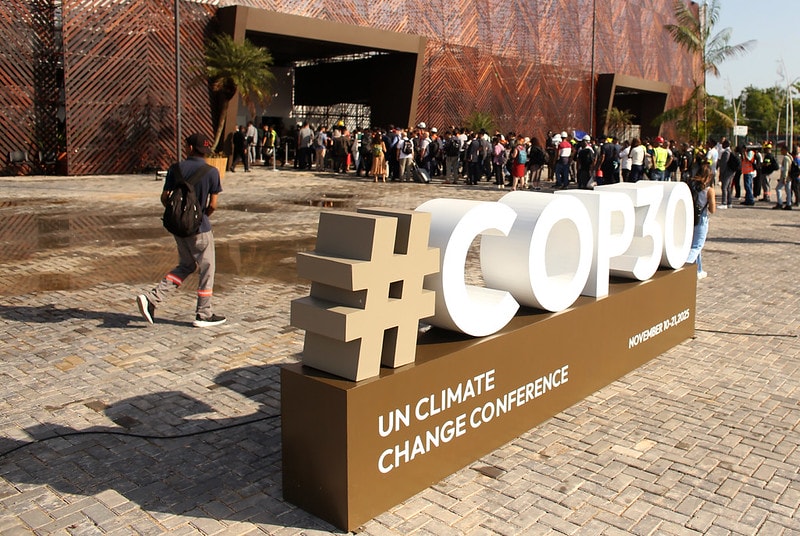
Editor’s Note: The opinions expressed here by the authors are their own, not those of impakter.com — In the Cover Photo: Entrance to COP30 in Belém, Brazil. Cover Photo Credit: Cop30 Brasil Amazônia