Impakter
  • Environment
    • Biodiversity
    • Climate Change
    • Circular Economy
    • Energy
  • FINANCE
    • ESG News
    • Sustainable Finance
    • Business
  • TECH
    • Start-up
    • AI & Machine Learning
    • Green Tech
  • Industry News
    • Entertainment
    • Food and Agriculture
    • Health
    • Politics & Foreign Affairs
    • Philanthropy
    • Science
    • Sport
  • Editorial Series
    • SDGs Series
    • Shape Your Future
    • Sustainable Cities
      • Copenhagen
      • San Francisco
      • Seattle
      • Sydney
  • About us
    • Company
    • Team
    • Partners
    • Write for Impakter
    • Contact Us
    • Privacy Policy
No Result
View All Result
Impakter logo
No Result
View All Result
The Future of Global Health and Financing: Real Change or “Plus ça change”?

The Future of Global Health and Financing: Real Change or “Plus ça change”?

IMF Managing Director announces possible creation of a “health and financing board” to address future pandemics and other health challenges

Richard SeifmanbyRichard Seifman
October 7, 2021
in Health, Politics & Foreign Affairs
0

On October 5, the IMF Managing Director Georgieva in looking toward the next IMF annual meeting spoke publicly on the subject of overcoming divides and removing obstacles to recovery. In her discourse she made mention of a “health and financing board” to deal with future health challenges like Covid, noting of course the very valuable billions of SDRs that had already been approved by her institution.

A “board” idea had already been around and created since 2018 in the form of the Global Preparedness Monitoring Board (GPMB).  It was composed of leading organizational heads, met, issued reports ( one in 2021) with little to show for concrete follow up of its recommendations, beyond good intentions.

In over several months in 2021, there have been meetings to voice support for creating a new “board” with a different concept, linking directly the big financiers with the technical entities. 

The Pan European Commission on health and sustainable development looked at how Europe and the world could be better prepared for the next emergency, resisting suggestions to restructure institutional arrangements (like, for example, merging WHO and FAO) and relying instead on the existing arrangements. Among the recommendations made, aside from the proposals to create two pan-European institutions, a network for disease control and a health threat council, what stood out was the proposed creation of a global health board. This new entity should be charged with the task to coordinate health, economic, and financial policies within governments and internationally.

In short, the report, under the leadership of former Prime Minister Monti, and building on the role Italy played in meetings of the G7 and G 20, proposed coordination of health, economic, and financial policies work under the G20. Monti said at a virtual press briefing in September that the Italian presidency of the G-20 had already “advanced quite a bit in achieving consensus on this” since the idea was first launched.

That this proposal is finding endorsement by such august bodies as the G20 is encouraging. But the underlying question is not if such a board gets established but what it will be empowered to do. Will it get the necessary financing to operate and have an impact? What would be needed is an entity capable of both guiding policy worldwide and help finance it, in short, to use IMF parlance, a “health and financing board”. But given the institutional territorial interests involved including the IMF, World Bank WHO, FAO, UNEP and OIE, will it have the ability and teeth to work in a coordinated fashion and have a real impact? 

To demonstrate its strong commitment, the  IMF itself could get the ball rolling so to speak, using its Article IV authorities by adding it to specifically include pandemic risk assessment. Article IV is how the IMF monitors country commitments to pursue policies conducive to orderly growth and provide data about their economy. Its advice is intended to identify weaknesses, actual and potential, causing or leading to financial or economic instability, a process known as “ surveillance”.  

Thus, the IMF assesses countries regularly looking at core economic and financial aspects, including regulatory frameworks. And we know now how much pandemic risk is a part of overall country viability.

At present, as illustrated in this example of a current Article IV review just published on Uruguay, the IMF does deal with Covid impact, but it does not look forward at pandemic preparedness and its economic and financial risk in the future, whether Covid or another pandemic.

If the IMF independently, or drawing on WHO and World Bank health expertise, or as part of the mandate of any new global health and financial board, would do so, now that would be “teeth”. But as far as we know, for now, that doesn’t appear to be on the table. Maybe the annual meeting will surprise us?


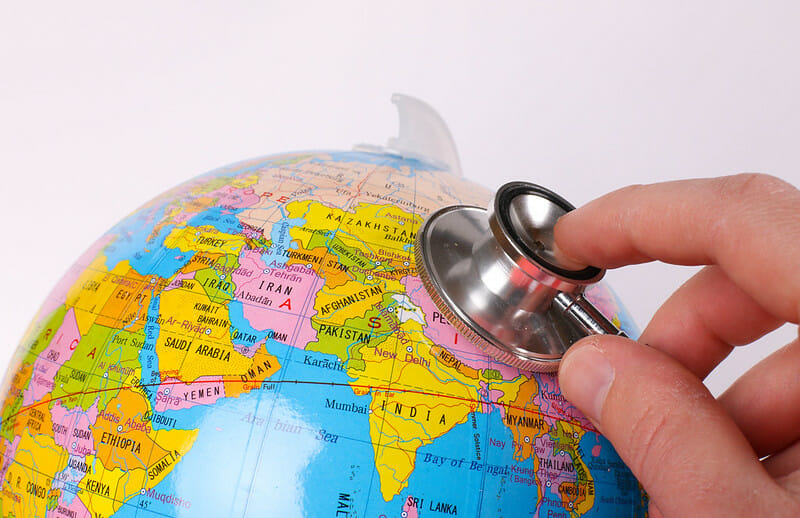
Editors Note: The opinions expressed here by Impakter.com columnists are their own, not those of Impakter.com — Featured Image credit: Doctor with stethoscope and globe in his hand. Medical network and health care in Europe and Africa (concept of world medicine, epidemic control, medical tourism) – Featured Photo Credit: Jernej Furman


Tags: G20global health boardhealth and financing boardIMF
Previous Post

Greenpeace Activists Block Shell’s Port Protesting ‘Greenwashing’ Adverts

Next Post

WHO Approves Malaria Vaccine in Scientific Breakthrough

Related Posts

fossil fuel subsidies
Business

How G20 Nations Can Make Progress After the Group Stalls on Fossil Fuel Subsidy Reform

The 2025 G20 Leaders’ Summit in South Africa sent mixed signals on climate action. In this year’s Leaders’ Declaration, climate change...

byInternational Institute for Sustainable Development (IISD)
November 28, 2025
ESG News regarding Cop30’s disappointing end, the G20 summit without the US, China’s Unipec fuel deal with Lufthansa, and Singapore’s Sembcorp IPO in India
Business

‘COP of Truth’ Highlights Glaring Differences in Global Climate Perspective

Today’s ESG Updates COP30 Delivers Weak Climate Deal: Global talks in Brazil ended without a plan to phase out fossil...

bySarah Perras
November 24, 2025
ESG news regarding IMF upgrades global growth forecast, ECB adds climate factor to collateral framework, US climate nonprofits hit by $20B grant freeze, Europe turns to portable AC
Business

IMF Upgrades Global Growth Forecast Despite Political Risks

Today’s ESG Updates IMF Upgrades Global Growth Forecast Amid Eased Tariffs: Growth forecast raised to 3% for 2025 as Trump...

byPeter Vigh
July 29, 2025
What Makes Today’s Debt Crisis so Pernicious?
Environment

What Makes Today’s Debt Crisis so Pernicious?

Many low-income countries are diverting scarce resources from development to service costly debt. But what’s driving current debt vulnerabilities—and what...

byInternational Institute for Sustainable Development (IISD)
June 18, 2025
One Health
Health

One Health: Urgent Message to the G7 and G20

This month, on June 11, the Rockefeller Foundation made public its report, "One World, One Health. A Strategic Vision for...

byClaude Forthomme - Senior Editorand1 others
June 17, 2024
Decarbonization companies
Business

Pace of Decarbonization by Public Companies Set to Decelerate

As world leaders and industry stakeholders gear up for COP28 in Dubai, the latest edition of the MSCI Net-Zero Tracker...

byMatt Davies
November 16, 2023
Climate Change
Climate Change

The Alarming Intersection Between Climate Change and Modern Slavery

By 2050, the World Bank predicts 143 million will be displaced in Africa, Asia & Latin America due to climate...

byTaida Nando
September 14, 2023
Why the G20 Is Useless
Politics & Foreign Affairs

Why the G20 Is Useless

Updated September 10, 2023:  The two-day G20 Summit that started in India on September 9 delivered a big surprise: For...

byClaude Forthomme - Senior Editor
September 10, 2023
Next Post
WHO Approves Malaria Vaccine in Scientific Breakthrough

WHO Approves Malaria Vaccine in Scientific Breakthrough

Recent News

ESG News regarding Nuclear Waste Storage; Canada Replaces EV Mandate; EU and Turkey Resume Trade Modernization Talks; Startup Raises $29M for Desk-Sized Fusion Reactor

Volunteers Needed for Nuclear Waste Storage

February 6, 2026
Rare Earth Metals 101

Rare Earth Metals 101

February 6, 2026
How to Spot Greenwashing in the Publishing Industry

How to Spot Greenwashing in the Publishing Industry

February 6, 2026
  • ESG News
  • Sustainable Finance
  • Business

© 2025 Impakter.com owned by Klimado GmbH

No Result
View All Result
  • Environment
    • Biodiversity
    • Climate Change
    • Circular Economy
    • Energy
  • FINANCE
    • ESG News
    • Sustainable Finance
    • Business
  • TECH
    • Start-up
    • AI & Machine Learning
    • Green Tech
  • Industry News
    • Entertainment
    • Food and Agriculture
    • Health
    • Politics & Foreign Affairs
    • Philanthropy
    • Science
    • Sport
  • Editorial Series
    • SDGs Series
    • Shape Your Future
    • Sustainable Cities
      • Copenhagen
      • San Francisco
      • Seattle
      • Sydney
  • About us
    • Company
    • Team
    • Partners
    • Write for Impakter
    • Contact Us
    • Privacy Policy

© 2025 Impakter.com owned by Klimado GmbH