“Governments are literally doubling down on fossil fuel production,’ said Antònio Guterres, the UN secretary-general, last week when a new UN report came out analyzing the expansion plans of fossil fuels producers. “That spells double trouble for people and planet’, he added, concluding grimly, ‘Fossil fuels are sending essential climate goals up in smoke.” (bolding added)
We at Impakter immediately reported on it (see here: Fossil Fuel Plans Inconsistent With 1.5°C Scenario, Production Gap Report Shows) and the Guardian published a remarkable article by its environment editor Damian Carrington, with the telling title “Insanity: petrostates planning huge expansion of fossil fuels, says UN report”. And they highlighted that “experts called the plans an “insanity” which “throws humanity’s future into question”.
Indeed, the energy investment plans show stunning increases in fossil fuels: They would lead to a 460% increase in coal, 83% more gas, and 29% more oil in 2030 than is compatible with the 1.5C level of global temperature agreed to at the Paris Climate Agreement in 2015.
We are very, very far from what was agreed eight years ago and will now obviously not achieve the Paris climate goals by 2030.
Unless something truly radical is done.
The UN experts in their report pointed the finger at India for coal, Saudi Arabia for oil, Qatar for gas and Russia for everything: coal, oil and gas. However India’s coal plans are gigantic, mind-blowing: They are three times those of second-place Russia.
But the rest of the world is not faring much better. Practically all countries are planning on expansion, in particular Canada, the US and Brazil, as is the United Arab Emirates, the host of the upcoming COP28 meeting, starting on 30 November.
Overall, only four countries in the world have plans for reducing their overall emissions from fossil fuels they produce: China, Germany, Norway and the UK.
Just four countries!
This is unbelievable, and as Inger Andersen, the executive director of the UN environment programme said, “These plans throw humanity’s future into question. Governments must stop saying one thing and doing another.” (bolding added)
Expect some fireworks at COP28, especially under the presidency of a petrostate!
To help us all grasp exactly what is happening, the Guardian in its article not only pointed fingers but also came up with a striking diagram that illustrates the problem. It is worth looking at for a moment as it clearly shows the gap between our supposed intentions (the Paris Climate Agreement) and our actual actions, political and economic:
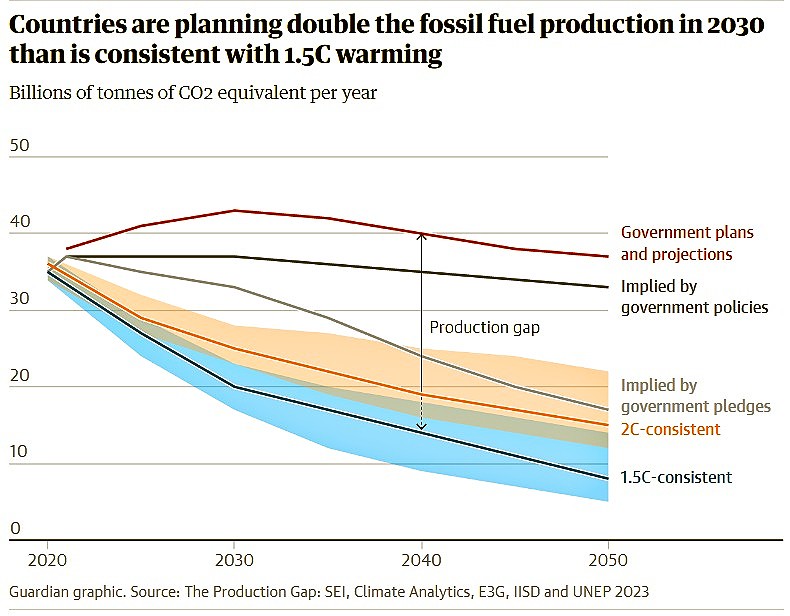 This remarkable graph zeroes in on the production gap between what was agreed in Paris in 2015 and all the plans and projections of our governments. And it is simply astounding: By 2040 – just one generation from now – the difference is a whopping 25 billion tons of CO2 equivalent per year.
Can you imagine the pollution and heat this will generate? Pollution already kills 10 million people a year, and heat waves have become deadly – like the 2003 heat wave that hit Europe and killed 30,000 people. It was considered one of the ten deadliest natural disasters in Europe for the last 100 years and the worst in the last 50 years.
And 2023 is headed toward a Guinness record of sorts, as the hottest year ever recorded in 125,000 years – this according to the non-profit organization Climate Central. And climate change is to blame as 7.3 billion people “faced temperatures strongly influenced by global warming”.Researchers found that the average global temperature over the past 12 months was 1.32 ºC above that during the pre-industrial baseline period of 1850 to 1900, surpassing the previous record of 1.29 ºC that was set from October 2015 to September 2016
Not to mention other extreme weather events like wildfires, floods, hurricanes…And this is not even taking into account the folly of wars – Ukraine, Gaza and so many other conflicts around the world that keep erupting. Because war is a huge contributor to climate change too.
I know that in climate reporting it is good manners to try and put forward an optimistic twist on climate news in order not to scare you. That makes sense and normally I’m all for politeness and respecting other people’s feelings. But now, it’s far too late for good manners. The situation is critical and it’s useless to pretend otherwise.
Indeed, it would be criminal on my part to tell you that it’s all OK, that with 25 million tons more CO2 emissions in our atmosphere, we’re going to be alright.
That we know how to handle it.
That we have the technology to ride it through. Hey, we’ll capture the extra CO2 from the air! There’s nothing to worry about!
And if you ask your friendly AI chatbot about this, it will tell you, as BING AI recently told me:
“The future of the human population is not predetermined by climate change, but rather influenced by the choices and actions that we make today and in the coming years. We have the opportunity and the responsibility to shape a more sustainable and healthy future for ourselves and for generations to come.”
Well, time to call a spade a spade. As AI chatbots say, our future may not be “predetermined by climate change” but our choices and actions do make a difference and that’s the whole problem!
We’re not OK.
We won’t capture that extra CO2 from the air, not enough of it at any rate. The technology requires high energy and could lead to a lot of climate pollution, more than it can remove. And even if we do, we’ll have to keep doing it every year and it will have tremendously negative impacts on global food production. That much is certain (and it’s likely to have many other negative impacts too).
People will go hungry, and not just a few people. Right now, over 800 million people are already going hungry and facing famine. And the numbers are rising: Since 2019, according to WHO, more than 122 million people have been pushed into hunger.
If you want to understand how a hot world will affect us, I highly recommend reading Jeff Goodell’s latest bestseller, The Heat Will Kill You First: Life and Death on a Scorched Planet. Note his title: He’s not speaking of “scorching” heat but of a “scorched planet”. And that’s because it’s happening now.
Scientists are increasingly calling this the sixth extinction, as Pulitzer Prize winner Elizabeth Kolbert so ably argued in her remarkable book, The Sixth Extinction, an Unnatural History. It was published in 2014 – incredibly, it’s almost ten years since she rang the alarm bell! If you are curious, see here for more about “A World Without Us”, an article we published in 2021 by our contributor Edmund Weisberg, a bioethics writer.
Yet nobody in the political world is listening. And no doubt, “smooth and pleasant” climate reporting is one reason.
Too many people tend not to take Greta Tunberg seriously, she’s just a kid, right? She doesn’t understand the complexity of the issues, the beauty of our business model, etc etc.
What complexity?
Actually, it’s very simple: With the level of heat that these investments in fossil fuels will cause, it’s game over for humanity.
It’s game over because we are letting the fossil fuels industry have a free run. Indeed, quite literally, as Greta Thunberg said three weeks ago when she was arrested (see video above), “We are choking on their fumes.”
By one measure (the Gaia hypothesis). if we do nothing, led by our “business as usual” obsession, the planet will be left with just 500 million people alive – out of the 8 billion living on it today. Can anyone picture how the disappearance of seven and a half billion people plays out? Or assuming things may not turn out as bad as all that, how do you think the world will look like when even half that number disappears?
And as journalists, it’s our duty to inform you. And that’s what I’m doing now, here, at Impakter, along with my colleagues.
But informing is only half the story. Doing something about it is the other half. Like voting for the right politician who understands climate change and has a concrete plan to address it.
Ultimately it’s up to you, up to every one of us.
Editor’s Note: The opinions expressed here by the authors are their own, not those of Impakter.com — Featured Photo: climate change Credit: https://www.needpix.com/photo/821303/