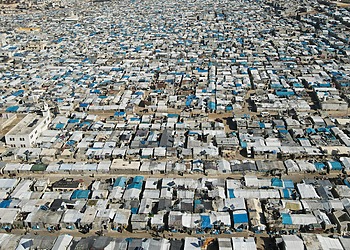
On February 2, U.S. District Judge Ana Reyes temporarily blocked the Trump administration’s plan —announced just days after the president took office in early 2025 — to terminate Temporary Protection Status (TPS) for Haitians, of which there are 350,000. The administration argued that Haiti had “improved sufficiently” to allow safe return. But the record before the court told a different story: gang-controlled neighborhoods, food insecurity, political collapse, and a U.S. State Department travel advisory warning Americans not to visit Haiti.
The injunction was quickly upheld by the U.S. Court of Appeals, setting the stage for a showdown at the Supreme Court. And that is where the future of Haitian TPS — and perhaps the future of executive power over immigration — now rests.
What is Temporary Protected Status?
Temporary Protected Status is one of the most consequential humanitarian tools in U.S. immigration law. Created by Congress in 1990, TPS allows nationals of countries experiencing extraordinary crises to remain and work legally in the United States until conditions improve.
TPS is available when “conditions in the [home] country…temporarily prevent the country’s nationals from returning safely, or in certain circumstances, where the country is unable to handle the return of its nationals adequately.” These conditions include “ongoing armed conflict (such as civil war), an environmental disaster (such as earthquake or hurricane), or an epidemic, and other extraordinary and temporary conditions.”
It is not a pathway to citizenship, nor does it grant permanent residency. At its core is the recognition that deporting people into catastrophe is incompatible with American values and international norms.
Haitians first received TPS in 2010, following a catastrophic 7.0-magnitude earthquake that left more than 200,000 dead and displaced over a million people. The designation was renewed repeatedly, citing ongoing instability, cholera outbreaks, and political unrest. By 2024, these numbers grew to roughly 350,000 under TPS, many for more than a decade. They had families, careers, and communities. Tens of thousands had U.S.-born children. Many had never returned to Haiti since the earthquake.
The Trump Administration’s Overzealous Push to End TPS
In early 2025, as the newly elected second term, President Trump issued six sweeping Executive Orders on immigration. One directed the Department of Homeland Security to “wind down” TPS for Haiti within 12 months. Officials insisted that Haiti had recovered enough to allow a safe return. But the evidence contradicts that claim as described above.
This effort was part of a broader pattern: an aggressive assertion of executive authority over immigration, often justified by claims of national security or administrative efficiency. For Haitian families, the consequences were immediate and terrifying. Deportation would mean returning to a country where kidnappings were rampant, hospitals barely functioned, and the government controlled little beyond its own buildings.
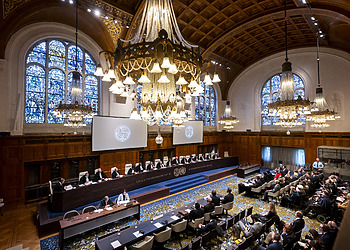
The administration’s decision triggered lawsuits across the country. But the case that rose to national prominence was Reyes v. Department of Homeland Security. In this instance, Judge Reyes issued a sweeping injunction halting the termination of TPS for Haitians.
Reyes’ order was affirmed on appeal that the judiciary has a role in ensuring that executive power is exercised within statutory limits. But that is not the final result: The Administration has brought the case to the Supreme Court.
The Supreme Court’s Immigration Record: A Mixed, Often Restrictive Pattern
A look at the current Supreme Court’s recent immigration decisions indicates that it has supported the broad authority of the Executive Branch over immigration. For example, while the facts and situation in Haiti differ significantly, in a 2025 case, Noem v. National TPS Alliance, the Supreme Court did grant the Administration’s request to end TPS participation by Venezuelans. And the Haitian case will be heard in the context of a wider pattern of aggressive executive actions on immigration, including expanding expedited removal, increasing detention of asylum seekers, restricting humanitarian parole, narrowing eligibility for refugee status, and accelerating deportations without full hearings.
This month, Yemeni nationals filed their own class action lawsuit in U.S. District Court for the Southern District of New York, challenging the unlawful termination of Yemen’s Temporary Protected Status (TPS) designation
These actions support the notion that immigration primarily must be seen through the lens of enforcement and deterrence rather than humanitarian protection or economic integration. The Supreme Court’s decision will have important implications, either way.
Related Articles: Caught in a War of Choice: Who Protects the Displaced in the Middle East? | The Prophetic Voice in the American Resistance | Refugees: Why We Should Stop Seeing Them As An Economic Burden | Migration Policy in Europe: Greece and Spain Take Divergent Paths
What the Haitian TPS Case Reveals About America’s Identity
For centuries, the U.S. offered protection to people fleeing war, persecution, and disaster. TPS is a modern expression of that tradition. The Haitian TPS case exposes deep tensions between humanitarian values vs. enforcement priorities, executive power vs. congressional intent, judicial oversight vs. administrative discretion, and national security rhetoric vs. actual country conditions.
If the Court rules in favor of the Administration, the consequences will be immediate and far-reaching for hundreds of thousands ordered to leave within months, U.S.-born children would face impossible choices, and industries reliant on Haitian workers would face labor shortages. Externally, Haiti’s fragile infrastructure cannot absorb such a large influx of returnees. If this is the decision, it becomes a precedent for other TPS populations. According to Congress, as of March 2025, nearly 1.3 million people from 17 countries were living in the U.S. with TPS protections.
If the Court sides with the Haitians, the administration must review its decision and base executive immigration actions on evidence, not politics. The decision could limit future administrations’ ability to unilaterally terminate humanitarian protection.
America’s Response
Beyond the legal and political dimensions is the moral question. For many Americans, welcoming people fleeing danger is not just policy — it is a core part of national identity, and many are first- or second-generation immigrants. Further, if humanitarian protections become subject to political whims, the U.S. risks losing a defining positive part of its global reputation.
The country now waits for the Supreme Court to decide not only the fate of hundreds of thousands of Haitians, but the meaning of America’s promise, as it is said on the Statue of Liberty outside New York harbor:
“Give me your tired, your poor, your huddled masses yearning to breathe free.”
Editor’s Note: The opinions expressed here by the authors are their own, not those of impakter.com — In the Cover Photo: Cover Photo Credit: