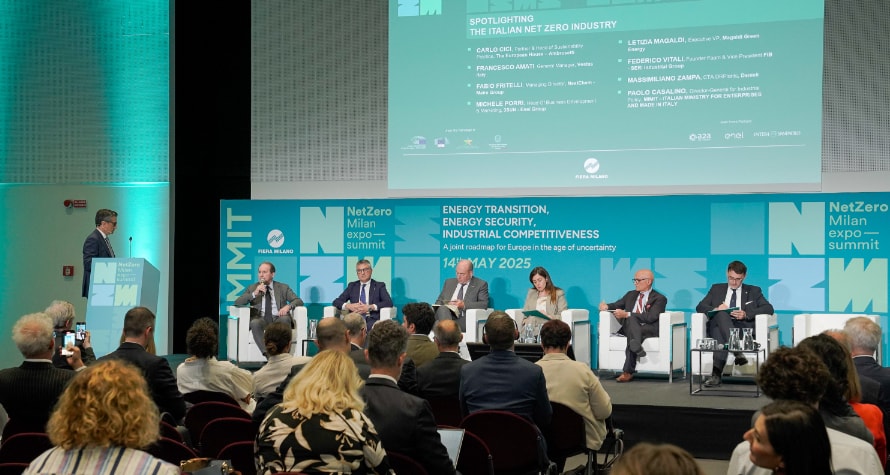
Last week, I attended the first-ever NetZero Milan expo-summit in Milan, Italy. The event brought together professionals from all over Europe to discuss Europe’s green energy transition. The overall tone at the summit was unanimous among speakers and attendees: Climate change is happening now, and we must take steps toward reshaping the energy sector.
The conference slogan was “Energy transition, energy security, industrial competitiveness: a joint roadmap for Europe in the age of uncertainty.” The summit can be broken down into four keywords: transition, uncertainty, diversification, and collaboration.
Transition
Europe has remained remarkably resilient throughout the COVID-19 outbreak and other natural and political disasters over the past few years because it has a clear direction and doesn’t change course. The European Union is committed to its target of net-zero emissions by 2050, and its dedication to climate change rarely waivers. Nevertheless, Europe is now entering a period of transition.
The European Commission’s Directorate-General for Climate Action, Marzena Rogalska, compared this transition in Europe to that of a baby to a teenager. She highlighted that this crucial moment is taking sustainable strategies from startup to scaleup in European countries. It is time for green energy to mature and develop across the continent.
The summit focused heavily on renewables, decarbonization, and electrification as the way forward. Davide Panzeri of the ECCO Climate Think Tank, an Italian non-profit focused on the changing climate, said that industrial decarbonization will be at the heart of this next, more difficult transition phase. He also called for less reliance on fossil fuels through decarbonization and electrification.
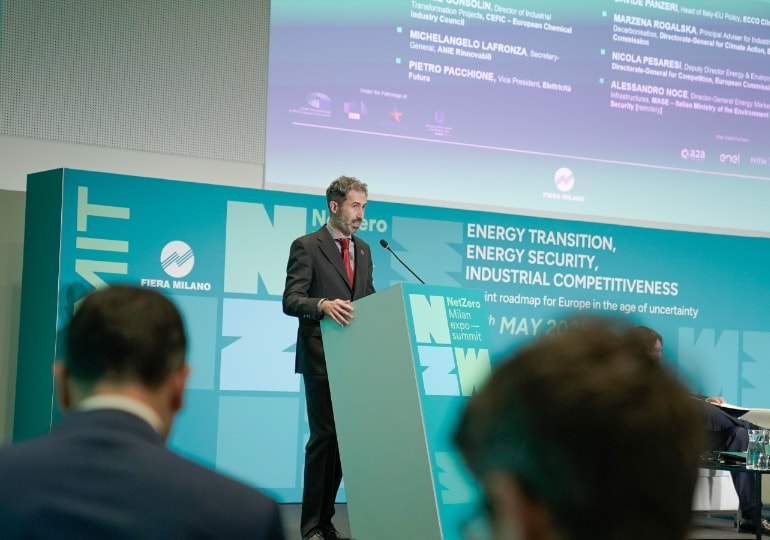
Ricardo Dutto, Head of Industry Infrastructure, IMI Corporate & Investment Banking at Intesa Sanpaolo, noted that China has leapfrogged the U.S. and Europe in the race toward electrification. Europe must strengthen its efforts in this sector to maintain a competitive edge.
Alessandro Noce, Director-General for Energy Markets & Infrastructures at the Italian Ministry of the Environment and Energy Security (MASE), said, “Transition is a very serious task.” It’s simply “a matter of finding the money to make the ‘how’ possible.”
The European Commission has allocated over €180 billion to energy-related improvements, with over €34 billion invested in swiftly making renewable energy operational across Europe. However, this funding is not enough for such a massive undertaking. Experts at the conference said that the consumers will be key in this transition, funding projects through tariffs and incentives.
Uncertainty
The current administration in the United States has made two things abundantly clear: They are defunding climate research and initiatives and loosening ties with the European Union. The Center for Strategic and International Studies (CSIS), a nonprofit, bipartisan think tank based in the United States, has stated that Europe and the U.S. “will likely clash, repeatedly and continuously,” in a transformation it calls a “post-American age.” Every speaker at the event seemed to share this sentiment.
Europe relies heavily on other countries for its natural gas needs. Most fossil fuels are imported into the EU, accounting for approximately 58% of energy demand. The United States is one of the biggest suppliers of these fossil fuels. With the looming tariffs and rocky relations, the European Union is in a vulnerable position. This makes the need for electrification and renewables even stronger.
Diversification
This political uncertainty leads to an increased need for security and diversification. Many speakers pointed out that what is happening in Ukraine is a strong example of why dependencies are never good. Diversification of the supply chain is crucial. Europe must combat geopolitical risks by strengthening its international market practices for critical materials.
In addition to diversification for security, diversification in renewable energy sources is also essential. The German term “dunkleflaute” refers to the period from late autumn through winter when there is little sunlight and light wind. These periods affect most of the continent, specifically the northern countries. To combat these periods, the grids must be updated and expanded throughout Europe, integrating renewable energy sources to enable flexibility.
Another argument for strengthening the grid comes from the blackout in Spain and Portugal earlier this month. Instead of reverting to fossil fuels, the EU must continue on its path toward sustainability by increasing green energy sources. Ricardo Dutto of Intesa Sanpaolo stated that the European Union, and Italy specifically, should seek a fourfold increase in renewables. This includes doubling wind energy and tripling solar energy.
Related Articles: Seven Ways Fossil Fuel Subsidies Undermine Energy Security | The Future of Europe: Dismal if Nothing Is Done, Says Draghi | Europe’s Energy Crisis: Small-scale Solutions To The Rescue
Collaboration
Perhaps the most common message at the summit was the need for collaboration. Norela Constantinescu, Director of Innovation and Technology at the International Renewable Energy Agency (IRENA), stated that for the EU to strengthen its competitiveness and ensure “no one is left behind,” it must take “coordinated action on innovation, skills, industrial development, and social inclusion.”

This is not a problem solely for those focused on sustainability. People and professionals across every sector must concentrate their efforts and investments on green energy. Davide Panzeri of ECCO Climate said that the business community’s voice is vital in this transition. Now, more than ever, investments in sustainability are crucial. Once companies start investing, it is impossible to know how far innovations will go.
Marzena Rogalska of the European Commission summed up this point by saying: “If we fail, nobody succeeds.” The European Union is a driving force in the energy transition. It must maintain momentum and aid other countries across the globe with this significant move for humanity and the planet.
Italy’s position in the energy transition
As NetZero Milan took place in Italy, a significant focus was on Italy and the country’s role in the green energy shift. Italy is Europe’s second-largest exporter of industrial products behind Germany. The substantial industry puts Italy in a position to make many changes.
Alessandro Noce of MASE emphasized that around 310 terawatts (TW) of energy are consumed annually in Italy, with 140 TW accounting for industrial consumption. He highlights that this consumption reinforces the need for electrification across Italy, switching from heavily used fossil fuels to renewable energy sources.
That said, the country may face some resistance. On Saturday, Prime Minister Giorgia Meloni claimed that this shift toward green energy could lead to “industrial desertification.” She argued that Europe’s manufacturing capabilities could be significantly reduced with a push toward electrification and condemned the EU’s strict governance of climate regulations.
Despite everything, the attitude at NetZero Milan was positive. Speakers and attendees alike seemed optimistic that a net-zero Europe by 2050 was achievable. Now, everyone must do their part to reach this goal.
Editor’s Note: The opinions expressed here by the authors are their own, not those of impakter.com — In the Cover Photo: Entrance to the first-ever NetZero summit in Milan, Italy. Cover Photo Credit: Author.