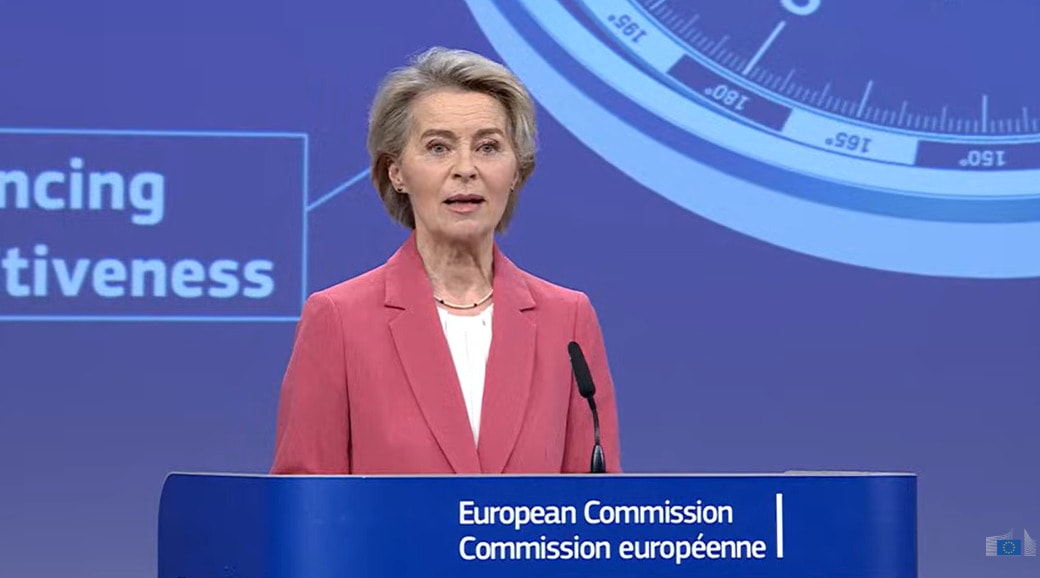

Yesterday, January 29, the European Commission announced the release of “A Competitiveness Compass for the EU.” The “days of relying on cheap Chinese labor and Russian energy are gone,” said EU Commission head Ursula von der Leyen at a press conference. She has no doubts: “Europe has everything it needs to succeed in the race to the top. But, at the same time, we must fix our weaknesses to regain competitiveness.”
Last year, von der Leyen received a brilliant report from Mario Draghi, former European Central Bank President and Italian Premier, which acted as a wake-up call on how to boost Europe’s economic growth.
And now, she’s acting on it, and as she explains:
“The Competitiveness Compass transforms the excellent recommendations of the Draghi report into a roadmap. So now we have a plan. We have the political will. What matters is speed and unity. The world is not waiting for us. All Member States agree on this. So, let’s turn this consensus into action.”
The EU Competitiveness Compass: innovation, decarbonization and security
The document outlines a five-year strategic framework aimed at boosting the EU’s economic competitiveness on a global scale.
It focuses on three core areas:
- Closing the Innovation Gap: The Compass seeks to reignite Europe’s innovation engine by fostering a supportive environment for all companies, including SMEs and startups, promoting industrial leadership in high-growth sectors like AI and biotechnology, and facilitating the adoption of new technologies across various industries; key components include:
-
-
- ‘AI Gigafactories‘ and ‘Apply AI‘ initiatives soon to be proposed to drive development and industrial adoption of AI in key sectors;
- A dedicated EU Start-up and Scale-up Strategy;
- A proposal for a 28th legal regime to simplify rules, including corporate law, insolvency, labour and tax law, and reducing the costs of failure;
-
- Joint Roadmap for Lower Energy Prices while continuing to Decarbonize: areas for intervention include:
-
- The upcoming Clean Industrial Deal to turn the EU into an attractive location for manufacturing, including for energy-intensive industries, and promoting clean tech and new circular business models;
- An Affordable Energy Action Plan to bring down energy prices and costs;
- An Industrial Decarbonisation Accelerator Act to extend accelerated permitting to sectors in transition.
- tailor-made action plans for energy-intensive sectors, such as steel, metals, and chemicals, the “backbone of the European manufacturing system;
- Reducing excessive dependencies and increasing security and resilience: In von der Leyen’s words, the EU is already a “champion of trade” that has set up trade deals with 76 countries, accounting for almost half of EU trade; but that needs to be expanded and measures proposed include:
-
- a new range of Clean Trade and Investment Partnerships to help secure supply of raw materials, clean energy, sustainable transport fuels, and clean tech from across the world.
- Public Procurement rules within the internal market will be reviewed to allow for a European preference in public procurement for critical sectors and technologies.
How will all this be implemented? Five “horizontal simplifiers” are proposed:
- Simplification: Recognizing that the complex EU regulations can be a burden on business, the EU Commission promises to make procedures for accessing EU funds and getting EU administrative decisions simpler, faster, and lighter through:
- the upcoming Omnibus proposal to simplify sustainability reporting, due diligence, and taxonomy, especially for thousands of “small mid-cap companies” with a target of cutting by at least 25% the administrative burden for firms and by at least 35% for SMEs;
- plans to “address the trickle-down effect” of the regulations “to prevent smaller companies along the supply chains from being subjected in practice to “excessive reporting requests” that the legislators never intended.
- Lowering barriers to the Single Market: To improve its functioning across all industries:
- A Horizontal Single Market Strategy will modernize the governance framework, removing intra-EU barriers and preventing the creation of new ones;
- EU Commission will make standard-setting processes faster and more accessible, in particular for SMEs and start-ups.
- Financing competitiveness: To remedy the lack of an efficient capital market that turns savings into investments, the Commission proposes:
- A European Savings and Investments Union to create new savings and investment products and provide incentives for risk capital
- A refocused EU budget will streamline access to EU funds in line with EU priorities.
- Promoting skills and quality jobs: the Commission plans to present an initiative to build a Union of Skills focusing on investment, lifelong learning, skills creation and retention, fair mobility, attracting and integrating qualified talent from abroad and recognition of different types of training to enable people to work across the EU.
- Better coordination of policies at EU and national level: To ensure it, the Commission will introduce the following:
- A Competitiveness Coordination Tool to ensure shared EU policy objectives at the EU and national level, cross-border projects, and related reforms and investments;
- A Competitiveness Fund in the next Multiannual Financial Framework to replace multiple existing EU financial instruments with similar objectives, providing financial support to the implementation of actions under the Competitiveness Coordination Tool.
That is, if nothing else, an impressive and very comprehensive list of proposed measures.
Draghi’s report vindicated?
It certainly looks like it. The Compass is closely based on the recommendations of the Draghi Report, which suggested a number of solutions to address the EU’s competitiveness gap.
It presents itself as a practical response to recent global challenges and seeks to enhance the EU’s security and resilience. This includes reducing dependencies on external factors, strengthening supply chains, and promoting a more secure and stable environment for businesses to operate in.
The EU Commission document thus appears as a practical, comprehensive roadmap for policymakers, intended to provide a framework for coordinated efforts to enhance the EU’s economic standing in the coming years.
Not everyone thinks it will work…
The EU Commission plan still has to go to the European Parliament, the European Council, the European Economic and Social Committee, and the Committee of the Regions to obtain their support and approval, so don’t expect instant adoption!
Most obvious is the extent and number of proposed measures: Clearly, as it has to go through the heavy EU regulation machinery, a lot of pieces could get lost on the way, and what starts as an ambitious giant could end up a modest dwarf.
Editor’s Note: The opinions expressed here by the authors are their own, not those of Impakter.com — In the Cover Photo: EU Commission President Ursula von der Leyen presenting The Competitiveness Compass at the press conference held on January 29, 2025 (screenshot)