Today’s ESG Updates:
- Indonesia Forms National Energy Council: With one of its aims being to reduce fuel import dependencies and achieve long-term energy security and sovereignty.
- US EPA Set to Review Fluoride in Drinking Water: The MAHA-backed move could tighten federal standards and CDC guidance, even as dental authorities defend fluoridation for cutting tooth decay.
- GlassPoint Raises US$20 Million to Decarbonise Industrial Heat: GlassPoint’s solution could be a game-changer in decarbonising the “heavy industries” like ceramics, glass, and steel.
- Google Joins $425 Million Capital Raise for Battery Storage Provider Redwood Materials: Google plans to invest further capital to scale its grid storage and critical minerals operations.
Indonesia forms national energy council
Indonesia has officially established the Dewan Energi Nasional (DEN), or National Energy Council, for the 2026–2029 term to accelerate energy self‑sufficiency and support the country’s energy transition agenda.
State Secretary Minister Prasetyo Hadi said the council’s mandate is to “coordinate among ministries and agencies to boost domestic energy production, expand renewable energy use, and shift consumption toward alternatives such as biofuel and biosolar.” He emphasised Indonesia’s significant solar potential as a key asset for future energy planning.
President Prabowo Subianto urged the DEN to prioritise cutting fossil‑fuel imports and achieving energy independence, framing it as a strategic move to enhance national resilience. “We must reduce dependency on imported fuel and move toward self‑sufficiency,” Prabowo stated during the council’s inauguration at the Presidential Palace.
Moreover, Indonesia’s Energy and Mineral Resources Minister and DEN daily chair Bahlil Lahadalia also supported Prabowo’s statement, “There are four key focuses. First, energy sovereignty: there must be no intervention by any party. Second is energy security: currently, our energy reserves last only 21 days, and we will increase this to three months, and we will definitely build storage facilities.”
Lahadalia also further stated, “We still import approximately 30 million kilolitres of fuel, both diesel and gasoline. The fourth focus is self-sufficiency. We will implement this in stages, with the ultimate goal of achieving energy self-sufficiency.”
***
Further reading: Indonesia forms Nat’l Energy Council to boost energy self-sufficiency; Prabowo urges DEN to cut fuel imports, boost energy self-sufficiency
US EPA set to review fluoride in drinking water

The US EPA (United States Environmental Protection Agency) has begun an expedited toxicity review to set “safe levels of fluoride in drinking water,” a move that could revise fluoride standards under the Safe Drinking Water Act and reshape CDC (Centres for Disease Control and Prevention) recommendations.
The review follows a 2024 court order to address fluoridation’s risk to children’s IQs and will focus only on “potential harmful effects and will not consider beneficial effects,” EPA water chief Jess Kramer told a MAHA Action webinar.
Meanwhile, key figures within the US EPA’s MAHA (Make America Healthy Again) movement, like Health Secretary Robert F. Kennedy Jr., oppose fluoridation and have pushed to halt CDC recommendations and reconvene an independent expert panel. At the same time, the FDA (Food and Drug Administration) has already moved to remove children’s fluoride supplements from the market.
However, the ADA (American Dental Association) still backs community fluoridation, citing studies showing it cuts tooth decay by more than 25% in children and adults. The EPA will take public comments for 30 days before finalising a peer-reviewed draft assessment.
***
Further reading: US EPA moves to take action on review of fluoride in drinking water
Klimado – Navigating climate complexity just got easier. Klimado offers a user-friendly platform for tracking local and global environmental shifts, making it an essential tool for climate-aware individuals and organisations.
GlassPoint raises US$20 million to decarbonise industrial heat
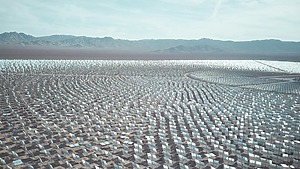
New York-based GlassPoint has raised $20 million to scale its solar industrial heat projects in the US and globally, with funding from New Investment Solutions (NIS) and MIG Capital.
Founded in 2009, the company focuses on developing solar technology designed to produce industrial process heat at scale. Using curved mirrors in glasshouses, it’s “enclosed through” solar steam technology that delivers high‑pressure steam, occupying roughly one-sixth the land needed by conventional solar photovoltaic (PV) to produce equivalent energy, with molten-salt storage enabling long-duration energy storage.
Hence, if successful and profitable, this solution could be a game-changer in decarbonising the “heavy industries” sector, as over half of global industrial activity is in regions suitable for deployment. Thus, positioning the company to address hard‑to‑abate fossil-fuel-based industrial heat.
Current and planned projects include 750 MW thermal with Searles Valley Minerals in California to support coal plant decommissioning, a 1.5 GW thermal project with Ma’aden to decarbonise a Saudi bauxite refinery, and a 330 MW thermal installation in Oman operating since 2017.
GlassPoint CEO Rod MacGregor said, “a proven solution to deliver industrial process heat at the lowest cost.” At the same time, NIS founder Takashi Sato highlights solar as now “the lowest cost source of industrial power” in many regions.
***
Further reading: GlassPoint Raises $20 Million to Decarbonise Industrial Heat with Solar Tech

Google joins $425 million capital raise for battery storage provider Redwood Materials

Founded in 2017 by Tesla co-founder JB Straubel, Nevada-based Redwood Materials has closed its Series E funding at $425 million, up from the $350 million announced in October, driven by “strong demand,” with the extra funding used to accelerate its energy storage platform and integrated recycling and critical minerals business.
The company has two key business lines: a cradle‑to‑gate grid energy storage business that delivers low‑cost systems using new and repurposed batteries, and a cradle‑to‑cradle critical materials business that recycles end‑of‑life batteries and refines and manufactures critical materials for the US supply chain.
Existing investors like Capricorn and Goldman Sachs re-upped, with Google joining the round as a new investor to align with its goal to run its entire business on 24/7 carbon-free energy by 2030.
As Redwood Materials put it, “as electricity demand surges driven by AI, data centres, manufacturing and electrification. Energy storage is no longer optional; it is essential infrastructure.”
***
Further readings: Google Joins $425 Million Capital Raise for Battery Storage Provider Redwood Materials
Editor’s Note: The opinions expressed here by the authors are their own, not those of impakter.com — In the Cover Photo: Inauguration of Indonesia’s National Energy Council led by President Prabowo Subianto. Cover Photo Credit: Indonesia State Secretariat