Impakter
  • Environment
    • Biodiversity
    • Climate Change
    • Circular Economy
    • Energy
  • FINANCE
    • ESG News
    • Sustainable Finance
    • Business
  • TECH
    • Start-up
    • AI & Machine Learning
    • Green Tech
  • Industry News
    • Entertainment
    • Food and Agriculture
    • Health
    • Politics & Foreign Affairs
    • Philanthropy
    • Science
    • Sport
  • Editorial Series
    • SDGs Series
    • Shape Your Future
    • Sustainable Cities
      • Copenhagen
      • San Francisco
      • Seattle
      • Sydney
  • About us
    • Company
    • Team
    • Partners
    • Write for Impakter
    • Contact Us
    • Privacy Policy
No Result
View All Result
Impakter logo
No Result
View All Result
Dilling: Clean Underwear for the whole family

Dilling: Clean Underwear for the whole family

Mr. Mohamad Akef - ColuminstbyMr. Mohamad Akef - Columinst
February 14, 2018
in Design, Fashion, Foodscape
0

There are some people who tend to assume that sustainability and eco-friendly business practices are things that only new companies adopt, due to the current consumer climate that has begun to favor those things. But while it is true that the sustainability trend has gained prominence relatively recently, it hasn’t left behind companies with an older pedigree either.

One case in point is DILLING, a Danish apparel company that’s been family-owned and run by four generations since 1916. Specializing in organic merino wool and organic cotton clothing, DILLING takes social responsibility very seriously, from its material sourcing to its dyeing and employee hiring practices. I recently reached out to DILLING CEO Morten Dilling to learn more about his views on sustainability, his emphasis on customer care, and what it’s like to lead a family business.

In the photo: DILLING underwear shoot Credit: DILLING

Q: What are the origins of DILLING?

MD: DILLING comes from Denmark originally. We dye our products in there and sew them in Lithuania. Our wool comes from Patagonia in Argentina, and our cotton comes from various countries, like India for example. Using clean and comfortable underwear is definitely a necessity. It’s an unwritten rule, so to say. In fact, a lot of people are even tuning to giving underwear as a present such as this couples underwear which can spice up the romance of that couple.

Q: What inspirations do you draw from when designing your products?

MD: We draw inspiration from many sources, like landscapes, cities, other clothing brands, trend studies, etc.
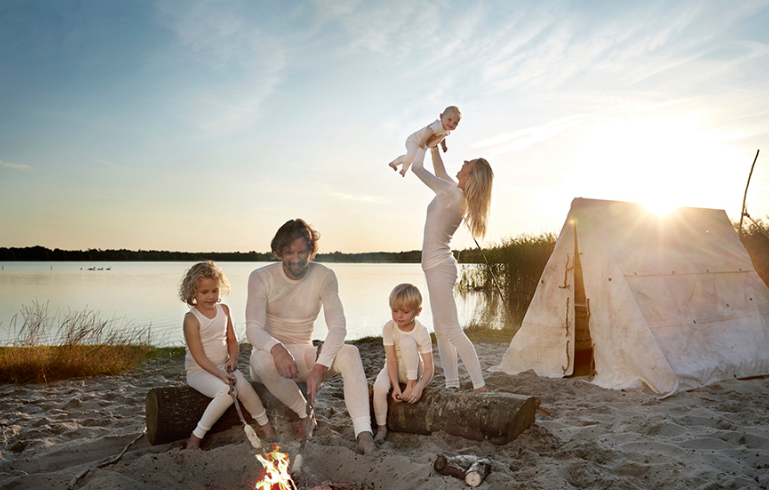
In the photo: Family photo shoot for DILLING Credit: DILLING

Q: What does sustainability mean to you and DILLING?

MD: To produce things as environmentally friendly as possible is not something we do because we can make a good marketing story out of it. We do it because it means something. We made the decision to keep our dye house in Denmark and not to place it in the Far East or in Eastern Europe, for example. The dyeing process is the most important one for both the environment and for our customers that wear our products. By having it in Denmark, we know exactly which colors and chemicals are being used. Clean production means everything for us because of nature and because of the skin of our customers.

Q: What challenges has DILLING encountered as it’s grown?

MD: There are quite a lot of challenges, like finding and keeping the best employees in order to develop our concept. We also believe that our customers expect us to do things right. The infrastructure (especially IT) in our company is big, but it’s also exciting and a positive challenge. In addition, we are also a family business, one that I have taken over from my father, and that has posed its own challenges as well. My father, Villy H. Bertelsen, has owned this company for 48 years ever since he took over from his farther in 1968 (we were founded in 1916 by my great-grandfather). Owning a company for so many years makes it difficult to give the responsibility to next generation, but we’ve made use of my father’s experience and have executed the change of ownership well.

In the photo: DILLING family photo shoot Credit: DILLING

Q: What does the future of DILLING look like in your eyes?

MD: We have to work hard to sharpen our concept. We want to build three product lines; one for kids, one for everyday luxury organic products, and one for outdoor activities. We will meet more competition because organic is currently “in” in many communities, but we think we have a strong concept where we only sell to consumers with no expensive middlemen (e.g. stores, distributors, etc.). That also means we have to ensure the right capacity for the growth we are working hard to ensure.


Editors note: The opinions expressed here by Impakter.com columnists are their own, not those of Impakter.com

Tags: businessDesignfamilyfashionImpakterSustainabilitythingserUnderwear
Previous Post

How 2030 Agenda provides chance for countries to escape “middle-income” trap and help finance global development

Next Post

Polis, the door-to-door app.

Related Posts

ESG News regarding Nuclear Waste Storage; Canada Replaces EV Mandate; EU and Turkey Resume Trade Modernization Talks; Startup Raises $29M for Desk-Sized Fusion Reactor
Business

Volunteers Needed for Nuclear Waste Storage

Today’s ESG Updates: US Offers Incentives for Nuclear Waste Storage: The Department of Energy is proposing a "package deal" of...

byEge Can Alparslan
February 6, 2026
ESG news regarding a new EU initiative that lets companies operate seamlessly across all EU member states, U.S. and India reaching major trade deal after tariff reductions, Spain fining Repsol €20.5 million for unfair fuel pricing practices, and Ørsted’s $7 billion Sunrise Wind project being cleared to resume construction.
Business

EU-INC Introduces a Unified Legal System to Simplify Business Across Europe

Today’s ESG Updates EU-INC Lets Companies Operate Seamlessly Across All EU Member States: The European Commission unveiled EU-INC at Davos,...

byAnastasiia Barmotina
February 3, 2026
RTA Cabinets
Architecture

RTA Cabinets vs. Pre-Assembled: What to Choose

Every homeowner knows that choosing kitchen cabinets is a critical step in their journey to building a nice and cozy...

byHannah Fischer-Lauder
January 29, 2026
Indonesia Forms National Energy Council
ESG FINANCE

Indonesia Forms National Energy Council

Today’s ESG Updates: Indonesia Forms National Energy Council: With one of its aims being to reduce fuel import dependencies and...

byAriq Haidar
January 29, 2026
When Food Waste Becomes Fashion: Emerging Innovations
Business

When Food Waste Becomes Fashion: Emerging Innovations

Imagine tossing an orange peel into the trash and later seeing it walk down a runway as part of a...

byKristen Bestmann-Danagogo
January 14, 2026
View of a kitchen in a new home with a functional design
Architecture

Designing a Functional Layout When Moving Into a New Home

Moving into a new home is exciting, but it can also feel overwhelming once the boxes arrive. Many people rush...

byHannah Fischer-Lauder
January 12, 2026
News about sustainability in the publishing industry
Environment

How the Publishing Industry Addresses the Carbon Footprint of Books

Books are ever-present in our lives: we look through picture books when we are children, study textbooks in school and...

byAnastasiia Barmotina
January 8, 2026
Business Growth graph
Business

How to Approach Business Growth with Fewer Risks

Is fast growth always worth the crash that sometimes follows it? Ask any startup founder who scaled too quickly and...

byHannah Fischer-Lauder
January 8, 2026
Next Post
Polis, the door-to-door app.

Polis, the door-to-door app.

Recent News

Underwater Wall to Protect the ‘Doomsday Glacier’: Necessary Intervention or Costly Distraction?

Underwater Wall to Protect the ‘Doomsday Glacier’: Necessary Intervention or Costly Distraction?

February 10, 2026
ESG News regarding EU ban on destruction of unsold clothes and shoes, UK securing record solar capacity, EDF’s ‘fish disco’ system potentially saving 90% of fish, and LNG demand in China setting to climb.

EU Moves to End Textile Waste

February 10, 2026
Friedrich Merz Proposing the Architectural blueprint of European institutions illustrating the Merz-Meloni non-paper strategy for EU deregulation

The Merz-Meloni Non-Paper: How the New Germany-Italy Axis Could Destroy Europe

February 10, 2026
  • ESG News
  • Sustainable Finance
  • Business

© 2025 Impakter.com owned by Klimado GmbH

No Result
View All Result
  • Environment
    • Biodiversity
    • Climate Change
    • Circular Economy
    • Energy
  • FINANCE
    • ESG News
    • Sustainable Finance
    • Business
  • TECH
    • Start-up
    • AI & Machine Learning
    • Green Tech
  • Industry News
    • Entertainment
    • Food and Agriculture
    • Health
    • Politics & Foreign Affairs
    • Philanthropy
    • Science
    • Sport
  • Editorial Series
    • SDGs Series
    • Shape Your Future
    • Sustainable Cities
      • Copenhagen
      • San Francisco
      • Seattle
      • Sydney
  • About us
    • Company
    • Team
    • Partners
    • Write for Impakter
    • Contact Us
    • Privacy Policy

© 2025 Impakter.com owned by Klimado GmbH