The pitch for AI data centres in space faces a vast amount of challenges, despite its great potential. Permits are slow, carbon emissions from rocket launches can be huge, and cooling systems must be adapted to the vacuum. All of these arguments are valid, but — as Kevin Roose recently noted on the Hard Fork podcast — “there is literally not enough capacity on our terrestrial energy grid to power everything.”
The constraint is real. The IEA projects data centre energy demand will exceed 1,000 TWh in 2026, roughly equivalent to Japan’s total consumption. Several US states, such as New York and Oklahoma, have imposed emergency grid moratoriums on new data centre connections.
Google stepped up to try to solve the issue with a research programme called Project Suncatcher: solar-powered data centres in space, where panels receive up to eight times the energy density of arrays on Earth, and the sun never sets on a dawn-to-dusk orbital path. There is also an NVIDIA-backed Starcloud project, Axiom Space, and both SpaceX and the Chinese government have announced moves in the same direction — the latter proposing the launch of 200,000 satellites with on-orbit processing capability to establish space data center infrastructure.
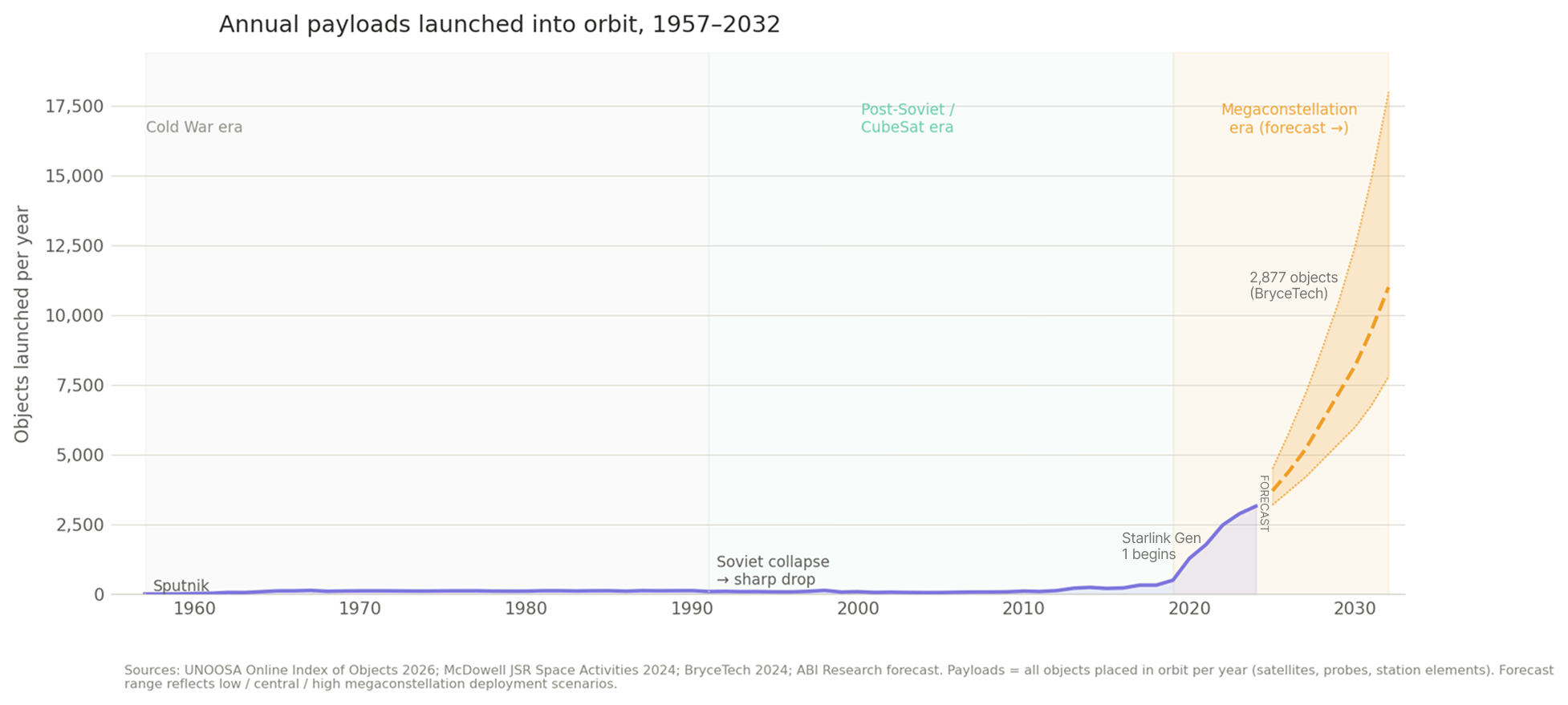
The trajectory is not incremental. The number of objects placed in orbit annually grew from under 500 in 2018 to nearly 3,000 by 2023. The forecast to 2032 shows an acceleration to around 10,000 that makes sustainability questions urgent. While the infrastructure decisions are still being made, it is critical to estimate potential carbon prices as accurately as possible.
How to account for sustainability of space-based data centres?
The lead sustainability claim, repeated across company announcements and media coverage, is that orbital data centres powered by solar produce a fraction of the carbon of their terrestrial equivalents. Starcloud puts the figure at ten times cleaner. Google’s Suncatcher research describes the technology as a route to carbon-neutral AI infrastructure.
Both claims are technically correct and defensible — in exactly one accounting frame. They compare orbital computing to gas-powered terrestrial data centres and count only the energy dimension of the lifecycle. They do not take into account what happens when the hardware comes up in space and back down.
Two peer-reviewed papers reached opposite conclusions in 2025 using the same underlying physics. NTU Singapore found that orbital data centres could become carbon-neutral within years. Saarland University researchers, on the other hand, found they are an order of magnitude worse than terrestrial equivalents, even under optimistic assumptions. The disagreement is not scientific — it is a dispute over which costs should be included.
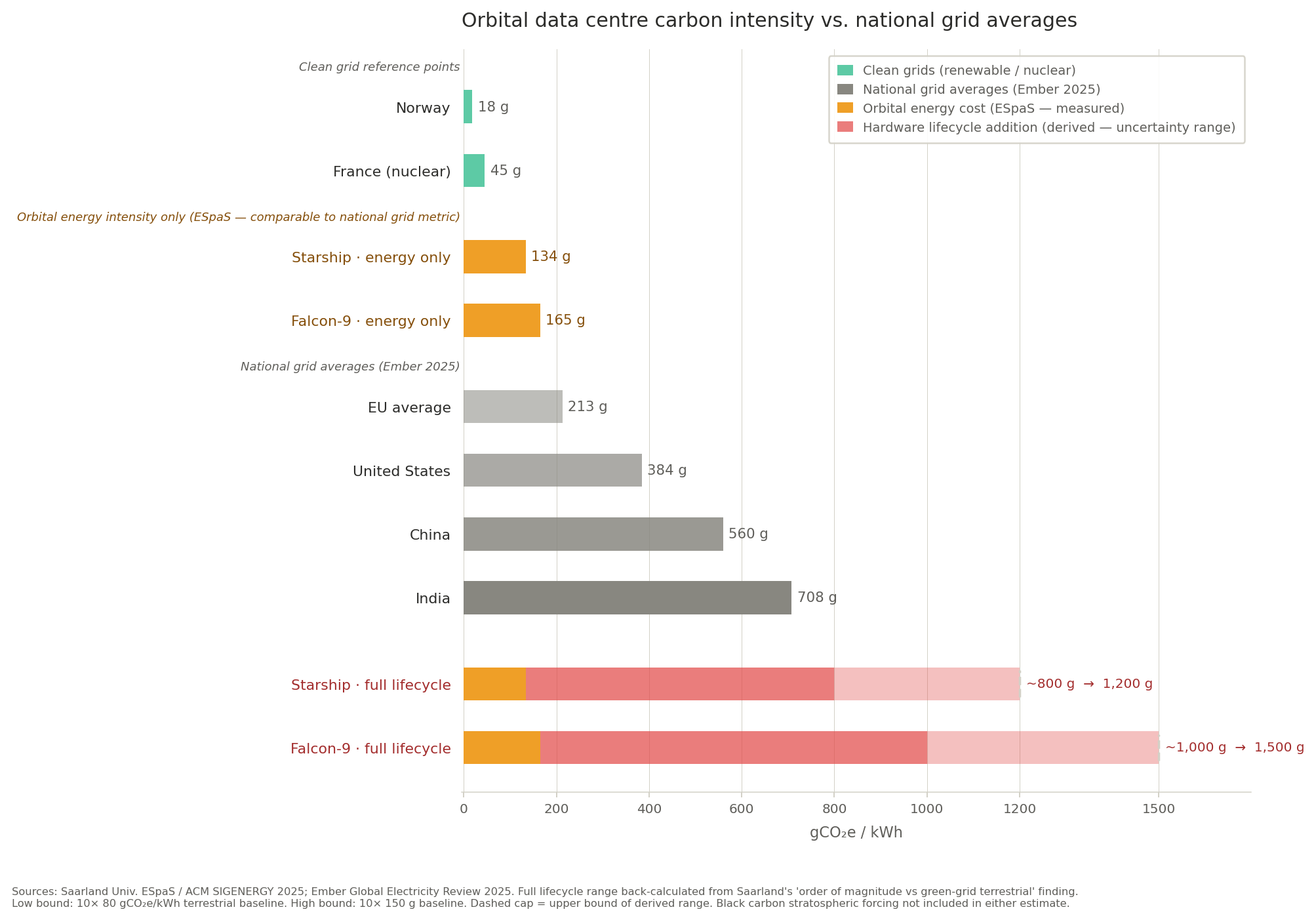
Saarland’s ESpaS model, which includes launch emissions, hardware manufacturing, and reentry, finds an effective carbon intensity of 800–1,500 gCO₂e/kWh for orbital compute — worse than any country grid on Earth. The industry figure of 134–165 gCO₂e/kWh counts only the energy dimension: a valid metric, but one that happens to be the only framing under which orbital compute competes with clean-grid terrestrial. Both sides know this.
There is also a structural asymmetry worth noting: NTU’s paper is a perspective — a framework proposal — funded in part by a research lab with commercial interests in space-grade semiconductors. Saarland’s is an empirical model with open-source code, that is reproducible by any researcher.
The main limitation: rocket emissions
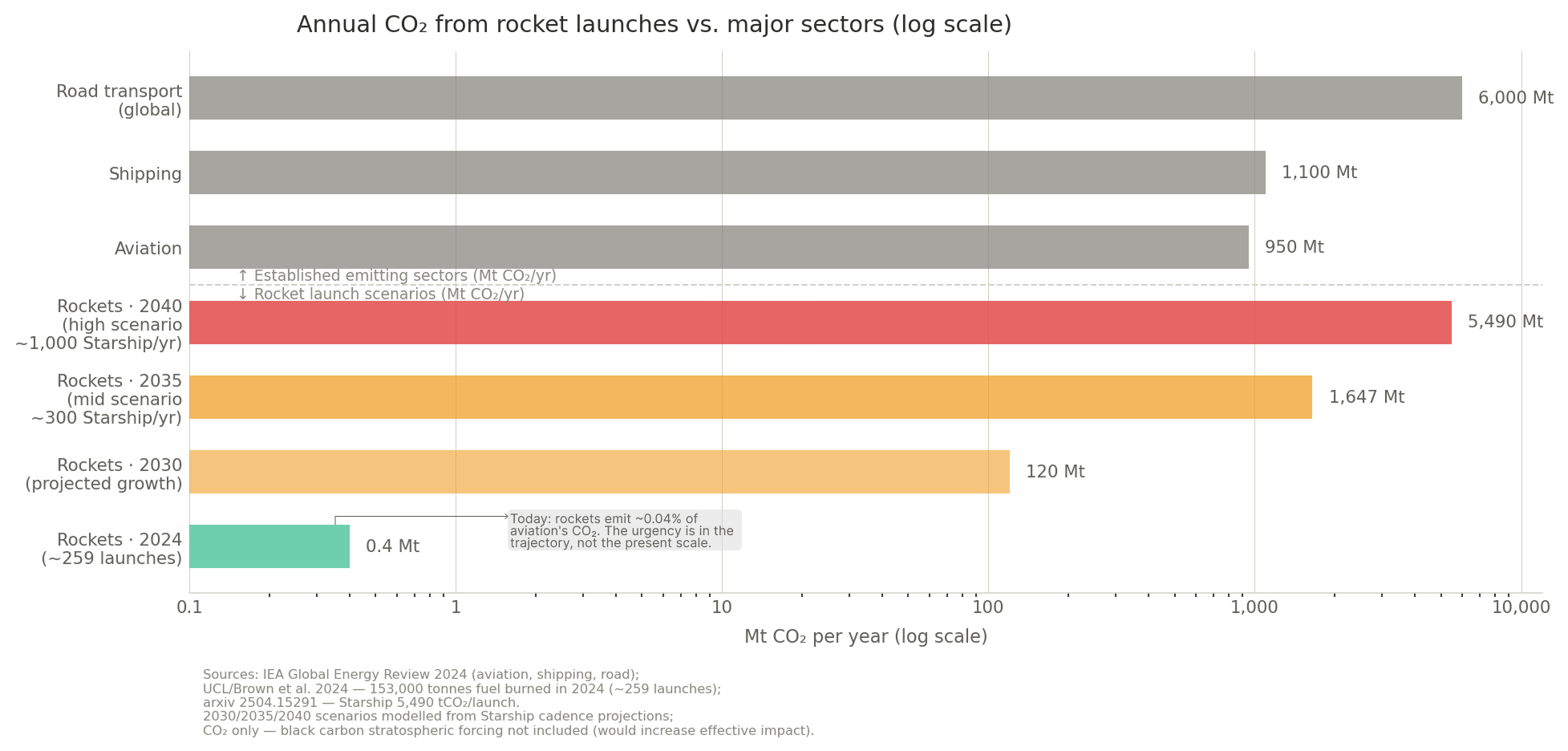
Today’s numbers require a correction that most estimates omit. All orbital launches in 2024 combined emitted roughly 0.4 million tonnes of CO₂ — approximately 0.04% of aviation’s annual output. Space data centres are not a meaningful contributor to global emissions today. The problems arise when looking at numbers tailored to projections. This is a key distinction.
Another important aspect is emissions from every new launch, which vary dramatically by vehicle. The dominant commercial trajectory points toward Starship — at 5,490 tonnes of CO₂ per launch, it is one of the most carbon-intensive operational rockets ever built. The ESA’s ASCEND study established a precise threshold for orbital computation to match the emissions of renewable-powered terrestrial data centres: launch vehicles would need to emit approximately 1.9 kg of CO₂ per kilogram of payload. Every rocket currently flying sits between 10 and 25 times above that line.
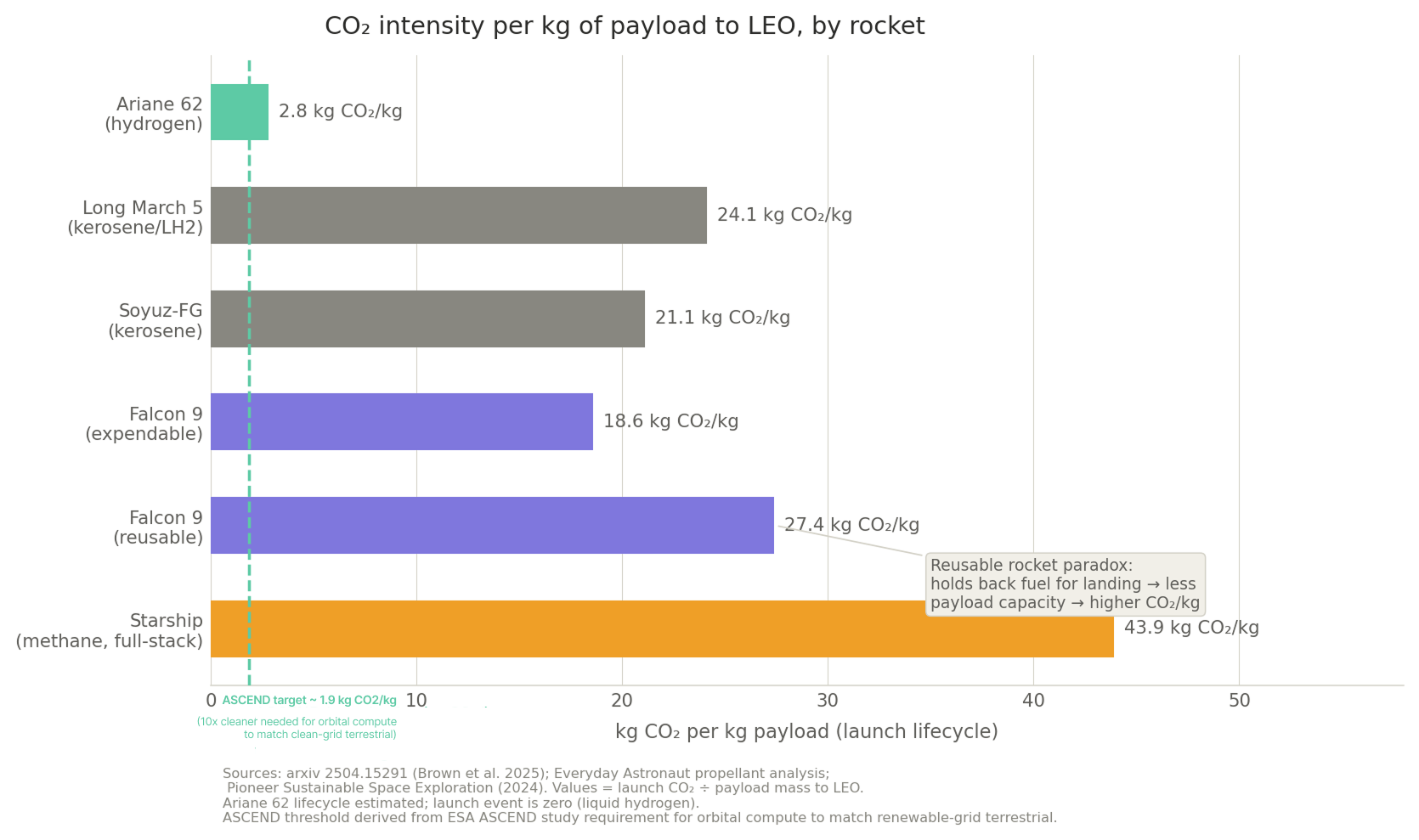
The reusable rocket paradox is particularly curious: Falcon 9 in reusable configuration actually produces more CO₂per kilogram of payload than in expendable mode, because retaining propellant for landing recovery reduces payload capacity while keeping total launch emissions roughly constant. Reusability reduces cost and launch frequency, but it does not automatically reduce emissions intensity.
Replacement cycles that remain unaccounted for
When a satellite reaches the end of its life, it burns. Until recently, atmospheric reentry was a disposal mechanism — clean, cost-free, self-regulating, or so we perceived. The latest findings in atmospheric science say otherwise.
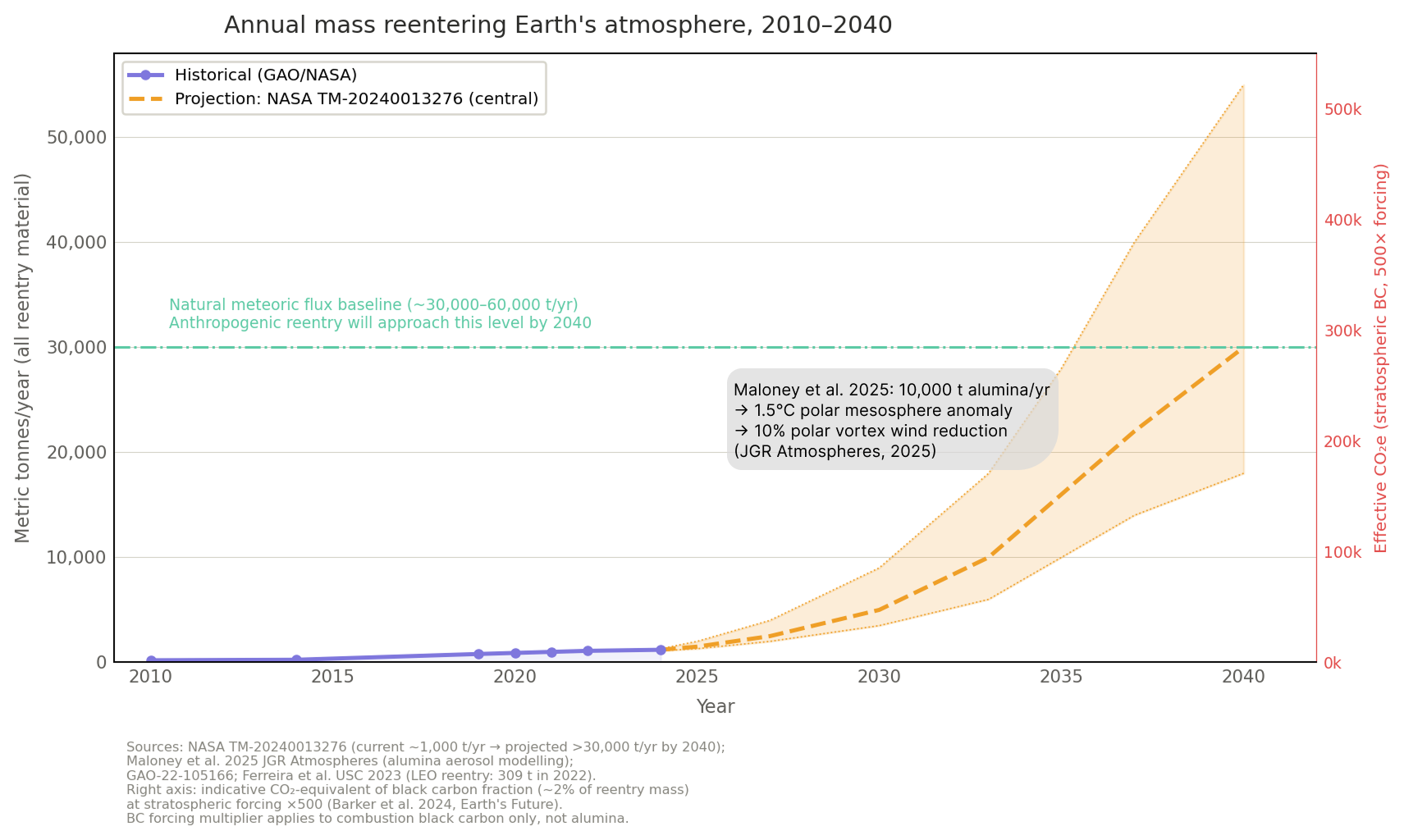
The scale of that burning is already larger than most coverage acknowledges, and it is accelerating. Currently, approximately 887 tonnes of material are injected into Earth’s atmosphere annually from anthropogenic reentry — the chemically active fraction that burns on descent rather than surviving to the ground. NASA’s 2024 Technical Memorandum projects that figure will exceed 30,000 tonnes per year by 2040, driven entirely by megaconstellation maintenance cycles.
The most recent numbers follow the trend: around 1,400 tonnes projected for 2025 alone, and the first wave of Starlink satellites launched in 2020 is now reaching the end of its five-year design lifetime. The reentry surge is not a future event.
What makes this more than a debris management problem is chemistry. By mass, human-made reentry is still dwarfed by the natural stream of space rocks that hit Earth’s atmosphere every day. But mass is the wrong unit. Based on recent systematic research, anthropogenic sources now dominate the atmospheric injection of 24 specific chemical elements, including a range of catalytically active metals that can accelerate ozone destruction and alter atmospheric chemistry in ways a simple weight comparison would never reveal.
The material does not vanish on reentry. Aluminium structures vaporise into fine nanoparticles that drift up and accumulate in the stratosphere, the atmospheric layer that includes the ozone layer. Scientists at NOAA have already detected spacecraft-origin metals, including exotic elements with no natural atmospheric sources. They estimate that roughly one in ten of the relevant particles already carry traces of spacecraft material. That share could reach 50% as constellations scale.
The consequences, according to recent modelling, include measurable changes in upper-atmosphere temperatures and wind patterns, and ongoing disruption to the chemistry that sustains the ozone layer. The ozone hole — the defining environmental crisis of a previous generation — was caused by a far smaller class of atmospheric interference. One often-proposed fix, active debris removal, does not avoid this problem. Controlled deorbiting changes when and where a satellite burns up. It does not stop the burn.
Rocket exhaust adds a second, unrelated problem on top of the first. Soot from rocket fuel, when released high in the stratosphere, traps heat far more effectively than the same soot at ground level. Research published in Earth’s Future puts the difference at around 500 times greater warming potential per unit mass.
Neither of these mechanisms — the metal contamination from reentry, or the soot from launch — appears in any published lifecycle emissions model for orbital data centres, including the most rigorous one available. Every estimate of how green these facilities might be is, for this reason alone, an underestimate.
Neither the NTU nor the Saarland paper accounts for AI hardware replacement cycles. GPU generations turn over every two to three years; satellite design lifetimes are 7 to 15 years. Every refresh cycle means a new launch-and-burn, with no cascade or recycling pathway.
Related Articles
Here is a list of articles selected by our Editorial Board that have gained significant interest from the public:
Space data centres and AI computing demand
Casey Newton, covering the space data centre wave last November, described it as a signal that tech companies “have come to feel like we cannot provide enough electricity for the future we want to build on the planet that we live on.” That sympathetic framing hides the unexamined issue.
AI computing demand will continue to grow. The only question is where to put the infrastructure, or how to use the infrastructure better. Dean Ball, who spent the first half of 2025 as the White House’s senior policy adviser on AI, offered a sharp diagnosis. The frontier labs’ real downfall is no longer the models themselves. It’s the infrastructure. Everyone is building data centres because they are safe assets.
In that framing, space data centres are not a sustainability solution. They are in an infrastructure arms race that has run out of room on Earth and is now heading upward. The alternative comparison is the one the industry is not making. If the real constraint is AI energy demand, the question might not be about working on building new data centres, but about using them more efficiently. The main challenge then becomes determining which is developing faster and has fewer limitations.
Epoch AI’s longitudinal tracking shows pre-training compute efficiency improving at roughly 3x per year. Inference costs have fallen from $20 to $0.07 per million tokens since 2022 — a reduction of nearly 300x driven by algorithmic improvements and hardware generations working in parallel.
That sustained trajectory reduces the case for new physical infrastructure entirely, which might be why it does not appear in any space data centre cost-benefit analysis. It’s a completely separate view on the whole problem: the demand for data centers is increasing, but people are becoming better at using them too.
Conditions for space data centers success
The conditions under which orbital data centres could be genuinely sustainable are specific. Launch vehicles would need to approach the ASCEND threshold — roughly 10 times cleaner per kilogram than current. Hardware would need modular on-orbit servicing to eliminate the reentry disposal cycle. The comparison baseline in all public claims would be renewable-powered terrestrial in a realistic scenario, not gas. Regulation would need to mandate lifecycle emissions disclosure that includes reentry — a cost that currently sits outside any accounting framework and regulatory jurisdiction.
None of these conditions exists yet. The direction of launch cost reduction is real. Starship’s cadence will continue improving. The threshold is not physically impossible. Google’s framing — comparing Project Suncatcher to the long development arc of Waymo and quantum computing — is not implausible on a fifteen-year horizon.
The industry’s error is not in imagining that future. Companies in the space center present current landscape as if the future has arrived.
Editor’s Note: The opinions expressed here by the authors are their own, not those of impakter.com — Cover Photo Credit: NASA