Impakter
  • Environment
    • Biodiversity
    • Climate Change
    • Circular Economy
    • Energy
  • FINANCE
    • ESG News
    • Sustainable Finance
    • Business
  • TECH
    • Start-up
    • AI & Machine Learning
    • Green Tech
  • Industry News
    • Entertainment
    • Food and Agriculture
    • Health
    • Politics & Foreign Affairs
    • Philanthropy
    • Science
    • Sport
  • Editorial Series
    • SDGs Series
    • Shape Your Future
    • Sustainable Cities
      • Copenhagen
      • San Francisco
      • Seattle
      • Sydney
  • About us
    • Company
    • Team
    • Partners
    • Write for Impakter
    • Contact Us
    • Privacy Policy
No Result
View All Result
Impakter logo
No Result
View All Result
Crisis in Sri Lanka: Into Default — to Feed the People

Crisis in Sri Lanka: Into Default — to Feed the People

Sri Lanka is about to declare its first default since independence, while protests demanding government resignation don’t seem to decrease

Leonardo BartolibyLeonardo Bartoli
April 19, 2022
in Politics & Foreign Affairs
0

Sri Lanka has surrendered. It’s default.  

The government has announced it will focus spending on importing essential commodities like food or fuel. Settlement of external debt will be delayed. Officials declared that continuing to repay the debt is not a sustainable policy, even though strenuous effort was undertaken to respect all external financial obligations.

The decision is far from being unexpected. Reuters reports that BlueBay Asset management’s senior emerging markets sovereign strategist, Timothy Ash, declared: “the only surprise is that it took the administration in Colombo so long to come to terms with the reality on the ground.”

But the government’s behavior is understandable. Yet declaring default amounts to an unequivocal admission of incapacity to manage the state. As Impakter already analyzed, the leading cause of this financial crisis is Sri Lanka’s reckless economic policy. It’s only logical that the government tried to make it less evident.

The government engaged in many inconsiderate investment plans, like the Hambantota port deal, whose cumulative effect caused a shortage in foreign currency reserves. Such reserves were both used to pay off the sovereign debt and the regular spending on essential commodities. 

Sri Lanka is deeply reliant on imports and, therefore, increasing the debt burden was hugely detrimental to the country’s future. As soon as a significant economic shock happened (as debt continued to grow) the economy would collapse.

And then covid hit.

So it is too simplistic to consider the current default as a consequence of unfortunate occurrences, as Sri Lanka’s finance minister tried to hint at in a statement where he declared that the pandemic, coupled with the war in Ukraine, made it impossible to pay creditors. Such a statement is not wrong per se, but it’s an attempt at diverting responsibility from the government to some ex Machina market fallacies, and in that sense, it is entirely incorrect.


Related Articles: Crisis in Sri Lanka: Feed the People or Declare Default? | China’s Debt-Trap Diplomacy |

On Monday, Sri Lanka is due to pay 78 million dollars as interest payments on its international sovereign bonds. There is a 30-day grace period after that date, but if the payment is not completed within then, Sri Lanka will find itself in its first default on foreign debt since its independence from the UK in 1948.

The government has called for patience from its population, and encouraged Sri Lankan nationals working abroad to send money into the country. The IMF restructuring of the debt, along with the default, is now a virtual certainty. It will imply that the country’s economic policies will be closely monitored to make sure the intervention is effective.

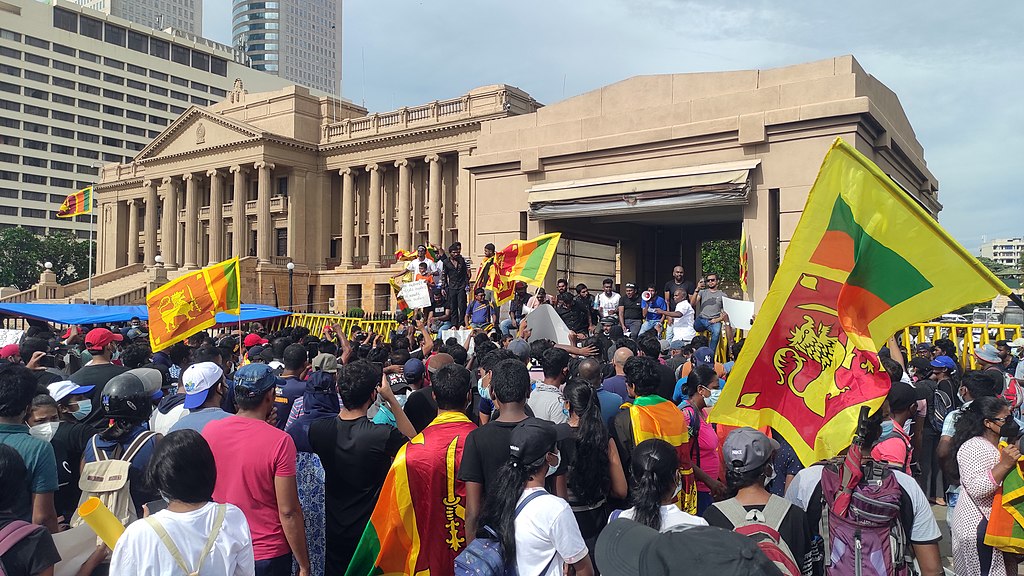
This fact, however, does not imply a complete revision of the country’s leadership. Gotabaya and Mahinda Rajapaksa, the country’s president and prime minister, are holding firm on power, even if protests demanding their resignation don’t seem to thin out.

“This protest will not end until this government is brought down. We will stay here for months, years. It is not about a single-family but the entire corrupt system,” 

Anonymous demonstrator, reported by ANI news

One has to hope these words are true, and that the population will not settle for a cheap buy-out from the government as the economic situation will improve after the IMF involvement. The Rajapaksa family and the system it represents, will only require a few years to compromise the situation again. 

Many will disagree, but any authoritarian leader doesn’t care about his people’s prosperity. Or in any case not more than his own. 

Sri Lanka remains deeply embedded in its worst crisis since independence, and the prospects are dire on all fronts. However, if one looks at the situation from a different perspective, sucht crises are tragedies as much as they are opportunities. 

That’s because crises involve change, and if that change is aimed in the right direction, it can lead to a better future.

Etymology is often useful for fancy dinner small talk, but on other occasions, it is a revealing discipline. Looking at the origin of words can unveil an overlooked dimension of meaning, an elusive shade of its essence and, ultimately, a different way to look at reality. 

If one were to check for the original meaning of “crisis” or Krisis in ancient Greek,  one would discover it’s not associated with an inherently negative connotation: it refers to the decisive moment in a state of things. The point at which change must come, for better or worse.

The Sri Lankan people need to stay in the streets if they want the original meaning of the word crisis, i.e. a radical change in their lives, to happen.


Editor’s Note: The opinions expressed here by Impakter.com columnists are their own, not those of Impakter.com. — In the Featured Photo: Anti-government protest in Sri Lanka, 13 April 2022. Featured Photo Credit: Wikimedia Commons.
Tags: defaultFinancial crisisimf bailoutprotestSri Lanka
Previous Post

Cambodia Targets Environmental Activism

Next Post

Tattoos: A Long And Checkered History

Related Posts

financial bubble
ESG FINANCE

Waiting for a Bubble to Burst: Decoding the Next American Financial Crisis

For much of the last century, financial logic was governed by a simple, foundational rule: equities for growth, representing a...

byDeepanshu Mohan - Professor of Economics and Dean, IDEAS, Jindal School of Liberal Arts and Humanities, O.P. Jindal Global Universityand1 others
November 5, 2025
When Protest Meets Art: Artist Paints Giant Plastic Bottle in Switzerland
Art

When Protest Meets Art: Artist Paints Giant Plastic Bottle in Switzerland

A few days back, a powerful message against pollution emerged in a Swiss park, as French-Swiss artist SAYPE unveiled a...

byValentina Morando
June 16, 2023
protest Georgia Law bill
Politics & Foreign Affairs

Georgia Caught Between Russia and the EU With Proposed ‘Foreign Agents’ Law

Thousands of protestors have swarmed the streets of Tbilisi, Georgia’s capital city, in protest of the controversial draft law on...

byLaetitia Exertier
March 9, 2023
French Pension Reform Hits a Wall: Seen as Retrograde and Iniquitous
Equal Rights

French Pension Reform Hits a Wall: Seen as Retrograde and Iniquitous

The French pension reform that President Macron so desired is coming up against what everything France is famous for and...

byLaetitia Exertier
March 8, 2023
Women protests Iran
Equal Rights

Iran Feels the Wrath of a Movement Held Down for Too Long

When Mahsa Zhina Amini — a young Kurdish-Iranian woman — was arrested by the police of Iran for not wearing...

byLadan Rahbari - Assistant Professor at the University of Amsterdam & Senior Researcher at the International Migration Institute (IMI)
November 22, 2022
A plane emitting carbon dioxide into the atmosphere
Climate Change

Airport Activism: Is a New Style of Protest Taking Off?

More than 100 climate activists blocked private jets from leaving Amsterdam’s Schiphol Airport on Saturday, in a protest coordinated with...

byGrace Stinson
November 7, 2022
Booker Prize Awarded to ‘Mordantly Funny’ Ghost Story Set in War-Torn Sri Lanka
Culture

Booker Prize Awarded to ‘Mordantly Funny’ Ghost Story Set in War-Torn Sri Lanka

This year’s coveted Booker Prize went to “The Seven Moons of Maali Almeida,” an “afterlife noir” written by Sri Lankan...

byGrace Smith
October 19, 2022
Should Climate Protests Give Vandalism a Go?
Culture

Should Climate Protests Give Vandalism a Go?

This past Friday saw two young protestors attached to the activist protest group "Just Stop Oil" desecrate Vincent Van Gogh’s...

byEeshaan Singh-Basu
October 18, 2022
Next Post
Tattoos: A Long And Checkered History

Tattoos: A Long And Checkered History

Recent News

A woman going through the checking account guide

How Checking Accounts Work: Simple Steps to Get Started Fast

February 20, 2026
Coal plants get reprieve on mercury limits, Striking unions fail to halt Milei's sweeping labor bill, Sweden's regulator reviews Swedbank's compliance controls, France backs INEOS decarbonization with €300M

Trump Admin Weakens Coal Plant Mercury Regulations

February 20, 2026
Crowds and filmmakers on the red carpet at the 76th Berlin International Film Festival in 2026

At Berlinale 2026, Artists Refuse the Comfort of Neutrality

February 20, 2026
  • ESG News
  • Sustainable Finance
  • Business

© 2025 Impakter.com owned by Klimado GmbH

No Result
View All Result
  • Environment
    • Biodiversity
    • Climate Change
    • Circular Economy
    • Energy
  • FINANCE
    • ESG News
    • Sustainable Finance
    • Business
  • TECH
    • Start-up
    • AI & Machine Learning
    • Green Tech
  • Industry News
    • Entertainment
    • Food and Agriculture
    • Health
    • Politics & Foreign Affairs
    • Philanthropy
    • Science
    • Sport
  • Editorial Series
    • SDGs Series
    • Shape Your Future
    • Sustainable Cities
      • Copenhagen
      • San Francisco
      • Seattle
      • Sydney
  • About us
    • Company
    • Team
    • Partners
    • Write for Impakter
    • Contact Us
    • Privacy Policy

© 2025 Impakter.com owned by Klimado GmbH