With global conflict costing us $13.6 trillion a year, is there a case for investing in peace?
The consequences of violence and armed conflict are unquestionably devastating, leading to the deaths of thousands of people they can reap havoc on a country’s physical infrastructure while leaving large numbers of people displaced and emotionally terrorised. The silent burden of violence is however its economic cost – it reached a staggering $13.6 trillion in 2015 alone, while just $15 billion was invested in peacebuilding and peacekeeping activities that same year. This highlights an enormous gap in the allocation of resources and spending worldwide. With efforts to consolidate peace constituting a mere 0.12% of the total cost of violence, it is worthwhile to ask: what are the potential economic dividends of investing more into peace?
The physical, emotional, and societal benefits that would result from improvements in peace seem self-evident; however, the potential economic benefits of peace are often overlooked in economic debates. In light of this, the Institute for Economics and Peace has invested in innovative research that focuses on measuring the economic impact of violence and conflict on the global economy. The methodology employs quantitative methods to estimate the economic costs of violence, as well as the potential economic benefits that would derive from improvements in peace. The framework covers 163 countries and independent territories- covering 99.5% of the global economy and population. The selection of the 16 expenditure categories is based on the definition of activities related to “containing, preventing and dealing with the consequences of violence” (Read the full report here).
It is important to note that the figures presented by IEP are conservative. Only variables for which reliable data is available are in fact included. Areas such as domestic violence, household out-of-pocket spending on safety and security, the cost of crime to business, self-directed violence and the cost of intelligence agencies are not included due to the absence of reliable data.
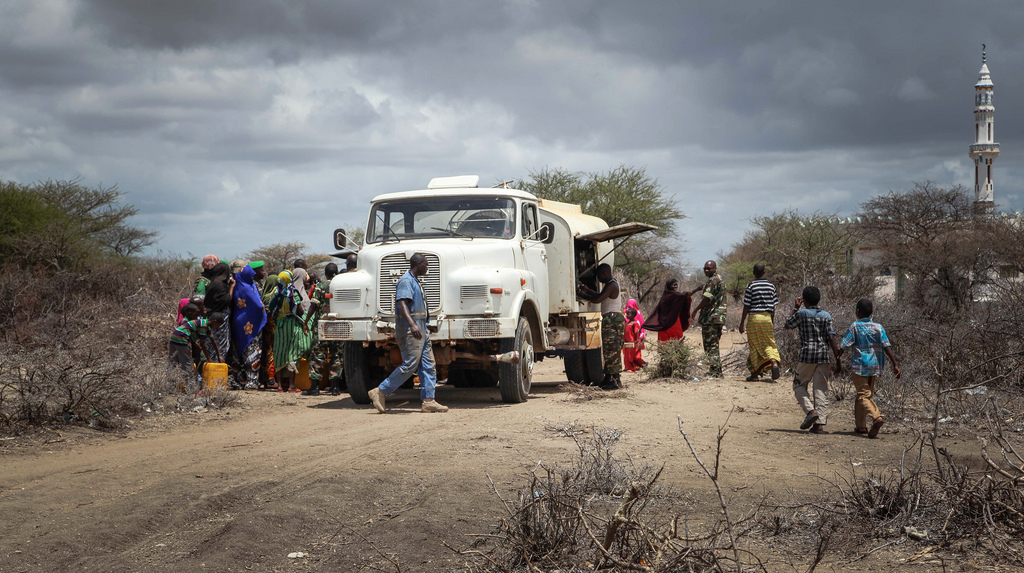
In the photo: AMISOM and Somali Troops Conduct Patrols near Baidoa – Credits: UN Photo/Abdi Dakan
If the economic activity related to violence containment was considered a single industry it would be the largest in the world, greater than the world agriculture sector, tourism and airline industries put together.
According to the most recent World Bank estimates 10.7% of the worlds’ population are currently living on less than $2 per day; an average cost of violence of $5 a day per capita demonstrates an alarming imbalance of priorities. Equally as alarming is the fact that violence costs (at least) 13.3% of world GDP – compare this to the never fulfilled 0.7% commitment in official development assistance (ODA). A 10% reduction in the economic impact of violence would be equivalent to ten times the value of global ODA, more than the total value of global food exports in 2014 or more than total global foreign direct investment in 2014.

In the diagram by IEP, we see the cost of conflict compared to Official Development Assistance, UN peacekeeping and peacebuilding spending.
Yet, these figures highlight two seemingly obvious and emerging trends, which support the argument for more investments into peacebuilding and peacekeeping activities. Firstly, where countries have experienced dramatic increases in conflict and violence, there is a corresponding impact on their economies. The primary example of this is the case of Syria where the civil war has devastated the country and economy, with violence and conflict costs equivalent to 54.1 % of GDP in 2015. Conversely, countries that have improved in peacefulness have reaped significant economic gains. For example, the economic impact of violence in Sri Lanka decreased 66% between 2009 and 2015, resulting in a peace dividend of $48 billion, which is equivalent to 20% of the country’s 2015 GDP.
Overall, the major contributor to global violence containment costs is military expenditure, which reached $6.16 trillion, or 45% of the economic impact of violence in 2015. Internal security expenditure is the second largest category, which encompasses mostly containment expenditures involving police, judicial and prison system spending among other factors. These figures are striking, with over 70% of the economic impact of violence accruing from what is mostly government spending on the military and internal security. This shows that significant amounts of government expenditure are tied up to this end, resources that in a more peaceful world could be directed towards more productive industries such as education, health and innovation.
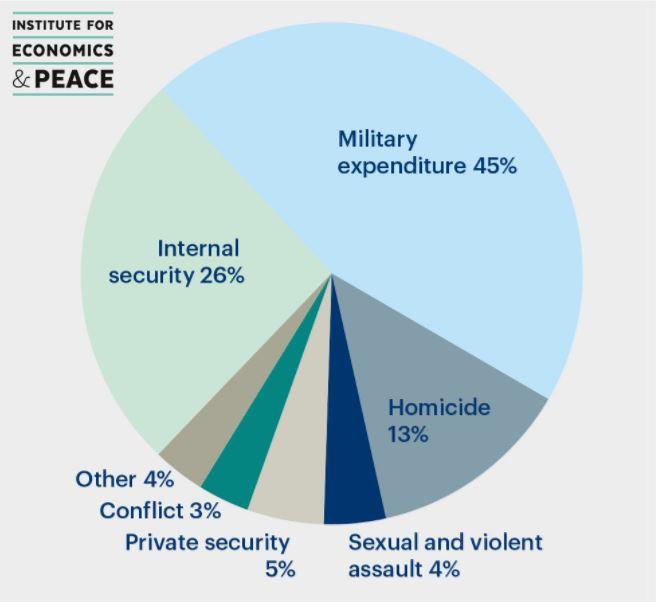
In the diagram by IEP we see the breakdown of the economic impact of violence 2015.
Unless we look at what is being spent, we cannot clearly understand if and where there are misallocations. A quick examination of the numbers reveals that the world continues to spend vastly disproportionate resources on creating and containing violence compared to what it spends on building peace. Some investments are more productive than others, and investments in violence are not that productive. A dollar goes further if used to build a school than a jail. If we could only slightly reduce the amount of money tied up in violence and invest it in elements that sustain peace, we would set in motion a virtuous cycle of less violence and stronger economies nurturing the tangible drivers of peace. A reallocation well worth thinking about.