
Australians indigenous to a collection of islands off the country’s northern coast lost a landmark climate litigation case against the government on Tuesday.
The inhabitants of the Torres Strait Islands sued the Australian government in an attempt to hold them accountable for what they felt were insufficient emissions targets as they faced sea-level rises far higher than the global average. The ruling is seen as a significant blow to climate protection measures in the country, one of the world’s largest coal exporters.
Over the past four years, the elders of Torres Strait communities have been fighting the Australian government in court. They claim that the government did not take sufficient action to protect their land through effective climate action.
Lawyers representing these communities called on the government to “reduce greenhouse gas emissions to a level that will prevent Torres Strait Islanders from becoming climate refugees.”
Tuesday’s ruling by the Federal Court of Australia found that the government had no obligation to protect the islands from climate change damage.
Michael Wigney, the Federal Court Justice presiding over the case, acknowledged that there is a “very real risk they will lose their islands, their culture and their way of life and become climate refugees.”
Wigney stated that while the “Torres Strait Islands have been and continue to be ravaged by climate change and its impacts,” the law does not allow for a community to sue the government for the loss of their customs or traditions.

Wigney went on to criticize the previous Australian administration for putting in place emissions targets from 2015 to 2021 that were too low and that did not take into account the “best available science.”
Australia’s previous government aimed for a 26% emissions cut by 2030. The current government has put in place new plans to reach net-zero by 2050 and cut emissions by 40% by 2030 instead.
Related Articles: Climate Change & Rising Sea Levels are Claiming Their First Victims: Islands | 2024 Virtual Island Summit Calls for More Collaboration and Financing for Climate Action | How the EU Is Helping Power its Islands’ Green Transition
Still, the people of the Torres Strait Islands are left surprised by Tuesday’s ruling.
“I thought that the decision would be in our favour, and I’m in shock,” said Paul Kabai, a Torres Strait local who helped bring the case to the Federal Court. “What do any of us say to our families now?”
Another plaintiff in the case, Pabai Pabai, said: “My heart is broken for my family and my community.”
The Torres Strait Islands are home to fewer than 5,000 people, comprising 274 islands between Papua New Guinea and Australia.

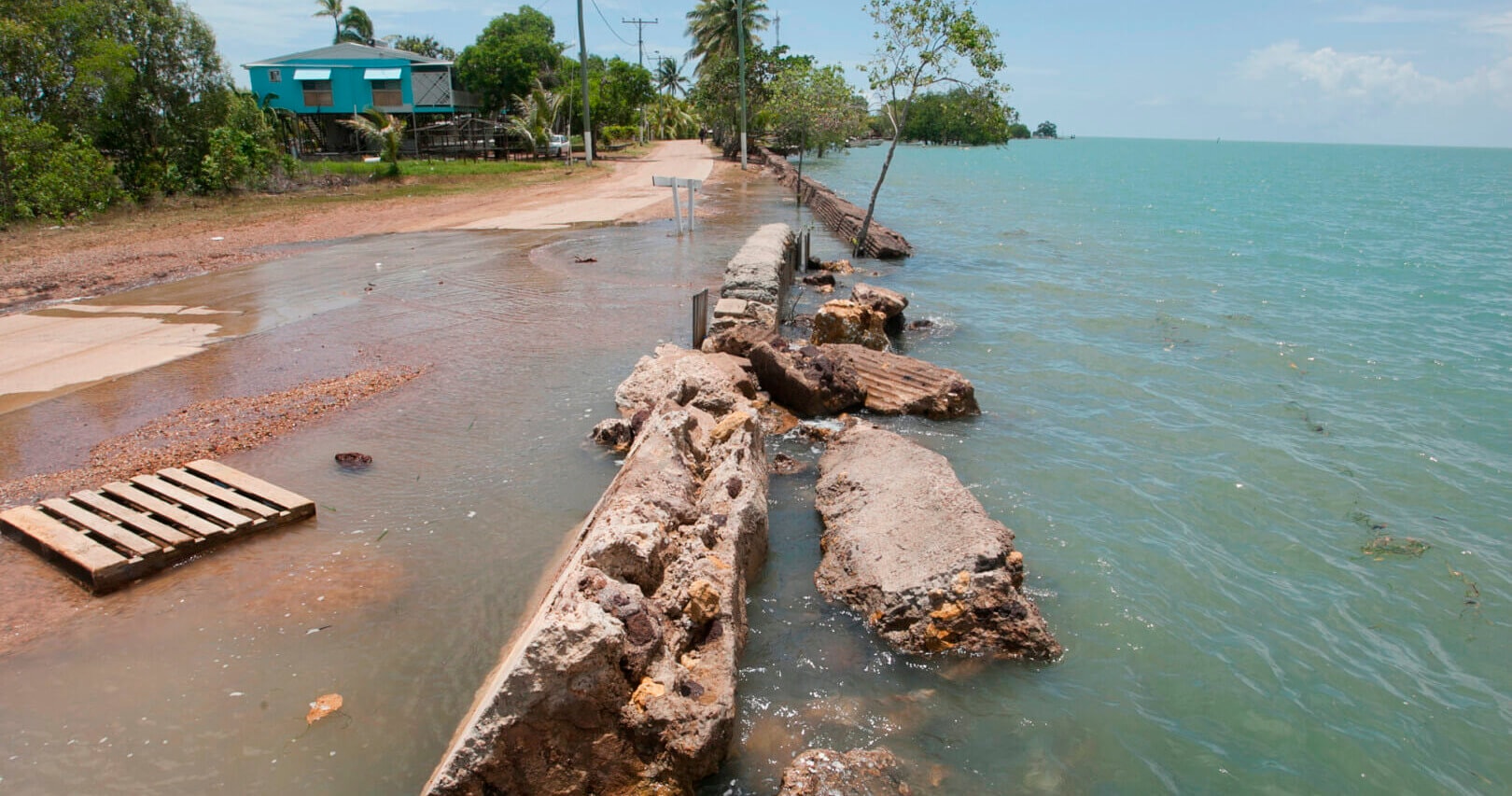
Sea levels on the islands are rising at a rate nearly three times the global average, according to official government figures. The sea has already washed away graveyards and salt from the ocean has tainted once-fertile lands.
Some of the more than 250 islands could become uninhabitable should global temperatures rise to more than 1.5 degrees Celsius above pre-industrial levels, according to the lawsuit.
This threshold is likely to be surpassed by the end of this decade, according to the World Meteorological Organization.
Editor’s Note: The opinions expressed here by the authors are their own, not those of impakter.com — In the Cover Photo: The community of Saibai Island, documented during high tides, January 2012. Cover Photo Credit: Brad Marsellos.