On Saturday, Sinn Féin, the party once considered the political wing of the Irish Republican Army hailed its first election win in Northern Irish history. Winning the regional elections means Northern Ireland has a nationalist leader for the first time in its history, which is important for a region that has long been governed by pro-British parties.
North Ireland’s election and its results
The counting of votes finished early on Sunday when all 90 seats in the Northern Ireland national Assembly were filled.
Sinn Fein won 27 seats, and secured the highest share of first preference votes at 29%, overtaking the Democratic Unionist Party (DUP)’s 25 seats and 21.3% share of first preference votes. The DUP has held the post of first minister since 2007.
The centrist cross-community Alliance Party scored its strongest ever result with 17 seats following its aim to establish itself as a third pillar of the Irish political system.
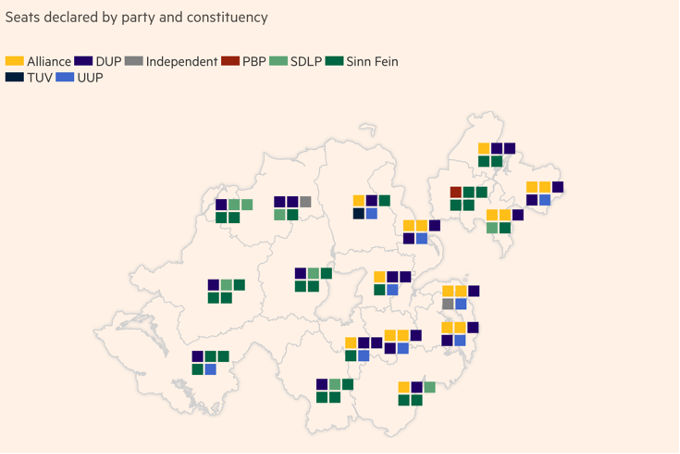
Source: Press Association
FT Graphic: AEndra Rininsland
Sinn Féin secured the same number of seats under Northern Ireland’s proportional voting system as it did in the 2017 elections, so its electoral success was in fact facilitated by a decline in DUP votes.
The DUP was a leading proponent of Brexit but saw its support weakened due to post-Brexit talks between London and Brussels that resulted in trade barriers between Northern Ireland and the rest of the UK.
Sinn Féin was previously shunned for its close association with IRA violence during ‘The Troubles’; three decades of fighting over Northern Ireland’s place within the UK, in a campaign to end British rule and unite Ireland.
However, since the 1988 peace deal, it has become the most popular party in the Irish Republic, repositioning itself as a grassroots left-wing political party focusing on social issues and finding a successful base of followers by campaigning on everyday issues such as the cost of living and healthcare.
There, Sinn Féin has focused on Ireland’s housing crisis, higher taxes for the rich and slashing childcare costs, which consequently attracted more young voters than the Fianna Fáil and Fine Gael parties.
In Northern Ireland, Sinn Féin similarly focused on economic concerns rather than Irish unity, in order to appeal to the middle ground electorate. Sinn Féin has also evidently amassed support for its championing of a united Ireland where Northern Ireland is not part of the UK.
These results make Sinn Féin the first Irish nationalist party to secure control of the assembly and nominate a first minister. This follows predictions made after their ‘strong showing’ in the 2020 general elections in Ireland.
Mary Lou Macdonald, President of Sinn Féin, told NewsTalk (a Dublin radio station) that O’Neill will be appointed first minister and that the result should accelerate planning for a so-called border poll (referendum) on Northern Ireland’s future status, something she wants to see within five years
“Today represents a very significant moment of change, it’s a defining moment for our politics and our people” Michelle O’Neill (Sinn Féin’s first minister to-be)
O’Neill has said that the party’s goal of reunification with the Republic of Ireland should be debated, telling CNN on Friday:
“Let’s have a healthy debate about what our future looks like, something that’s better for each and every one of us where we all have a valued place in our society…We need to be alive to the fact that change is underway” Michelle O’Neill
Possibilities lie ahead for Sinn Féin, but also challenges: The DUP for forming an executive and Britain for the possibility of an Ireland-wide referendum
Sinn Féin‘s emergence as Northern Ireland’s largest party could force a conversation around the possibility of a ‘border poll’ and that means a referendum is likely.
However, critics have stated that O’Neill’s promotion is only a symbolic shift as the Northern Irish government requires one ‘First Minister’ and one ‘Deputy Minister’, and some claim that the roles are in fact equal. While the winning party has the right to put forward a candidate for the First Minister, the DUP could oppose this and so delay forming an executive.
Jeffrey Donaldson (DUP leader) also said his party would not rejoin the executive until the post-Brexit trading arrangements that are currently disrupting commerce between Britain and Northern Ireland are overhauled and the protocol is gone.
Donaldson has said he would see what Boris Johnson says on the matter in a speech this week before deciding his next move. Without DUP participation, Northern Ireland’s government cannot function meaningfully.
Under the Irish rules requiring a Nationalist and Unionist minister in the executive, this could lead to a stalemate. This introduces questions of how democratic it is for the DUP, with just 21% of first preference votes, to bargain with the other party’s right to govern.
Sinn Féin’s goal of unification could too be delayed. After the Troubles, British and Irish governments signed the 1998 peace accords. A clause within the Good Friday Agreement established that a referendum (border poll) on Irish unification could be held if it appears that the majority of the region would vote in favour and support reunification, and a referendum in the Irish Republic would also be needed. Such a day remains distant.
“Sinn Féin gets the first minister because the unionist vote is so split but that doesn’t necessarily mean that in Northern Ireland, there is this inevitable surge towards a united Ireland,”. Kevin Cunningham, Politics lecturer at Technological University Dublin and founder of pollster ‘Ireland Thinks’.
Sinn Féin’s relationship to Britain could also be a limiting factor, as the Good Friday Agreement requires the UK Secretary of State to call for a referendum depending on a nationalist majority.
Sinn Féin’s win therefore arguably doesn’t bring unification much closer, as nationalist votes still remain roughly as they used to be, but this time they instead rose by the marginalisation of other parties and splintering of Unionism due to a decline in DUP popularity following the Northern Ireland protocol issue. Some Unionist voters joined Traditional Unionist Voice, a more hardline party, and some joined the Alliance party which does not identify with either region and is the only community to have grown considerably since 1998.
Nevertheless, Cunningham’s recent survey found that 51% of respondents believed there should be a referendum, and 57% would vote for Union. The mere possibility of a Northern Irish referendum would also build on Scotland’s independence campaign, and so Scottish First Minister Nicola Sturgeon was among the first to congratulate Sinn Féin.
Many congratulations to @moneillsf and @MaryLouMcDonald on a truly historic result for Sinn Féin. I wish Michelle & her colleagues – & all Northern Ireland’s elected representatives – the very best for what comes next & hope to see the NI government functioning again soon.
— Nicola Sturgeon (@NicolaSturgeon) May 7, 2022
This means that Johnson is now fighting on a Scottish front and a Northern Irish front to preserve the United Kingdom.
The perceived threat is therefore real, and accordingly, Britain’s Northern Ireland Minister Brandon Lewis released a statement calling on the parties to form an executive quickly and for more flexibility on the Northern Ireland trading protocol, signalling that the UK government could take unilateral action on the matter if necessary.
How a united Ireland would work is unclear: many voters in Northern Ireland are attached to NHS free healthcare, and many still associate Sinn Fein with its past associations with violence.
However, despite the bureaucratic and political challenges that lie ahead, Sinn Féin’s recent victory is hugely symbolically important. It marks the end to a century of DUP prowess. Additionally, if one reflects on 1960s Ireland, where the Catholic nationalist minority faced many abuses and rights violations, support for having a nationalist executive in power is a milestone.
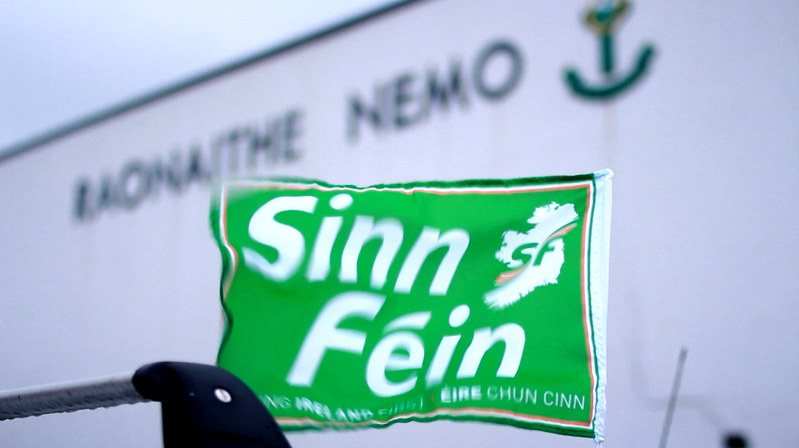
Editor’s Note: The opinions expressed here by Impakter.com columnists are their own, not those of Impakter.com. — In the Featured Photo: Sinn Féin Flag. Featured Photo Credit: Flickr